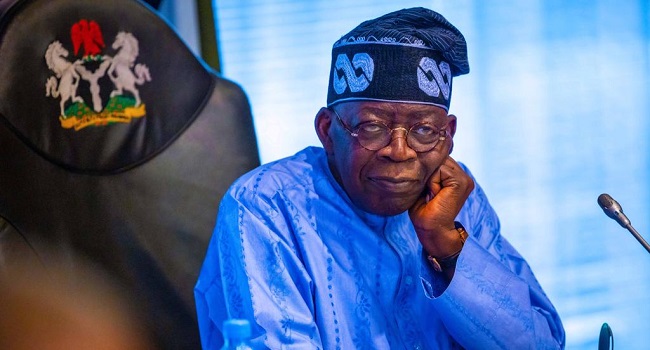
A political analyst in Zamfara State, Prof. Abubakar Ahmed Abdullahi, has called on President Bola Tinubu to intervene in the continuing divisions among major political blocs within the All Progressives Congress (APC) in the state.
Abdullahi, a political science professor at Usmanu Danfodiyo University, Sokoto, said the recent resignation of eight members of the Zamfara State House of Assembly from the APC had exposed deeper disagreements within the party ahead of the 2027 elections.
His position was contained in a statement made available to the News Agency of Nigeria (NAN) in Gusau on Monday.
Analyst wants Tinubu to bring APC leaders together
Abdullahi urged President Tinubu to facilitate discussions involving former Zamfara Governor Abdul’aziz Yari, Minister of State for Defence Bello Matawalle and Governor Dauda Lawal.
He argued that continued disagreements among the political camps could complicate the APC’s preparations for the 2027 elections.
“Politics is indeed a game of numbers,” the don said, stressing the importance of grassroots support to political parties.
His comments followed the resignation of eight Zamfara lawmakers from the APC on Sunday.
Eight lawmakers leave APC
The lawmakers who announced their exit are Aliyu Ango Kagara, representing Talata Mafara South; Ibrahim Tukur Bakura, Bakura; Faruk Musa Dosara, Maradun I; and Bashir Abubakar Masama, Bukkuyum North.
Others are Muktaru Nasiru Kaura, Kaura North; Nasiru Abdullahi, Maru North; Bashar Bello, Bungudu West; and Bashar Aliyu, Gummi I.
The lawmakers cited insecurity, alleged political injustice, internal divisions and unpaid salaries and allowances among their reasons for leaving the party. Some also criticised the handling of security challenges affecting their constituencies.
The development has added a new dimension to the political contest within Zamfara ahead of the 2027 elections.
The dispute dates back to 2024
The latest development is also connected to a much older dispute involving eight members of the Zamfara State House of Assembly.
In February 2024, the Assembly suspended eight lawmakers after accusing them of misconduct and holding an unauthorised sitting. The House said the lawmakers had breached its Standing Orders and were involved in an attempt to disrupt legislative proceedings.
The affected lawmakers disputed the allegations. At the time, they said their actions were linked to concerns about insecurity and the leadership of the Assembly. They subsequently alleged that they had been forced to leave the state because of threats to their safety.
The Zamfara State Government also instituted a criminal complaint against the lawmakers in connection with the incident.
Assembly rejects suggestion that the defection reflects instability
There is an important counter-position from the Zamfara State House of Assembly.
Speaker Bilyaminu Ismail Moriki said on October 5 that the eight lawmakers had been suspended since February 2024, well before their latest departure from the APC. He said the suspension followed allegations including gross misconduct, conspiracy, contempt and an unauthorised sitting.
Moriki therefore rejected the suggestion that their departure demonstrated that the Assembly itself was in disarray.
This distinction is important because the analyst’s interpretation of the lawmakers’ departure as evidence of wider APC weakness is political analysis rather than an established fact.
Why the development matters
Abdullahi said the lawmakers had considerable influence in their constituencies and that their movement away from the APC could alter political calculations in several parts of Zamfara.
He particularly highlighted Zamfara West, noting that five of the eight lawmakers reportedly come from local government areas within Yari’s senatorial district.
The analyst also singled out the departure of Aliyu Ango Kagara and Ibrahim Tukur, saying their political associations could have implications for established political networks in the state.
However, the actual electoral consequences remain uncertain. The lawmakers have not, according to the reports reviewed, established a new party platform or formally announced a common political destination.
What is really behind the Zamfara APC crisis?
The current dispute appears to have several overlapping layers, rather than one single disagreement.
The 2024 Assembly crisis
Eight lawmakers were suspended after an internal legislative confrontation in February 2024. Their account of the incident differed substantially from that of the Assembly leadership.
Unpaid entitlements
The lawmakers have now cited prolonged non-payment of salaries and allowances among their reasons for leaving the APC. Reports put the outstanding period at roughly 32 months.
Insecurity
Several of the lawmakers have linked their decision to the security situation in their constituencies and criticised the government’s response.
Rival political blocs
The current political debate is also being framed around competing networks associated with Yari, Matawalle and Lawal. Abdullahi argues that these differences need to be addressed before the 2027 electoral cycle intensifies.
2027 calculations
The APC will have to manage relationships among its state-level political actors while also dealing with the wider national contest involving President Tinubu.
For now, however, it would be premature to treat the eight lawmakers’ departure as evidence of a particular 2027 electoral outcome. It is a significant political development, but its eventual effect will depend on subsequent alliances, party movements and developments within Zamfara.