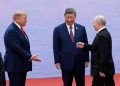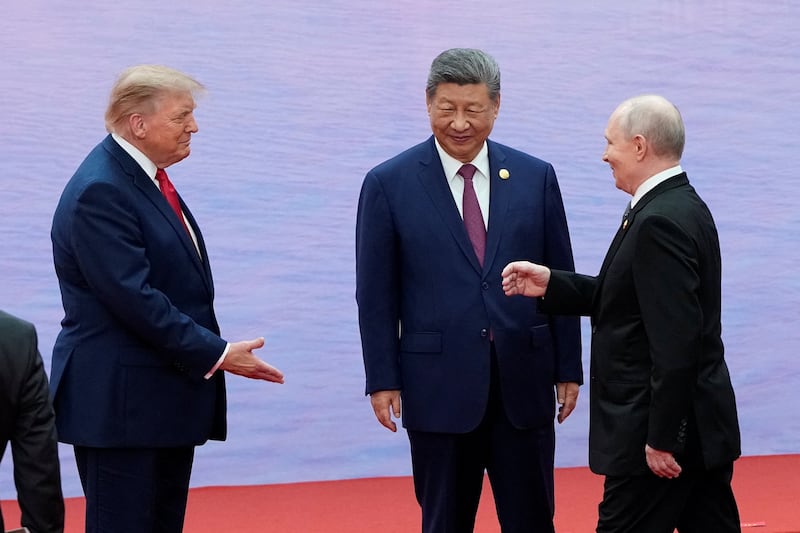
Chinese President Xi Jinping, United States President Donald Trump and Russian President Vladimir Putin have agreed to strengthen international security, promote strategic stability and pursue dialogue aimed at reducing nuclear risks following an unprecedented trilateral summit in Shenzhen, China.
The meeting, which brought together the leaders of three of the world’s most influential powers for the first time in a trilateral presidential format, ended with the adoption of a joint declaration outlining areas of cooperation on international peace, energy security, United Nations reform and nuclear non-proliferation.
The summit took place on Thursday, November 19, on the sidelines of the Asia-Pacific Economic Cooperation (APEC) Economic Leaders’ Meeting.
In his opening remarks, Xi described the gathering as a historic diplomatic development, arguing that constructive relations among major powers were essential to maintaining international stability.
He recalled the cooperation between China, Russia and the United States during World War II, when the countries joined forces against fascism, saying the historical experience offered important lessons for contemporary international relations.
Xi warned that competition and confrontation among major powers could undermine global peace, urging the three countries to pursue cooperation based on mutual respect, peaceful coexistence and shared economic interests.
He outlined four principles for managing relations among major powers: mutual respect, peaceful coexistence, win-win cooperation, and dialogue and consultation.
The Chinese leader called for respect for national sovereignty, territorial integrity, political systems and individual countries’ development choices.
He also cautioned against interference in domestic affairs and actions that could undermine other countries’ legitimate security interests.
Nuclear risk reduction takes centre stage
One of the summit’s most significant outcomes was the leaders’ renewed commitment to preventing nuclear conflict and strengthening international nuclear security.
The joint declaration reaffirmed that nuclear war cannot be won and must never be fought, while committing the three countries to dialogue on reducing nuclear risks and preventing the proliferation of nuclear weapons.
Trump welcomed the opportunity for cooperation, expressing optimism that engagement among the three powers could contribute to reducing nuclear weapons and preventing their use.
Xi also argued that confrontation was not inevitable among major powers, urging the countries to avoid strategic rivalry that could threaten international security.
Leaders seek stronger United Nations and energy cooperation
The three presidents also agreed to pursue reforms aimed at making the United Nations more effective in addressing international challenges and fulfilling its responsibility for maintaining global peace and security.
As permanent members of the UN Security Council, China, Russia and the United States occupy influential positions in decisions concerning international peace and security.
On economic cooperation, Xi called for stronger trade relations and greater coordination in areas where the three countries possess complementary economic strengths.
Energy security featured prominently in the declaration, with the countries indicating plans to increase the production and supply of refined petroleum products while maintaining stable energy flows.
The leaders also emphasised the importance of uninterrupted energy supplies to international industrial activities and global supply chains.
Controversy over international judicial institutions
Another notable provision of the joint declaration concerned the authority of international judicial institutions, particularly the International Criminal Court (ICC).
The three countries emphasised the importance of state consent and immunity for government officials, expressing opposition to what they described as the potential abuse of jurisdiction by the ICC and similar bodies.
The position introduces an important international legal dimension to the summit, particularly amid continuing disagreements over the reach of international criminal justice and the relationship between national sovereignty and international accountability.
Ukraine and Iran conflicts remain unresolved
Despite the diplomatic significance of the meeting, the declaration did not announce a specific agreement to end the Russia-Ukraine war or resolve the conflict involving Iran.
The absence of concrete agreements on these conflicts suggests that major geopolitical differences remain despite the leaders’ willingness to engage directly.
Putin described the trilateral format as useful, while Xi characterised the discussions as positive, constructive and fruitful.
The summit nevertheless established an unprecedented platform for direct engagement among Washington, Beijing and Moscow.
For the international community, attention will now turn to whether the commitments made in Shenzhen translate into sustained diplomatic engagement, practical nuclear-risk reduction and progress on other pressing international security challenges.
The ultimate significance of the meeting will depend on the willingness of the three governments to turn their declaration into concrete action.