


American officials struggling to reimagine their strategy after Britain’s decision to divorce the European Union (EU) say the most urgent challenge will be to find a way to replace their most reliable, sympathetic partner in the hallways of European capitals.
It will not be easy.
No nation shares Washington’s worldview quite the way Britain does, they say; the country has long been the United States’ most willing security ally, most effective intelligence partner and greatest enthusiast of the free-trade mantras that, until recently, were a keystone of America’s internationalist approach.
And few nations were as willing to put a thumb as firmly on the scales of European debates in ways that benefit the United States.
Now that quiet diplomatic leverage — including moderating European trade demands and strong-arming nations to contribute more to NATO military missions — is suddenly diminished.
Even if Britain eventually regains its influence on the Continent — a big if — it will be deeply distracted for years. Moreover, the loss of Britain’s strong voice in Europe comes at a particularly bad moment: just as the United States and its allies are debating how to handle a revanchist Russia and reinvigorate NATO, hurry along an American-European trade pact that has been languishing, and work through a diplomatic settlement in Syria that could relieve the migrant crisis in Europe.
“When Vladimir Putin is cheering,” David Miliband, the former British foreign minister, said on “Meet the Press” Sunday, “then you know you have got a problem in the international system.”
And then, of course, there is the threat of the Islamic State, which has found in Europe a new battlefield, one in which the development and sharing of intelligence, seamlessly, is critical.
Addressing those challenges was daunting enough, American officials say, during the American presidential campaign, particularly Donald J. Trump’s questioning of whether alliances are worth it if allies are not willing to pay more for American protection.
But now, with Britain’s exit, called Brexit, whatever passed for long-term plans — a Europe that gradually takes a greater role in its region and the Middle East as America devotes more attention to Asia — are imperiled.
Like the Arab Spring, the result of Britain’s referendum took Washington by surprise. As late as early last week there was something between a hope and an assumption that the vote would “go the other way,” as Secretary of State John Kerry said in Rome on Sunday. As a result, there was no serious planning for the all-consuming task of reimagining the European relationship, a task that will face President Obama for the next six months, and his successor for years to come.
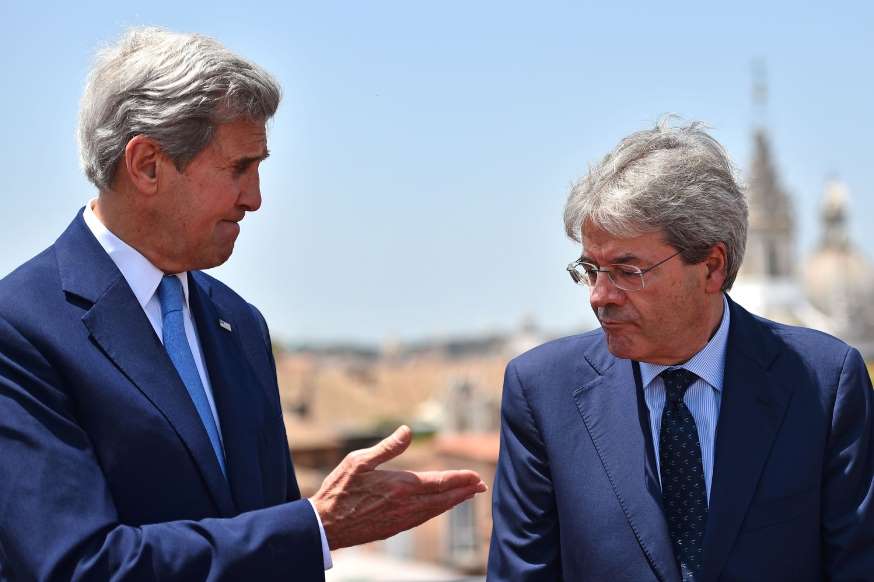
Kerry, usually the optimist, sounded almost downbeat in Italy. He did not make any references to a “shriveled Europe,” as one of his top aides did in a conversation over the weekend. But he made clear that European allies are also going to have to rethink their relationships with the United States.
“Twenty-two of the nations in the E.U. are members of NATO,” he said less than a minute into his meeting with his Italian counterpart, Paolo Gentiloni. He warned that the most critical step was to “work together to provide as much continuity, as much stability, as much certainty as possible” to “protect the values and interests that we share in common.”
The problem is that no one shares those values and interests quite the way the British do, a widespread belief that no American diplomat would utter in public for fear of offending other members of the European Union. But British officials who have been at the center of that daily interaction say the concern goes both ways.
“I worry that we will have less clout on our own: In the future we won’t have as much influence on Europe’s response to Putin’s transgressions, Iran’s nuclear ambitions, or the E.U.’s foreign and security policy,” said Peter Westmacott, one of Britain’s most experienced diplomats and, until January, ambassador to the United States. “And we will be less able to ensure it is U.S.-friendly. So we are going to have to work extra hard to make our views count.”
He added that without Britain’s direct involvement, Europe was likely to be less enthusiastic about free trade.
Still, Westmacott noted that “we should be able to cooperate much as in the past on counterterrorism, on intelligence, on cyber and on military issues,” assuming that “our economy does not shrink too much as markets, investors and the Scots take stock of Thursday’s outcome.”
All of which raises the question: If Britain can no longer play that indispensable role for Washington, surely there is another country that can? Perhaps, but it is hard to think of who.
It is not a role Germany has shown a real willingness to step into. Its post-World War II ethos still prevents it from committing combat forces, and it is not a member of the inner circle of intelligence sharing called the “Five Eyes,” a club made up of the Anglo victors of World War II. (The other three are Canada, Australia and New Zealand.) A lengthy negotiation to improve the intelligence relationship last year ended with only modest changes.
For all of its cooperation with the United States on a variety of issues, Germany still harbours deep suspicions of the United States that were fueled by the revelations from Edward J. Snowden, the former National Security Agency contractor, including the American surveillance of Chancellor Angela Merkel’s cellphone conversations.
And American officials were shocked recently when Germany’s foreign minister, Frank-Walter Steinmeier, warned that recent NATO exercises to deter Russia from thinking about destabilising Poland and the Baltic members of the military alliance amounted to “saber-rattling and warmongering.”
France has also not been as natural a fit with the United States as Britain. While relations have changed drastically since the George W. Bush administration, Paris often goes its own way. And other nations friendly to the United States, like Italy, the Netherlands and Poland, have their own shortcomings acting as a diplomatic heavyweight.
Moreover, there is a question of leadership.
British leaders were the Europeans most closely aligned with the American negotiating position in the major trade and investment deal being hashed out between the United States and some of its largest trading partners.
When Obama visited London in April, he warned voters that Britain would be excluded from the deal if it left the bloc and would “go to the end of the queue” for its own bilateral trade agreement. But the United States would also lose Britain’s voice in moderating Europe’s trade demands.
The intelligence challenges created by Brexit are more subtle. Bilateral cooperation will continue as tightly or more tightly than ever to try to prevent terrorist attacks. But the hope that Britain could improve intelligence sharing among the major European powers — something that is sorely needed — is most likely dashed even as terrorism threats have risen.
Over a lunch near the White House a few weeks before the referendum, a senior intelligence official said the obvious solution to intelligence gaps was a far more powerful, Pan-European intelligence service.
It is hard to imagine a new intelligence institution, however, without MI-6 and GCHQ — the British equivalents of the C.I.A. and the N.S.A. — playing a lead role. And given Britain’s likely preoccupation with the Brexit fallout, it is far from clear how high a priority a new intelligence organization, or a rethinking of NATO strategy, would be for Britain.
There is a counterargument that Britain could emerge as a stronger security partner for the United States, that it will value its role in NATO and other institutions all the more.
Admiral James Stavridis, who served as the 16th supreme allied commander in Europe and is the dean of the Fletcher School of Law and Diplomacy at Tufts University, presented that view in an article in Foreign Policy.
He said that a “new British government will presumably be a very motivated NATO partner.”
“Now that it has chosen to become a relatively marginal economic player on the international stage,” he continued, “it will have to look for new ways to demonstrate value in its partnership with the United States if it hopes to maintain anything like the ‘special relationship’ it has become accustomed to (and dependent on).”
But even if Britain seeks a more active role in NATO, it may not be accepted as one by its other members; Britain has often been referred to as an American puppet — with other states noting that former Prime Minister Tony Blair followed Mr. Bush into Iraq with few questions.
There is nothing permanent about political unions and alliances, of course, and some argue that Britain’s departure from the European Union is not necessarily a calamity for Washington.
As James F. Jeffrey, a former American diplomat in the Middle East, and Simon Henderson of the Washington Institute wrote last week, “The U.S. and U.K. were bosom allies for 30 years before Britain joined the E.U.”
But part of what made the special relationship special in an era of global diplomacy was Britain’s ability to act for Washington with the Europeans, to bridge the gap. Now, as one White House official put it, the bridge has been wiped out by a surge that few predicted.
*Culled from The New York Times