*How an unregulated scrap economy is putting infrastructure, communities and public health at risk
How much of a bridge must be eaten away before government recognises that scavenging has crossed the line from an informal livelihood into a public safety threat?
The question has acquired fresh urgency in Lagos.
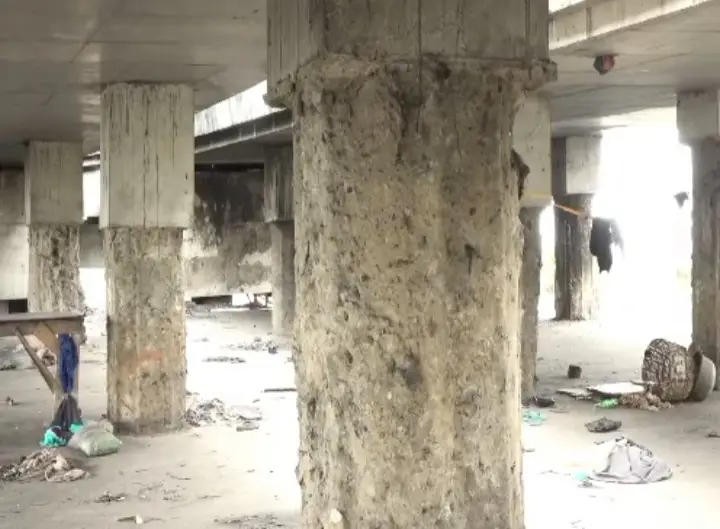
A disturbing video showing damage to the concrete supports of the bridge linking Festac Town and Alakija has brought into the open a problem that can no longer be treated as a matter of street nuisance. According to reports, suspected scavengers had broken into the concrete around the bridge supports to remove embedded iron rods and other materials. The Lagos State Government subsequently announced the arrest of 27 suspects during a midnight enforcement operation and described the alleged vandalism as a serious threat to public safety and critical infrastructure.
That should concern more than Lagos.
A bridge is not a scrap yard. The steel reinforcement buried within its concrete is not abandoned metal waiting to be harvested. It is part of an engineered structure designed to carry lives, vehicles and economic activity. If structural components are deliberately removed for sale, the value of the metal is almost irrelevant beside the potential cost of what may follow.
Yet this is precisely where government must exercise some discrimination.
Not every scavenger is a criminal. Informal waste collection and recycling provide livelihoods for thousands of Nigerians and contribute to recovering materials from the waste stream. Research has recognised the economic and environmental contribution of the informal recycling sector. The problem begins when the boundary between legitimate recovery of discarded materials and the theft of identifiable public assets becomes blurred.
That boundary is becoming dangerously blurred.
The evidence from Abuja is difficult to dismiss. In January 2025, the Federal Capital Territory Police announced the arrest of 50 suspects over the alleged theft and vandalism of manhole covers and other public infrastructure. Twenty five manhole covers were reportedly recovered, together with vandalised solar streetlights, galvanised rods used in flyover construction and other materials. The police said their investigation indicated that the suspects were part of a larger network selling stolen manhole covers to scrap dealers.
Therein lies the part of the problem that government must examine more closely.
The material does not disappear with the person who removes it. It enters a market. The Abuja investigation itself pointed to scrap dealers receiving stolen manhole covers. That raises a more consequential question about the chain of commerce: how does identifiable public property become ordinary scrap without someone asking where it came from?
A manhole cover removed from a busy road is not simply metal. It becomes a trap for a pedestrian, a motorcyclist or a motorist who encounters the opening at night. The FCT Administration has separately reported the removal of manhole covers from Constitution Avenue and warned of the danger to road users.
The same logic applies to railway equipment, electrical cables, streetlights, bridge components and other public installations. Their destruction cannot be measured by the price fetched at a scrap yard. Their real value lies in the service they provide and the lives they protect.
This is why the scrap market deserves as much attention as the street collector.
If stolen public property can be bought, transported, processed and sold without a credible account of its origin, there is an economic incentive for the theft to continue. Arresting the person who removes the material while leaving the market that absorbs it largely untouched is unlikely to solve the problem.
Government must follow the material beyond the point of collection.
That does not mean criminalising recycling. It means making it difficult, if not impossible, for stolen public infrastructure to pass through the recycling chain as ordinary scrap.
There is already a foundation on which to build. Lagos Waste Management Authority maintains a register of approved recyclers and collection points across the state, including a registered recycling point in Alakija, Festac. LAWMA has also warned against illegal recycling and scavenging in unlicensed facilities, citing indiscriminate sorting, dumping, storage and trading of recyclables as environmental hazards.
The challenge, therefore, is not that government has no idea what regulation should look like. The deeper problem is enforcement, traceability and coordination.
The environmental dimension is equally troubling.
Uncontrolled sorting and handling of waste expose scavengers themselves to dangerous materials, while poorly managed waste sites can affect surrounding communities. Research into waste scavenging in Abuja found elevated exposure to infectious diseases and other health hazards and identified scavenging as a possible pathway for the spread of some communicable diseases.
The lesson should not be that poor Nigerians must be driven away from waste collection. It should be that people working within the waste economy deserve a safer and more organised system, while the public deserves protection from the environmental consequences of uncontrolled operations.
The security dimension cannot be ignored either.
There have been documented cases in which people associated with scavenging environments have been accused of violent criminal conduct. In one Abuja case, a 19 year old man was reportedly killed at the Mpape Panteka market after being accused of stealing. Such cases must be treated individually and investigated on their evidence. They should not become a licence to label every waste picker a criminal. But neither should the legitimate existence of waste pickers provide cover for criminal networks.
That distinction is central to any sensible government policy.
There is also a sobering lesson from the collapse of a partially demolished building at Sabon Lugbe in Abuja in 2024. At least seven people died. Police told the Associated Press that scavengers searching for scrap metal had further weakened the structure. The tragedy was not simply about scavenging, since other factors surrounding the building were also relevant, but it demonstrated the deadly consequences that can arise when vulnerable structures become targets for uncontrolled recovery of metal.
Rail infrastructure presents another area requiring vigilance. Nigeria’s railway system has repeatedly faced the problem of vandalism and theft of railway assets. We should be careful, however, not to attribute particular derailments to scavengers without the findings of an official investigation. The point is simpler and more defensible: removing components from railway infrastructure creates a risk that extends far beyond the value of the stolen metal.
The pattern should now be obvious.
The environmental authorities see waste. The police see vandalism. The agencies responsible for roads and bridges see damaged infrastructure. Railway authorities see threats to their installations. Residents see open manholes, unsafe surroundings and deteriorating public assets.
The criminal market sees something else entirely: an opportunity to turn public property into private cash.
Government must begin seeing the whole chain.
There should be a coordinated national framework for scrap collection and recycling, with registration of legitimate waste pickers and dealers, licensing of scrap yards, proper records of high risk materials and clear rules requiring dealers to establish the provenance of identifiable public assets.
A manhole cover should not arrive at a scrap yard without questions being asked.
Neither should railway components, bridge reinforcement, electrical cables, streetlight fittings or other materials that plainly do not resemble ordinary household waste.
Security agencies, environmental authorities, transport agencies, road authorities and local governments should share intelligence on vulnerable locations and known markets. Bridges, railway corridors, manholes, streetlights and exposed electrical installations should be periodically inspected rather than examined only after something has disappeared.
And where evidence establishes an organised network, enforcement should move beyond the person at the bottom of the chain to those who knowingly receive and commercialise stolen public property.
The Lagos bridge incident offers government an opportunity to demonstrate that it understands the seriousness of the warning. The 27 arrests are welcome if those arrested are prosecuted on evidence. But arrests alone are not enough. The affected structure should undergo a professional engineering assessment to establish the extent of the damage and determine whether its structural integrity has been compromised.
The larger lesson is straightforward.
Nigeria does not have to choose between protecting the livelihood of legitimate waste recyclers and protecting public infrastructure. It can do both.
But that requires regulation rather than neglect, enforcement rather than periodic raids, intelligence rather than guesswork and a determination to follow stolen material into the market where it acquires its final value.
Above all, government must recognise that public infrastructure does not become scrap merely because somebody has discovered a price for the metal from which it was made.
A bridge is not a quarry.
A railway is not a scrap yard.
A manhole cover is not abandoned metal.
They are public assets, paid for by citizens and built to serve and protect them.
The Lagos bridge is still standing.
That is precisely why there is time to act.
We should not wait for the concrete to give way before discovering that the iron rods being removed were never scrap.
They were holding up our lives.
*Lanre Ogundipe, Public Affairs Analyst, former President Nigeria and Africa Union of Journalists, writes from Abuja.