


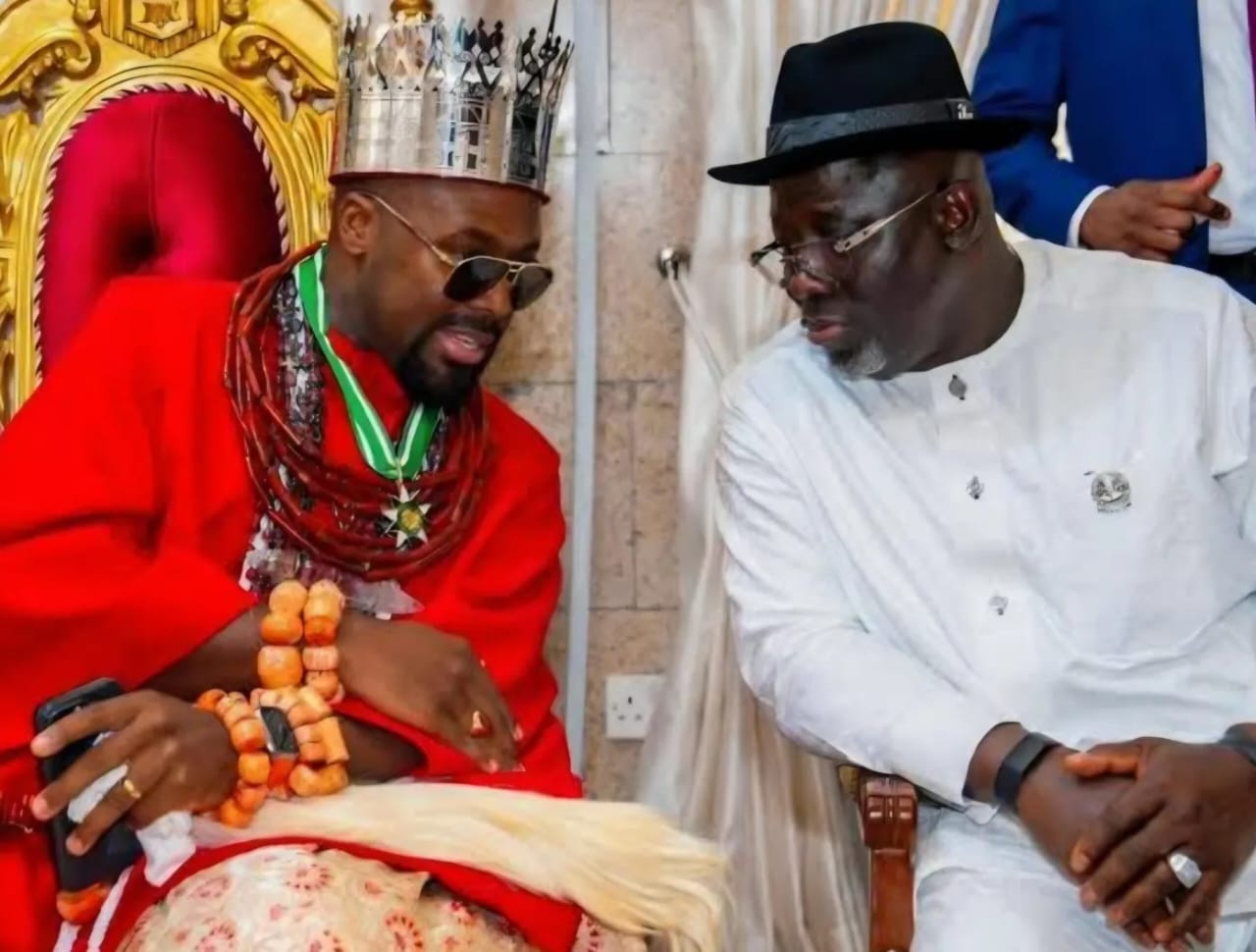
●Petitioners seek removal of Atuwatse III for alleged desecration of Ogbowuru Temple, breach of 1979 Edict
A fresh war of words has erupted over the Warri throne after a prince of the kingdom, Prince Ajemijeroma Gabriel Mene-Ejegi, publicly faulted a petition by the HM Erejuwa II Descendants to Delta State Governor, Rt. Hon. Sheriff Oborevwori, seeking the removal of the Olu of Warri, His Imperial Majesty, Ogiame Atuwatse III, CFR.
In a statement titled “The Itsekiri Throne Transcends Personal Grievances,” Mene-Ejegi, who describes himself as a descendant of Okunuwa and son of HM Olu Erejuwa I, said no individual, family, lineage or association has the authority to appropriate the collective voice of the Itsekiri people or determine the occupant of the throne.
“The Itsekiri Nation is neither the private preserve of any individual nor the exclusive possession of any family, lineage, or association. No ancestral affiliation, however distinguished, confers upon any group the unilateral authority to appropriate the collective voice of the Itsekiri people or diminish the sanctity and dignity of our revered traditional institution,” he said.
He argued that ancestral descent is a privilege of heritage and a responsibility to preserve collective history, not an instrument for advancing personal grievances, promoting sectional interests, or making unilateral pronouncements on matters concerning the entire kingdom.
“The submission of a petition, irrespective of its signatories, does not automatically confer collective legitimacy, represent the consensus of the Itsekiri Nation, or vest its authors with the authority to determine the occupant of the Olu’s throne,” Mene-Ejegi said.
He reaffirmed his “profound respect, unwavering allegiance, and support” for Ogiame Atuwatse III, insisting that matters touching on the throne must be approached with historical consciousness, cultural sensitivity, institutional respect, and strict regard for recognised customary and lawful procedures.
“They should never be reduced to platforms for public disparagement, divisive rhetoric, or the pursuit of individual and sectional interests,” he said.
“The Itsekiri nation transcends every individual, family, lineage, or association. No personal grievance or sectional interest should be permitted to override our collective heritage or compromise the dignity of the Warri throne,” he added.
He declared: “Ogiame Reigns! The Itsekiri Throne Endures!”
—The petition at the centre of the row—
The rejoinder was in response to a petition dated 21 November 2026, addressed to Governor Oborevwori at Government House, Asaba, and signed by Prince Bernard Oritsetimeyin Emiko, Olori-Ebi of Erejuwa II Descendants, and Prince Yemi Emiko.
According to reports of the petition, the two princes asked the governor to urgently intervene in what they described as a simmering crisis in Warri Kingdom and set in motion the process to remove Prince Tsola Emiko as the Olu of Warri. e973
The petitioners alleged that since Prince Tsola Emiko became Olu on August 21, 2021, Itsekiri has known no peace, claiming his actions have pitched communities and people against one another. e973
They also alleged interference in chieftaincy titles, claiming that senior titles owned by known families were being conferred without recommendation from the particular families, and in some cases given to persons outside those families. e973
Central to their case, according to the reports, are two long-running claims:
1.Breach of the 1979 Edict: The petitioners alleged that the 1979 Edict — the Traditional Rulers and Chiefs Law, 1979, otherwise known as Edict No. 16 of 1979 of the former Bendel State — forbids Prince Tsola Emiko from ascending the throne, and claimed that oracles warned against his enthronement. e973
2.Desecration of Ogbowuru Temple: They alleged desecration of the sacred Ogbowuru Temple at Ode-Itsekiri, claiming that only the Olu is permitted to enter that temple with his clothes and shoes on, but that the Olu recently allowed junior chiefs to walk in there with full clothes on. e973
They further claimed that Atuwatse II, Tsola’s father, never stepped into that temple in all of the 28 years he reigned as Olu, because he claimed to be a Christian.
Another report summarised the petition’s headline demand as: “Quit the throne for spraying ‘anointing’ oil at the revered ‘Ogbowuru Temple’” — with the petitioners quoted as saying: “The Oracles warned us about fostering him on the throne against the wishes of our ancestors.”
The petitioners urged the governor to set the process in motion to have him removed permanently as the Olu of Warri, “lest the people take the laws into their hands”. e973
As at the time of filing those reports, the Palace of the Olu of Warri had not reacted to the petition.
—Background: A succession dispute that never fully healed—
The current row did not begin with the November 21 letter. It is the latest chapter in a succession dispute that dates back to the death of Olu Ikenwoli in December 2020.
Prince Tsola Emiko — Utieyinoritsetsola Emiko — son of the 19th Olu, Atuwatse II, was crowned on 21 August 2021 as the 21st Olu of Warri, Ogiame Atuwatse III, at Ode-Itsekiri.
His emergence was fiercely contested by a faction led by Prince Bernard Emiko, junior brother to the immediate past Olu, Ogiame Ikenwoli.
In June 2021, Bernard Emiko approached a High Court in Warri seeking nullification of the nomination and enthronement of Prince Tsola Emiko as Olu-designate.
In that suit, Bernard Emiko claimed to be the Olori-Ebi of the Ogiame Erejuwa II Ruling House. Erejuwa II was the 18th Olu and father of both Atuwatse II (father of Tsola) and Ikenwoli (father of Prince Oyowoli Emiko).
He asked the court to set aside the purported nomination of Tsola Emiko and restrain then-Governor Ifeanyi Okowa and the Attorney-General from recognising him as Olu, including presenting him with a staff of office.
That legal challenge, and the parallel dispute over the Ologbotsere (Prime Minister) title involving Chief Ayiri Emami, have continued to shadow Atuwatse III’s reign.
Ayiri, who chaired the Olu Advisory Council, had argued that the choice of Prince Tsola Emiko as Olu-designate violated the 1979 Edict. After his coronation, Atuwatse III de-robed Ayiri on 5 October 2021 and later installed Chief Oma Eyewuoma as Ologbotsere — a move Ayiri’s camp has contested in court, insisting the title is held for life.
That dispute took a new turn on 19 November 2026, just two days before the Erejuwa II Descendants’ petition, when Atuwatse III publicly reaffirmed Eyewuoma as Ologbotsere after a consultation of the Ifẹ́ Oracle at Ode-Itsekiri in the presence of 25 chiefs, elders and stakeholders.
—-Why the Ogbowuru Temple matters—
The Ogbowuru Temple at Ode-Itsekiri, the ancestral home of the Itsekiri, is one of the most sacred sites in the kingdom. Allegations of desecration therefore carry weight far beyond ordinary palace politics, touching on spiritual authority, customary law, and the Olu’s role as both spiritual and temporal head of the kingdom.
At his coronation, Atuwatse III himself leaned heavily on spiritual symbolism, reversing a curse his grandfather, Olu Erejuwa II, was said to have placed on Nigeria over alleged injustice meted out to him.
“I, Ogiame Atuwatse III, the 21st Olu of Warri, the first son of Olu Atuwatse II, the grandson of and direct descendant of Olu Erejuwa II who was offended on this throne, hereby reverse the curse placed over this land,” he declared at the time.
That history makes the invocation of Erejuwa II’s name by the petitioners particularly potent — and, for defenders of the throne like Mene-Ejegi, particularly sensitive.
—What happens next—
For now, there are two competing narratives:
The petitioners’ narrative: That Atuwatse III’s enthronement was flawed from the start, that his reign has brought division, and that only gubernatorial intervention and removal can restore peace.
The palace defenders’ narrative, as articulated by Mene-Ejegi: That the throne is an enduring institution sustained by history, custom and lawful procedure, and that it cannot be overturned by petition, personal grievance or sectional agitation.
Governor Oborevwori has not publicly responded to the petition. Under Delta State law, the governor plays a formal role in recognising traditional rulers, but removal of a recognised Olu would require due process under the Traditional Rulers and Chiefs Law and customary procedure — not merely a petition.
Mene-Ejegi’s intervention suggests that loyalists of the palace intend to frame any attempt to unseat Atuwatse III as an attack not just on one man, but on the institution itself.
“Our responsibility as custodians of this great heritage is to uphold the truth of our history, preserve the integrity of our customs, defend our traditional institutions through lawful and constructive engagement, and safeguard the unity of the Itsekiri Nation for generations yet unborn,” he said.
With the Ologbotsere dispute still in court, the succession litigation unresolved in the public mind, and now a direct petition to the governor, the Warri throne crisis appears set to remain a defining test of traditional authority, customary law and political management in Delta State.