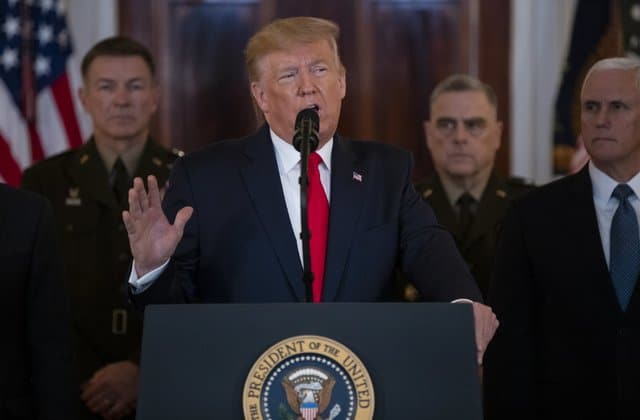
United States (U.S.) President Donald Trump late on Monday said that he would “temporarily suspend immigration into the United States” by executive order amid the coronavirus pandemic.
“In light of the attack from the Invisible Enemy, as well as the need to protect the jobs of our GREAT American Citizens, I will be signing an Executive Order to temporarily suspend immigration into the United States,” he tweeted.
The president did not provide further details about the move, which came as his administration sought to start reopening the country after it was shut down in an attempt to slow down the transmission of the novel coronavirus.
Vice President Mike Pence said the U.S. had enough testing for every state to begin phase one of a three-phased approach to reopening the country presented by the White House.
“By our best estimates, we have enough testing capacity today for every state in America to go to phase one if they meet the other criteria of 14 days of reduced cases and sufficient hospital capacity to prepare for any eventuality that may occur,” Pence told a daily briefing.
Meanwhile Anthony Fauci, the top U.S. public health official on infectious diseases, tempered expectations of a quick return to economic normality saying the virus had to be contained first.
Speaking on broadcaster ABC, Fauci cautioned that testing for antibodies to the virus had not yet been perfected while also warning that immunity was still being studied.
“If you jump the gun and go into a situation where you have a big spike, you’re going to set yourself back,” he said, adding: “Unless we get the virus under control, the real recovery, economically, is not going to happen.”
Trump said there were additional testing sites that governors knew of and could be using, taking a swipe at two governors who he said “didn’t understand” this.
The president said New York governor Andrew Cuomo, who has been one of the most outspoken critics of Trump’s coronavirus response, would visit the White House on Tuesday.
Earlier on Monday, Cuomo called for help from the federal government on fixing supply chain issues that left labs with shortages of chemicals and equipment for testing.
Maryland has acquired 500,000 tests from a company in South Korea, according to a tweet by an aide of Governor Larry Hogan.
They are among governors who have warned that testing remains inadequate to quickly identify and contain new outbreaks of the virus, with current capacity at just a fraction of what experts are recommending, though efforts are under way, including in the private sector, to roll out more kits with faster turnaround for results.
Fauci said antibody testing for the coronavirus was still in its infancy, raising concerns that it might be difficult to determine who was really immune.
Moreover, Fauci cautioned, as he had in the past, that immunity to the new coronavirus was still not proven, even if it was being assumed.
“We don’t know how long that protection, if it exists, lasts,” Fauci said.
The antibody tests still need to be “validated and calibrated”.
Fauci has in the past floated the idea of issuing certificates of immunity, once it is possible, to help facilitate relaxing shutdown guidelines.
The governors of South Carolina, Georgia and Tennessee, on Monday, announced that some businesses would be allowed to reopen starting on the day.
Protests against stay-at-home orders imposed to stem contagion have spread across the U.S. in recent days.
Trump has shown signs of support for the protests, even as his administration continues to insist on social distancing guidelines.
Some of the protests have seen flagrant violations of anti-pandemic rules and called for reopening the economy, in spite of the health risks.
Facebook said it was banning pages for events that violated social distancing rules.
“Events that defy government’s guidance on social distancing aren’t allowed on Facebook,” a company spokesperson said by email.
New York’s Cuomo said: “You don’t need protests to convince anyone in this country that we have to get back to work and we have to get the economy going.”
New York, the epicentre of the country’s outbreak, is past the plateau, but “nobody knows” how long the descent would take, Cuomo told a daily press conference.
“The numbers would suggest we’re seeing a descent.
”The question is now how long is the descent and how steep is the descent?” he said.
The governor said the hospitalisation rate continued to decrease and the one-day death toll was fewer than 500 for the first time in more than two weeks, with 478 more fatalities.
More than 14,300 have died due to the virus in New York.
Meanwhile, the New York State Nurses Association launched three lawsuits on Monday against the state and two hospitals, alleging that their members were being exposed to dangerous working conditions amid the pandemic.
The suits say nurses were not given protective equipment and sufficient training.
Also, Trump says his country is looking to add 75 million barrels of oil to its strategic reserve amid the collapse in oil prices.
He told a daily news confetence on Monday at the White House that the addition would “top out” the national petroleum reserve for the “first time in a long time.”
U.S. crude oil prices plummeted to their lowest levels ever, as contracts settled deep in negative territory for the first time, amid tight shortages in storage capacity with the collapse in demand because of the coronavirus.
West Texas Intermediate (WTI), the U.S. benchmark, settled for the day at negative 37 dollars a barrel for May deliveries, as contracts are set to expire on Tuesday.
The problem of physical delivery was weighing heavily, leading to a single day decline of more than 200 per cent.
The price moved back up somewhat, but was still in negative territory, as US stock markets headed to their close, with equities under pressure.
However, longer term WTI contracts were faring somewhat better, while still down on the day, signalling optimism that economic production will improve by the end of 2020, and indicating the storage space issue was acutely pushing down the immediate term price.
June contracts were at just over 20 dollars per barrel and deliveries for later in the year are priced even higher.
Brent crude was lower by about 8 per cent, and was trading at 25 dollars a barrel.
Oil prices have been hit by both the coronavirus bringing major economic sectors to a near standstill, and a price war between Russia and Saudi Arabia that kicked off at about the same time the pandemic was spreading.
Earlier this month, OPEC+ countries – an expanded format of the Organisation of the Petroleum Exporting Countries (OPEC) – agreed on a deal to cut production by 9.7 million barrels per day for May and June, but failed to support prices back to previous levels.