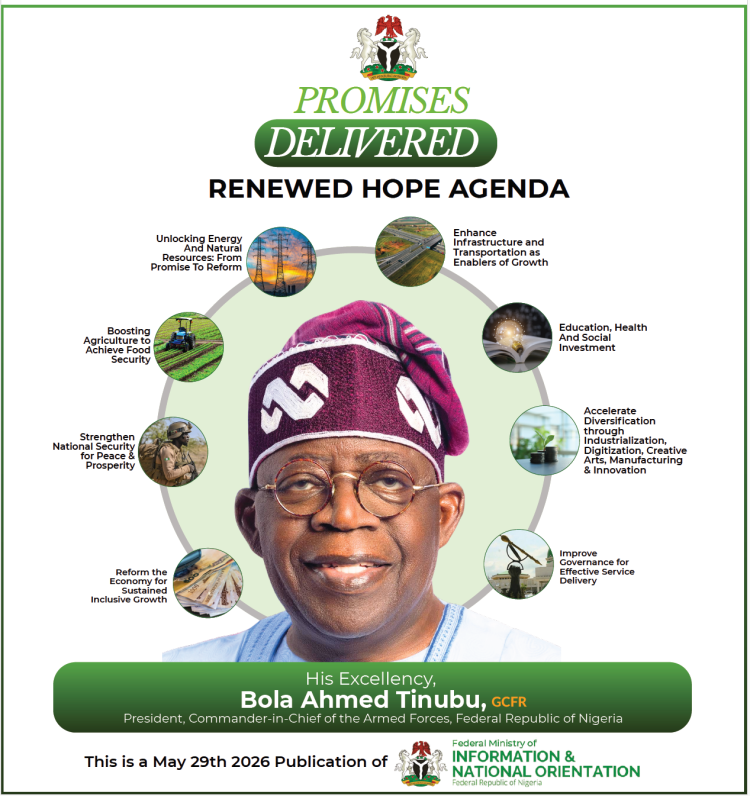




The administration of Bola Tinubu has relied heavily on dialogue, reconciliation, and stakeholder engagement over the past three years to resolve long-standing national disputes and strengthen economic recovery efforts.
This position was outlined in a statement released in Abuja by Abiodun Oladunjoye, titled “Tinubu @3: Peace-Building, Conflict Resolution and National Development.”
According to the statement, the government’s reform agenda since taking office has included fuel subsidy removal, exchange rate unification, the rollout of the Nigerian Education Loan Fund, the compressed natural gas (CNG) initiative, improvements in workers’ welfare, and expanded infrastructure development.
Oladunjoye explained that beyond economic reforms, the administration has placed strong emphasis on conflict resolution as a foundation for stability, investor confidence, and sustained growth.
One of the major issues highlighted was the long-running Ogoni crisis in the Niger Delta, which dates back to the 1990s and was driven by environmental concerns that disrupted oil exploration activities.
The government, through the Office of the National Security Adviser, facilitated consultations involving community representatives, Nigerian National Petroleum Company Limited, traditional rulers, and security agencies.
The submission of the Presidential Committee report on Ogoni consultations, chaired by Don Baridam in September 2025, marked a turning point, paving the way for renewed peace and the planned resumption of oil exploration in the region.
The President also hosted reconciliation meetings at the Presidential Villa and paid tribute to key figures lost during the crisis, including Ken Saro-Wiwa.
Another significant breakthrough cited was the resolution of the long-standing dispute over Oil Prospecting Licence 245 (OPL 245), commonly referred to as the Malabu oil case, one of Nigeria’s most valuable oil assets.
The Attorney-General of the Federation, Lateef Fagbemi, noted that settling the dispute removed years of legal uncertainty that had hindered development.
Officials believe the resolution could boost investor confidence and increase national oil output by approximately 150,000 barrels per day.
In the aviation sector, the government also resolved a more than two-decade dispute involving the concession of the Murtala Muhammed Airport Terminal Two (MMA2) in Lagos between the Federal Government and Bi-Courtney Aviation Services Limited.
The Minister of Aviation and Aerospace Development, Festus Keyamo, confirmed that the issue was settled following extensive stakeholder negotiations.
The administration’s dialogue-based approach has also been applied to security challenges in Plateau State, where the President convened a broad stakeholders’ meeting involving Governor Caleb Mutfwang, former leaders, traditional rulers, religious figures, and youth representatives.
Rather than impose solutions, participants were encouraged to review past policy documents and recommend practical steps toward long-term peace.
Analysts say this strategy of negotiation, institutional collaboration, and diplomacy has contributed to easing tensions, rebuilding trust, and encouraging investment.
As the administration approaches its fourth year, observers note that sustaining these gains will depend on transparency, consistent implementation of agreements, and inclusive governance practices.