

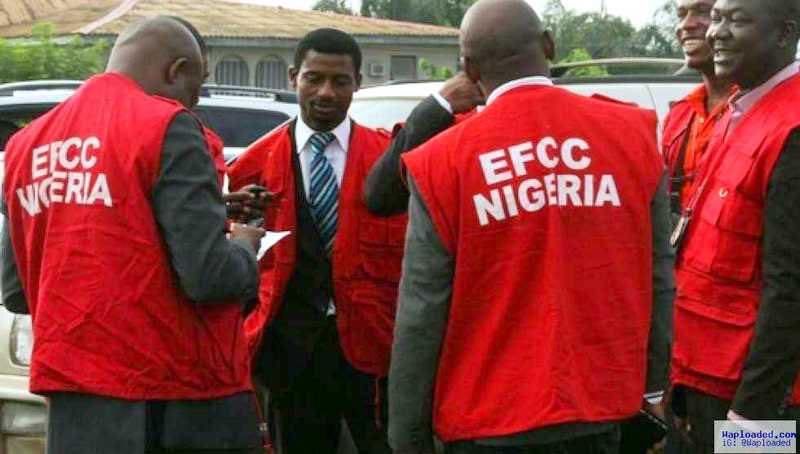
A legal practitioner, Jelili Owonikoko, on Thursday made a no case submission in a case of attempted bribery filed against Rickey Tarfa (SAN) by the Economic and Financial Crimes Commission (EFCC) at the Lagos High Court.
Owonikoko made the submission over the alleged bribery and attempt to pervert the course of justice charge brought against the Senior Advocate, by the EFCC.
The counsel told the court that he had reviewed the prosecution’s case and concluded that there was no case to answer.
He also said that they have, therefore, filed an application on this view and served the prosecution.
“We urge your Lordship to discharge the defendant on the view that he has no case to answer.
“Our application is supported with an affidavit and a written address,’’ Owonikoko said.
Rotimi Oyedepo, Counsel to the EFCC, had admitted that a 54-paragraph affidavit was served on them on Nov. 10, which they have yet to respond to.
He said that the commission was still going through the application and would need a short adjournment to enable them to respond to it.
Justice Adedayo Akintoye then adjourned the case until December 12, for hearing.
The EFCC had first arraigned Tarfa on March 9, 2016 on a 27-count charge bordering on offering of gratification to some judges and perversion of the course of justice.
The anti-graft agency alleged that Tarfa offered N5.3 million gratification to a judge of the Federal High Court, Justice Hyeladzira Nganjiwa, to `compromise’ the judge.
The agency also claimed that Tarfa transferred the money in several tranches to the judge between June 27, 2012 and December 23, 2014.
The EFCC alleged that the Senior Advocate lied about his age and failed to declare his assets to the commission, upon his arrest on Feb. 5, 2015.
The offences, according to the anti-graft agency, contravene Section 64 (1) of the Criminal Law of Lagos State, 2011.
Tarfa, however, pleaded not guilty to all the counts of the charge.
He, subsequently, sought to quash the charge on the argument that they were incompetent, but his application was dismissed by Justice Akintoye, making him to go on appeal.
The EFCC later reduced the 27 counts to 26 counts and substituted Section 38(2) for Section 39(2) of the EFCC Act, 2004.
On October 23, the EFCC closed its case.
Oyedepo, counsel to the EFCC, had told the court on that date that the prosecution had no more witnesses to call in the case.
The EFCC had called six witnesses, who testified against Tarfa in the trial that began in March, 2016.


Tarfa enters no case submission over bribery allegation


Leave a Reply








Latest Stories







© 2026 Published by SWAAYA LIMITED, Plot 20, Block G, Scheme 1, Residential 3, OPIC Beachland Estate, Lagos/Ibadan Expressway, Lagos. Gabriel Akinadewo, MD/CEO 08023010222, 08094000056, 08052097814.