


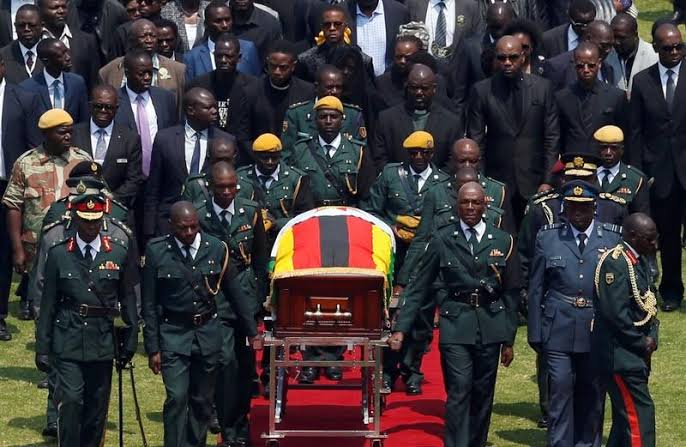
Foreign leaders, supporters and ordinary citizens, on Saturday, attended the state funeral of Zimbabwe’s founder, Robert Mugabe, after a week of disputes over his burial that threatened to embarrass his successor, President Emmerson Mnangagwa.
Mugabe led Zimbabwe for 37 years, from independence until he was ousted by the army in November, 2017.
He died in a Singapore hospital on September 6, aged 95.
His remains will be interred in a mausoleum at the National Heroes Acre in the capital Harare in about 30 days, his nephew said on Friday, contradicting earlier comments that burial would be held on Sunday.
Mnangagwa, Mugabe’s former deputy, who conspired to topple him, said late on Friday that building the mausoleum would delay the burial of the man, who was once his mentor.
On Saturday, Mnangagwa walked behind the casket carrying Mugabe’s body as it was wheeled into the centre of Harare’s National Sports Stadium and placed on a podium decorated with flowers so that ordinary Zimbabweans could say their farewells.
Senior army generals and Mugabe’s wife and children followed as a brass band played.
“Today, let us put aside our differences and come together as we remember the past and look to the future as one proud, independent and free nation,’’ the president wrote on Twitter.
Mnangagwa and the ruling ZANU-PF party wanted Mugabe buried at the national shrine to heroes of the 15-year liberation war against white minority rule.
But some relatives, expressing bitterness at the way former comrades ousted Mugabe, had pushed for him to be buried in his home village.
South African President Cyril Ramaphosa, who also chairs the African Union, Kenya’s Uhuru Kenyatta and long-ruling leaders from Equatorial Guinea and Congo were among heads of state attending Saturday’s event.
Ramaphosa was booed by some people at the event, apparently in reaction to xenophobic attacks in South Africa.
Banners at the stadium, where Mugabe’s body lay in state ahead of the funeral, read “Hamba Kahle, Gushungo,” (go well, Gushungo)”, a reference to his clan name, and “Pioneer of nationalist politics”.
Cleo Mapuranga, a caterer, said: “I feel low because Mugabe fought for us.
“I remember him for land to the blacks, economic freedom and higher education, which was non-racial’’.
“Now, people are suffering; no one is controlling the prices in the shops.
“Our finance minister is trying to implement first-world policies, which don’t work in third-world countries.’’
Mugabe’s death has made some Zimbabweans question what Mnangagwa has achieved in his two years in power.
His government has taken steps to cut the budget deficit, remove subsidies on fuel and power and repeal laws curbing public and media freedoms, but those reforms and austerity measures have compounded ordinary people’s hardships.
Mugabe was feted as a champion of racial reconciliation when he came to power in 1980 in one of the last African states to throw off white colonial rule.
By the time he was toppled in 2017 to wild celebrations across the country of 13 million people, he was viewed by many at home and abroad as a power-obsessed autocrat, who unleashed death squads, rigged elections and ruined the economy to keep control.
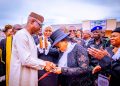
Meanwhile, Nigeria’s Vice President, Yemi Osinbajo, has said that the legacy of determined, proud and assertive black emancipation left by Mugabe will live long in the hearts of Africans.
Osinbajo conveyed the message on the condolence register for Mugabe at Harare International Airport.
Osinbajo was in Zimbabwe to represent President Muhammadu Buhari at the state funeral.
“Nigeria most respectfully condoles with the Republic of Zimbabwe on the passing of her President, Robert Mugabe – who led the republic and her people to freedom and majority rule – alongside so many other patriots.
“His legacy of determined, proud and assertive black emancipation will live long in the hearts of Africans.
” We wish the people of Zimbabwe great peace and prosperity.”
Osinbajo, later while speaking with Zimbabwean journalists at the Harare International Airport, said that Mugabe was a great encouragement to independent movements everywhere.
He said that Mugabe was also a great motivation to self-realisation for black people practically everywhere.
According to Osinbajo, the passing on of Mugabe is indeed sad, especially for those who are leaders today.
“First let me say that for all of us, the whole of Africa, the memories of the years of decolonisation, the years of the struggle for black majority rule in various places are years that bring joy and confidence to most of us, especially leaders today.
“This is one of the reasons President Mugabe stood out as one of those leaders whose zeal, passion and selfless commitment to the emancipation of the people of Zimbabwe was not only a great encouragement to the independent movement everywhere, but more to the self-realisation for black people practically everywhere.
“So, his passing is indeed sad. I think that for most of us, especially those who are leaders today, there’s a lot to learn from such an incredibly illustrious career, especially the role that he played in decolonisation.
“And, of course, alongside the work that was done, not just by the frontline states, but by the likes of Nelson Mandela in South Africa and so many other African patriots; their lives and times, especially during the period of the struggle for black majority rule in Southern Africa and the support that other African countries gave, especially sub-Saharan African countries; Nigeria being, as you have noted, a frontline state.
“There are times when I think we should be extremely proud of what we achieved as black people,” he said.