



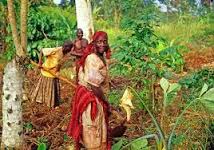
Religious and ethnic tensions continue to brew in different parts of Nigeria, erupting into outbreaks of violence and leading, in turn, to escalating poverty and malnutrition. BODE DUROJAIYE examines rural poverty and women as wasted potential for real growth.
Nigeria has a population of more than 160 million, the largest in Africa.
Agriculture is the mainstay of the economy, contributing about 40 per cent of Gross Domestic Product (GDP).
The agriculture sector employs approximately two-thirds of the country’s total labour force and provides a livelihood for about ninety per cent of the rural population.
Nigeria is the world’s largest producer of cassava, yam and cowpea –
all staple foods in sub-Saharan Africa. It is also a major producer of
fish.
Unbelievably, it is a food-deficit nation and imports large amounts of
grain, livestock products and fish.
Nigeria’s huge agricultural resource base offers great potential for growth.
Findings showed that of an estimated 71 million hectares of arable
land, only about half is presently under production.
Also, there is substantial scope for an increase in irrigation, which
now covers only seven per cent of irrigable land.
Irrigation and other inputs would substantially increase average
yields for major staple crops, which are below those in other
developing countries.
Despite Nigeria’s plentiful agricultural resources and oil wealth,
poverty is widespread in the country and has increased since the late
1990s.
Some seventy per cent of Nigerians, Food and Agricultural Organisation
[FAO] live on less than US$1.25 a day.
Poverty is especially severe in rural areas, where up to eighty per
cent of the population lives below the poverty line, as social
services and infrastructure are limited.
The country’s poor rural women and men depend on agriculture for food
and income. About ninety per cent of Nigeria’s food is produced by
small-scale farmers who cultivate small plots of land and depend on
rainfall rather than irrigation systems.
The poorest groups eke out a subsistence living but often go short of
food, particularly during the pre-harvest period.
The productivity of the rural population is also hindered by ill
health, particularly HIV/AIDS, tuberculosis and malaria.
Women play a major role in the production, processing and marketing of
food crops.
Yet women and households headed solely by women are often the most
chronically poor members of rural communities.
Men, it was gathered, have higher social status and, as a result, more
access to schooling and training.
In recent decades, the number of men migrating from rural areas in
search of employment has increased, and the number of households
headed solely by women has grown substantially.
Rural infrastructure in Nigeria has long been neglected, as
investments in health, education and water supply have been focused
largely on the cities.
As a result, the rural population has extremely limited access to
services such as schools and health centres, thus making about half of the population to lack access to safe drinking water.
Neglect of rural infrastructure, FREEDOM ONLINE investigation revealed, had affected the profitability of agricultural production.
The lack of rural roads impedes the marketing of agricultural
commodities, prevents farmers from selling their produce at reasonable
prices, and leads to spoilage.
Limited accessibility cuts small-scale farmers off from sources of
inputs, equipment and new technology, and this keeps yields low.
As the population swells and puts pressure on diminishing resources,
escalating environmental problems further threaten food production.
Land degradation as a result of extensive agriculture, deforestation
and overgrazing are already severe in many parts of the country.
Drought has become common in the north, and erosion caused by heavy
rains, floods and oil pollution is a major problem in the south and
south-east and south-west.
Amongst the factors that most feed the cycle of poverty in Nigeria and
other West African countries are mass unemployment and lack of
productivity.
Unemployment causes the huge human waste, and includes issues of
income, well-being and diseases that can all be attributed to this.
A lack in productivity means a lack of supply in goods and services in
the country.
However, a study of women entrepreneurs in Nigeria revealed very
interesting aspects that can assist in alleviating poverty.
For a majority of women, what drove them to entrepreneurship was
mostly the ideal of gaining control of their lives and/or make more
money.
It was also because they had no other choice since there was no job to
be found around town.
But the main discovery was about cultural differences in the way
entrepreneurship is perceived.
While in the West entrepreneurship is often viewed as a male domain,
investigations showed that in Nigeria (and possibly other West African
countries), a great majority of women saw opportunities to become
entrepreneurs as available to both men and women.
Most of these women were married, often had children, and relied on
family members or friends as role models. This shows how family and
social dynamics are important to improve the conditions of women, and
thus family income and poverty in Nigeria.
The main problems remained those of entry barriers into the market, as
well as difficulties in setting up a business (legally and
administratively speaking) and issues with women’s access to credit.
In this regard, microfinance is a major driver of female
entrepreneurship in the country and continued access to credit is key
to continuing this trend.
Because of the importance given to banks and financial services, a
system of community banking was established early on in the 1990s.
These banks were expected to provide micro-finance services but also
basic banking services such as deposits and savings, all while
encouraging investment.
It is worrisome to discover that succeeding federal, state and local
governments had not been assisting local farmers, but were rather
excluded from markets, while banks have on the contrary been granting
loans mostly to trade-related activities, which imply short term
gains.
This was pretty much the opposite of what they were expected to do
since rural farmers were mostly counting on community banking to
develop the country’s agriculture and manufacture.
Speaking on the issue, an expert in agriculture and rural management, said the biggest problem remains that of corruption and
the lack of political will to develop the country.
“This is mostly the reason why private and/or foreign microfinance
initiatives have been expanding so well. But the government still has
a role to play in building a proper legal environment for the
development of rural finance. Without the right legal framework,
people (and businesses) are often more exposed to corruption and scams
of all kinds”.
As they exist now in Nigeria, he asserted that community banks are
not suited to the poor, adding that they should focus on opportunities
to create more jobs in agriculture, help women create businesses, and
provide services more adapted to the needs of the poor (in terms of
loan sizes, repayment mechanisms etc).
“The great ethnic diversity in Nigeria contributes to the lack of
national cohesion and opposition to the problem of corruption, thanks
President Muhammadu Buhari’s administration unrepentant determination
to fight corruption headlong. If waste and corruption could be
overcome, money could finally go to the country’s infrastructures,
such as hospitals, potable water supply, sound education system, among others”.