


Former Information and Culture Minister, Alhaji Lai Mohammed, 2027 PDP governorship candidate in Ogun State, Mr Ladi Adebutu, and other stakeholders have identified security, strong institutions and good governance as preconditions for economic growth and Nigeria’s future.
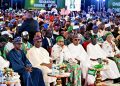
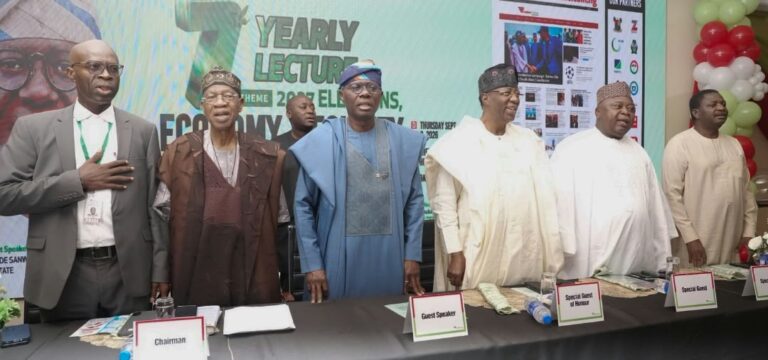
They made the submission on Thursday in Lagos at the 7th Yearly Lecture organised by SWAAYA Ltd., publishers of Freedom Online.
The lecture, held in Ikeja, has as its theme: “2027 Elections: Economy, Security and Nigeria’s Future.”
Mohammed, Chairman of the occasion, said security was precondition for economic growth, stressing the need for political stability and economic inclusion.
“It is important to note, first, that security is the precondition for economic growth.
“No business thrives in an atmosphere of uncertainty, and no foreign or local investor deploys capital where safety cannot be guaranteed.
“In turn, political stability depends on economic inclusion,” Mohammed said.
Mohammed said the 2027 election should not be reduced to a contest for political power, but should contribute to continuity, nation-building and stronger democratic institutions.
He said : “Politics must never be allowed to override governance.
“The real measure of our democratic progress is whether our electoral outcomes strengthen institutions, bolster investor confidence and guarantee peace across our communities.
“Second, the 2027 election must be viewed not merely as a contest for power, but as a commitment to continuity and nation-building.”
He said Nigeria was facing difficult challenges in security and economic reform, adding the problems required patience, consistency, institutional strengthening and national cooperation.
“When young people are gainfully employed and see a clear path to self-actualisation, the political space becomes far less susceptible to manipulation and electoral violence.
“It is also important to acknowledge that the Federal Government is confronting some very difficult challenges in the areas of security and economic reform.
“These are not challenges that can be solved overnight,” he added.
Mohammed said the efforts of the Federal Government to stabilise the economy, attract investment and improve security deserved constructive engagement from stakeholders.
“They require consistency, patience, institutional strengthening and, above all, national cooperation.
“The efforts being made by the administration to stabilise the economy, attract investment, improve security and create a more sustainable foundation for growth deserve constructive engagement from all stakeholders.
“What I will offer, as Chairman, is simply this reflection: as we look toward 2027, our collective duty, as citizens, as media, as leaders, is to strengthen the foundations already being laid, not merely to critique them.”
Mohammed also emphasised the media’s role in shaping the national conversation, particularly during election periods, urging journalists to promote responsible and truthful reporting.
In his remarks, Adebutu said capitalism could not thrive in an environment where laws, institutions and security were weak.
“The system will fail where there is no desire to make our institutions strong for robust economy and strong security.
“Who will invest money, put his future in a system where is no security guaranteed?
“Truly, wealthy people keeps their money out of the country because of lack of transparency and security in the system,” he said.
Adebutu decried political polarisation and called for stronger institutions and transparent elections that reflected the will of the people.
He said, “We are polarised so much that the idea of one Nigeria is failing. To build a prosperous future, our institutions has to be strong with strong desire to keep our laws. Our elections has to be transparent and credible.”
He said stakeholders, including the media, must be courageous enough to speak truth to power without fear of persecution.
“That is our duty. We have no other country, we believe in one Nigeria,” Adebutu said.
Speaking, Mr Femi Adesina, a former presidential spokesman and former President of the Nigerian Guild of Editors, said Nigeria’s future depended on a robust economy and improved security.
“Things are very difficult in Nigeria no doubt, without the economy being revived, security being improved, what future do we have.
“We are in a very difficult time, but we are not going to give up,” Adesina said.
Chief Gani Adams, Aare Oba Kakanfo of Yorubaland, called on President Bola Tinubu to fast-track processes toward implementing state police to improve security and investors’ confidence.
“State police is the best way to solve our problem of insecurity in Nigeria. If allowed, I am sure within size months we will forget insecurity. The President should please fast track this,” he said.
In his welcoming address, Mr Gabriel Akinadewo, Managing Director and Editor-in-Chief of Freedom Online, called for fundamental reforms in Nigeria’s governance system to address insecurity, economic challenges and development deficits.
Akinadewo said Nigeria must separate politics from governance and development, noting that “we have a four-year cycle of elections but pitiably, there is no four-year cycle of development.”
He said the country needed to modernise its laws and security architecture to reflect contemporary realities, stressing that “we can’t continue to use the system adopted in the 60s to govern Nigeria of 2026 and beyond.”
Akinadewo particularly advocated state police and restructuring, arguing that decentralising security would improve understanding of local security challenges.
“Insecurity, which has become a monster, threatening to consume the nation-state called Nigeria, must be tackled,” he said.
Akinadewo also urged Nigerians to use the post-2027 election period to pursue fundamental changes and reorder the country’s value system, adding that “restructuring is key to ensure rapid development of this country”.
Gov. Babajide Sanwo-Olu of Lagos was the Special Guest Speaker, while Sen. Gbenga Daniel was the Special Guest of Honour at the lecture.