


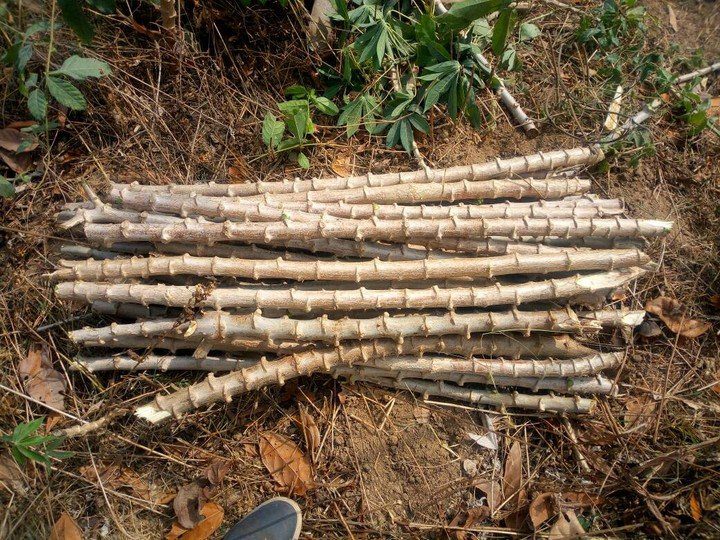
Nigeria requires more than 450 million bundles of cassava stems every year to meet the planting needs of farmers across the country, but current supplies fall significantly short of demand, according to the International Institute of Tropical Agriculture (IITA).
The shortage of quality planting materials is limiting farmers’ access to improved cassava varieties and raising concerns about agricultural productivity, profitability and food security.
Kayode Olasupo, an agronomist with IITA GoSeed, disclosed the figures during an interview with the News Agency of Nigeria (NAN) in Abuja on Monday.
He explained that although Nigeria remains the world’s largest cassava producer, the country is struggling to provide farmers with sufficient quantities of certified and improved planting materials.
According to Olasupo, the country currently supplies less than 10 per cent of the estimated annual requirement, leaving millions of farmers dependent on unreliable sources of cassava stems.
High transportation costs worsen farmers’ difficulties
Olasupo identified the limited presence of commercial seed companies within farming communities as one of the major obstacles to improving access to quality cassava planting materials.
He said farmers often travel considerable distances to obtain improved stems, with transportation expenses sometimes exceeding the actual purchase price of the planting materials.
The agronomist called for greater investment in commercial seed enterprises, particularly businesses operating closer to farming communities.
He believes expanding the network of local seed entrepreneurs would make improved planting materials more accessible, affordable and readily available to farmers.
More than six million farmers affected
According to estimates drawn from IITA projects, more than six million smallholder farmers cultivate cassava across Nigeria.
Olasupo said the estimated annual demand of over 450 million bundles reflects the scale of planting requirements within the country’s cassava industry.
He warned that the shortage forces many farmers to depend on stems obtained from neighbours, repeatedly reuse existing planting materials or purchase varieties whose quality and identity have not been properly verified.
Such practices, he explained, can prevent farmers from benefiting fully from improved cassava varieties developed by agricultural research institutions.
He stressed that access to healthy and improved planting materials was essential for increasing farm productivity, improving farmers’ earnings and strengthening rural livelihoods.
Research innovations offer hope for cassava production
The agronomist also raised concerns about the gap between agricultural research and the availability of improved varieties at farm level.
He observed that several varieties released by research institutions had not reached enough farmers because of weaknesses in the multiplication and distribution systems.
To address this challenge, IITA GoSeed is using modern propagation techniques to increase the production of improved cassava planting materials.
Olasupo described the organisation as an early-generation seed company established to multiply and distribute improved varieties developed by IITA and other research institutions.
One of the technologies being deployed is Semi-Autotrophic Hydroponics (SAH), which enables the rapid multiplication of cassava planting materials under controlled production conditions.
He explained that conventional multiplication methods produce relatively few planting stems from a single cassava stem, whereas the newer technology can generate hundreds of thousands of plantlets annually from one starting stem under appropriate production conditions.
According to him, the innovation could reduce the time required for newly released cassava varieties to reach farmers from many years to approximately two or three years.
Improved planting materials critical to food security
Olasupo maintained that expanding access to certified cassava stems would help farmers increase productivity, improve profitability and make better use of agricultural research innovations.
He called for stronger participation by commercial seed producers, improved distribution networks and greater investment in technologies that can accelerate the multiplication of quality planting materials.
The development is particularly important for Nigeria, where cassava supports millions of farming households and serves as a major raw material for food processing and other industries.
Closing the gap between the production of improved cassava varieties and their availability to farmers could therefore play an important role in strengthening Nigeria’s agricultural sector, supporting rural incomes and improving national food security.