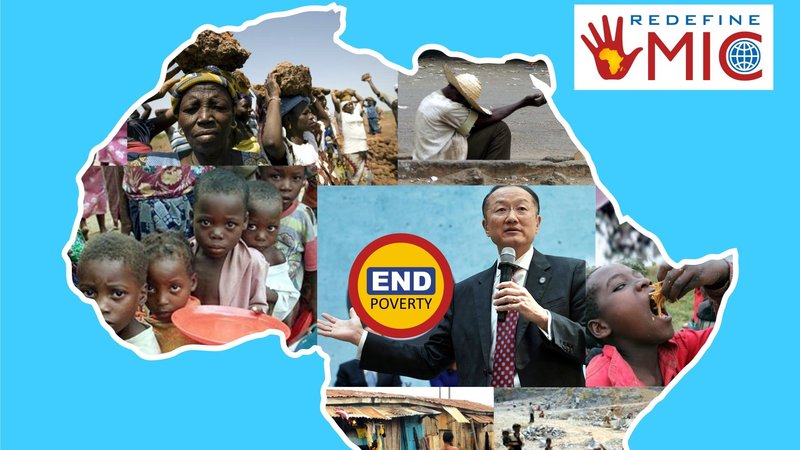
The World Bank’s Middle Income Classification (MIC) underlines an unhealthy alliance with governments of our nations, thereby denying the people the help they urgently need (from international donor agencies) through an economic rating system that is silent on the realities that the poor face.
While we have no doubt that the dire impacts of diseases and poverty facing the African continent today is a direct result of the misrule of our nations, we also note that the fate of our people, today, looks more harrowing, by the seeming insensitivity of the World Bank’s income classification policy.
Engaging with the real problem
The Middle Income Classification has compounded the on-going socio-economic challenges rather than provide decisive action and a positive turn-around. Designations for Low, Middle and High-Income countries are arbitrarily set by the World Bank based on the countries’ Gross National Income, an approach that grossly understates the extent of poverty in the MICs.
The countries classified as MIC by the World Bank are supposed to be countries whose economies are doing well and whose citizens’ have an income threshold that is sufficiently able to cater for a person’s basic necessities; putting him or her firmly and comfortably above the poverty line of $1.25 daily. What then is the moral justification for classifying countries as MICs when majority live below the poverty line and where only a small percentage of the population earn as little as $2.86 (#572) per day – the income threshold the bank says is sufficient for anyone on the continent to escape poverty? Whereas, this is about as much as the price of a phone recharge card in many Sub-Saharan Africa countries, insufficient to decently feed a person, talkless of feeding a family in a day.
For example, Nigeria (a MIC) is third on the world poverty index; with 7% of the world’s poor residing in that country. 46% of Nigerians live below the poverty threshold of $1.25 daily; while 69% of Nigerians actually live in poverty conditions (NBS -2014). Everyday according to UNICEF, Nigeria losses about 2, 300 children under 5 years and 143 women of child bearing age, making the country the second contributor to the under 5 and maternal mortality rates in the world. Additionally, 3.4 million Nigerians are living with HIV/AIDS, 700, 000 of whom are on antiretroviral drugs (ARVs), representing 41% of those who require treatment. Only 12% of all infected children requiring treatments are able to access them. For education, a recent international study reported by the World Bank, in which learning achievements of 22 countries in sub‐Saharan and North Africa were compared, the learning achievements of students in Nigeria’s primary schools were reported as the lowest, with a national mean scores of 30%.
Kenya on the other hand, another MIC country is said to be one of the ten countries that account for 80% of the world’s extreme poor, and in Zambia, a MIC, 60.5% live below poverty line. Therefore the World Bank middle income classifications are not only cruel, but also compound poverty and inequality!
Designations for Low, Middle and High-Income countries are arbitrarily set by the World Bank based on the countries’ Gross National Income, an approach that grossly understates the extent of poverty in the MICs. Thus, the Middle Income Classification has compounded the on-going socio-economic challenges facing the people rather than provide decisive action and a positive turn-around.
While we take note of an expanding middle class in many of the MIC countries, however, it is also the case that these very countries have the highest burden of preventable diseases, account for over 70% of the world’s poorest people, and have high numbers of internally displaced persons as a result of insurgency. In all honesty, the seeming “economic boom” pales in comparison to the hardships faced by citizens in these countries.
Implications of the Middle Income Classification
With severe national budgetary constraints, overall reduction in levels of development assistance and potential donor fatigue, it is by all means that the health sector in sub-Saharan Africa will be grossly affected. The implication for example includes, but not limited to;
a) Reduction in grants portfolio: The Global Fund to Fight AIDS, TB and Malaria makes a smaller amount of grant money available to MICs, even though they have a high burden of the three diseases. We can all agree that withdrawal in donor funds or foreign aids gravely impacts the continuum of care by minimizing access to prevention, care, and treatment and support services. ‘‘Withdrawal in funding due to a perceived upgrade in income classification, creates the idea that people get used to living in poverty and ill-health, and therefore do not need international aid because of their governments’ ability to pay’’ says Médecins Sans Frontières.
b) Denying the poor access to essential healthcare services: In the Nigerian HIV/AIDS sector for instance, most patients are charged for consultations and routine tests because PEPFAR reduced the profile of its support; unfortunately this is translating into treatment gaps and adherence issues as many of the patients cannot afford to pay the fees. Swaziland, (which has the highest HIV/AIDS prevalence globally- 1 in 3 persons is positive; while 63% of the population live below the poverty line), is witnessing withdrawal of support in the provision of free Condoms from UNFPA, as Swaziland is now an MIC.
c) Undermining gains previously achieved: The current burden of Maternal and Infant Mortality across the continent of Africa will be seriously compounded with cuts to aids, while this also is without its negative implications, particularly on the status of other reproductive healthcare services that are available due only to donor funding which the MIC status threatens.
Our demands
We would like to call upon the World Bank President to consider the following;
1. A review of how the World Bank groups countries by income level.
2. Designations must factor in disease burdens, unequal pay and quality of life.
3. That the lowest limit of the MIC category be set at $3650 of GNI per capita – equivalent to $10 day as it is currently unrealistic for someone to survive on $1.91 ( N382) a day.
4. Review of the current aid allocation logic and request a true assessment of the health needs in countries, knowing fully well that without international support which the MIC status may restrict, these countries are even less likely to achieve the SDGs and bring their disease burdens under control.
If the World Bank is serious about ending poverty; then a MIC redefinition becomes imperative.