


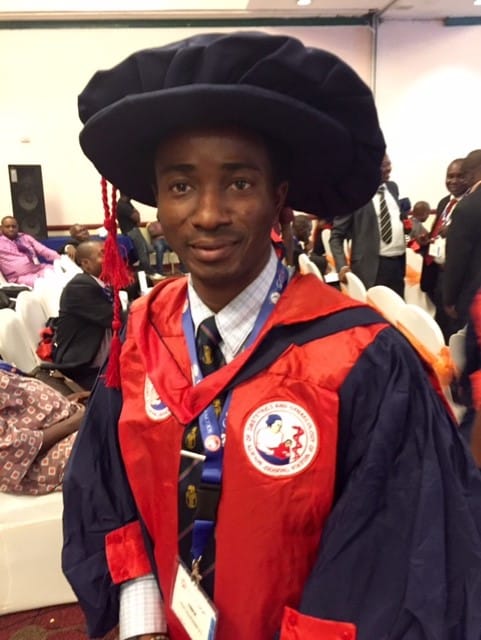
Dr. Oluseyi Olaboyede Atanda is a Consultant, Assisted Conception and Fertility Unit, Department of Obstetrics and Gynaecology, Ladoke Akintola University of Technology Teaching Hospital, Ogbomoso, Oyo
State.
Born an Ifa priest, baptized and ordained 30 years ago, Dr.
Atanda, is also Coordinator, Healing, Teaching and Tourism Temple of
African Faith International, Nigeria chapter, as well as
Secretary-General, Traditional Religion Worshippers Association, State
of Osun (TRWASO). The medical specialist, fondly referred to as Doctor Babalawo, spoke with BODE DUROJAIYE, on his biography, research and development of traditional medicine in Nigeria, as a tonic for development.
On Biography
Dr Oluseyi Olaboyede Adeyi Atanda was born on the 29th March, 1975 into the family of Jagun Oje-Ogidigba, Osogbo, Osun State. His father is Aare (Dr) Ifagbenusola Olalekan Atanda and mother is Chief Mrs. Folashade Atanda.
Dr Oluseyi was born in Lagos and attended Immaculate Heart
Comprehensive High School, Maryland, Lagos where he graduated in 1992.
He later graduated from Ladoke Akintola University of Technology
(LAUTECH), Ogbomoso as a medical doctor in 2003 as one of the best
graduating students. This earned him an automatic internship placement
at Lautech Teaching Hospital, Osogbo on merit.
During his university days, he also had a brief stint with student
leadership roles. He was the Senate President of Lautech Medical
Students Association in year 2000. He was also House officers’
Representative during his internship.
Seyi served in Nkwerre Local Government, Imo state in 2004/2005 as a
Medical Officer where he was also elected as the State President of
all Medical and Allied Health Graduates Community Development Service
(CDS) group. He also bagged an award from the then NYSC Director
General for his contribution to community service and exemplary
leadership roles.
Seyi’s quest for knowledge and excellence drove him to pursue his
postgraduate medical training in Obstetrics and Gynaecology
immediately after his national youth service year at Lautech Teaching
Hospital and subsequently qualified as a Fellow of The National
Postgraduate Medical College of Nigeria in the Faculty of Obstetrics
and Gynaecology in 2012.
During his years as a resident doctor, he was also involved in
leadership roles where he had served as P.R.O., Association of
Resident Doctors [ARD], Ladoke Akintola University of Technology
Teaching Hospital [LTH], Osogbo branch in 2008, Co-Chairman, ARD LTH
Caretaker Committee, 2011 and Foundation President, Association of
Resident Doctors, LTH Ogbomoso, 2011/2012.
Dr Atanda was appointed a Consultant in the Department of Obstetrics
and Gynaecology of Lautech Teaching Hospital, Ogbomoso where he works
till date. He has also travelled far and wide to garner more
experience to improve his medical practice.
He is a Fertility Specialist and Laparoscopic Surgeon, a member of
the Society of Gynaecologists and Obstetricians of Nigeria (SOGON) and
European Society of Human and Reproductive Endocrinology (ESHRE). He
is also a member of the Nigerian Medical Association (NMA).
Dr Atanda to his credit has various publications in both local and
international journals, for which some of his publications have won
best paper awards of the respective journals.
Oluseyi has always enjoyed giving back to the society and has been
involved in various community services either in his local community
of residence or to Osogbo and Osun state at large.
He is presently the Chairman of Osogbo-Asheville Sister Cities
Association (OASCA), a Non-Governmental organization affiliated to the
Sister Cities International (SCI) through Asheville Sister Cities
Incorporated (ASCI). This NGO has won various grants and undertaken
various projects in Osogbo, notably among the numerous is the
Reconstruction and Remodeling of Atelewo Primary Health Care Centre to
Atelewo Model Primary Health Care Centre with Emergency Obstetric
Services where Dr Atanda has also been volunteering his services as a
mentor since 2014 under the Volunteer Obstetrician Service scheme
(VOSS).
He has also facilitated various organizations and people relationship
between Osogbo and city of Asheville, NC, USA. and Xiangyang, Hubei
Province, China.
Recently, he led a team of 4 doctors to china on a 2-months training
in laparoscopy and has established a relationship between Lautech
Teaching Hospitals, Osogbo/Ogbomoso and No. 1 Peoples Hospital,
Xiangyang, China whereby there would be exchange of medical personnel
for training purposes.
Dr Oluseyi Atanda,a seasoned Ifa Priest is presently the Ajana Awo of
Osogbo, The Coordinator of HATTAF INTERNATIONAL (Ajo Aboruboye Agbaye)
and current Secretary General of Traditional Religion Worshippers
Association, State of Osun (TRWASO).
DR Atanda is also a fish farmer and aquaculture consultant with over
10 years experience. Despite his obviously tight schedule, he still
finds time to recreate as he enjoys walking, playing table tennis and
volley ball. Above all, he cherishes making people happy. He is a
lover of children.
Dr O.O.A. Atanda is happily married and blessed with children.
On Herbal Medicine
The 21st century is witnessing serious scientific effort to discover
major active ingredients in medicinal plants through research and
development (R and D). This perhaps may be sequel to the inability of
orthodox medicine to comprehensively address most disease conditions
plaguing mankind or it may be a response to the clarion call by the
World Health Organization that developing countries should endeavour
to develop and utilize local medications that are most appropriate to
their local circumstances especially for Primary Health Care (PHC) in
order to cut down on huge cost associated with incessant drug
importation. Technological Research and Development is the complex
process of activities aimed at acquiring new knowledge, improving new
engineering designs and functions and creating new products, all with
a view to some ultimate application. The results of most research
outputs from R and D are beginning to form the basis for measuring the
degree of industrial, technical and economic development of any
nation. Through technological R and D, countries of the Far East Asia
such as China, South Korea and India have been able to develop and
upgrade the quality of their herbal medicine. China for instance is
the World leading producer and exporter of herbal medicine. In 1993
the total sales of herbal medicine in China amounted to $2.5 billion.
In Japan, there was a 15 fold increase in herbal medicine sales when
compared to 2.5 fold increase of pharmaceutical products between 1974
and 1989. The countries of the Far East Asia have been able to meet
75% of their health care needs through the development and utilization
of herbal medicine and traditional medicine practice. Meanwhile, only
40% of herbal medicines consumed in Nigeria are produced locally and
the remaining 60% are imported from foreign countries. Again, the
commercial interest to mass produce herbal medicine through R and D
and make them available for local and international use is lacking and
it would probably take a longer time for this to improve and grow
significantly. In Nigeria, effort at local herbal medicine R and D is
yet to yield the desired benefits dueto lack of commitment, lack of
adequate infrastructural facilities, non-commercialization of most
research results despite huge budgetary allocation annually for
research and development. Others include low demand that constraints R
and D investment and problems faced by herbal medicine researchers.
Herbal medicine in the simplest form are medicines or drugs made from
herbs or plants and can be said to process several synonyms all of
which refer to plants as the raw materials for medicine namely,
phytomedicines, plant medicines, green medicines, traditional medicine
portions, traditional remedies plant drugs and forest health products
among others. The World Health Organization also defined herbal
medicine as finished labeled medicinal products that contain as active
ingredients aerial or underground parts of plants or other plant
materials or combinations thereof whether in crude juices, gums and
fatty oils and other substances of this nature. Herbal medicine may
contain standard excipients in addition to the active ingredients.
Medicines containing plant material combined with chemically defined
active substances including chemically defined isolated constituents
of plants are not considered to be herbal medicine. Exceptionally, in
some countries herbal medicine may also contain by tradition, natural
organic or inorganic active ingredients which are not or plant origin.
A Traditional Medical Practitioner (TMP) is as a person who is
recognized by the community in which he lives as competent to provide
health care by using vegetable, animal and/or mineral substances and
certain other methods based on the social, cultural and religious
background as well as the knowledge, attitudes and beliefs that are
prevalent in the community regarding physical, mental and social
well-being and the causation of diseases and disability. The
production techniques or processing of herbal medicine in Nigeria is
still largely antediluvian and therefore, benefit of the use of modern
technology. Hence, the current debate in academic circle on the
safety, efficacy and quality of herbal medicine. Before now, bare
hands were used to pick dirt and separate unwanted parts of plants
(Garbling) and grind herbs into powdery forms. These have been
replaced by special machines that help pick or sort the desired herbs
and mill them with the aid of hammer, knife or teeth mills.
On Traditional Knowledge
Endowed with a rich mix of human and natural resources, there are over
250 cultural groups and vast areas of tropical forest in Nigeria. This
country has had a long history of traditional knowledge based on plant
remedies. Passed down through generations of traditional health
practitioners [ THPs], it is estimated that such knowledge has served
eighty percent of the population’s healthcare needs, highlighting the
important role that it has played in the nation’s healthcare history.
THPs (and their knowledge), moreover, have not only been vital to
health outcomes (a result of a medical condition that affects lifespan
or quality of life) in Nigeria; they have also been the repositories
of an enormous amount of medicinal traditional know-how. Indeed,
approximately 4,000 traditional medicines have been found to exist
within this community. Such knowledge spans thousands of plant species
including Guinea grains (Aframomum melegueta; a spice used to treat
microbial infections), Ainslie (Langenaria breviflora; a fruit used as
a pain remedy by women in labor) and Garcinia Kola (a fruit-producing
forest tree that has provided medicines to treat throat infections).
ON IFA WORLDVIEW
As with most orthodox systems of religion, practitioners of Ifa embed
themselves in a complex system of tribal and cultural obligations,
which determine not only the view point of the practitioner regarding
external phenomenon, but also immutably affirms the connection between
human beings and the world around them. In parallel with Taoism,
education in Ifa creates an appreciation that the individual cannot be
removed from the matrix of relationships which extend beyond those of
humanity and the animal realm. Within this tribal system, the web of
influences of natural cycles of the day, season, and phase of life
surround the patient. Subtle influences from the plant world and
realms of sentient beings, which find their abode in the wind, the
earth, the sky, and other places, are accepted realities to the Ifa
herbalist and physician.Disease is primarily understood as a disorder
or misalignment of the internal or external milieu of the patient.
Part of the role of the physician is to align the patient with the
matrix of influences that will rebalance their particular disorder.
Sometimes also, a disorder develops as a result of losing or ignoring
a relationship with a matrix of influence.Utilizing non familiar forms
of diagnosis, such as divination and dream interpretation, in addition
to the traditional format of questioning, observation and touching,
the Ifa physician may use familiar techniques of dietary therapy,
psychotherapy, surgery, and herbal medicine, but may also perform
exorcisms, rituals, sacrifices and other procedures which seem more
the province of priests than physicians. In fact, Ifa physicians are
often priests, priestesses, or high priests, or belong to a guild-like
society hidden within tribal boundaries, completely secret to the
outside world. In Ifa communities, even obtaining an education in
medicine may require becoming an initiate of one of these societies.
Central to the tenets of Ifa is the necessity for practitioners to
establish a good relationship with the world that we inhabit. Ifa
practitioners have faith in a form of reincarnation where the
individual repeatedly returns, after death, to greet the earth, while
part of that individuals essence always resides in heaven as a
spiritual double.The Ifa concept of fair exchange means also that by
greeting the earth with good character, the natural world will welcome
us and support us. We will live in harmony with the seasons,
environment, and the other inhabitants of the earth. Clearly
understood also, is that if we disrespect our environment, abuse and
squander the gifts and blessings that we enjoy while on earth,
suffering will be the outcome. Living in an honorable path requires
that the practitioner develop specific attributes of good character
and moral behavior. This entails personal responsibility, a gentle
nature, and a humble disposition. That is why an Ifa priest is
different from an herbalist. If you look at various crimes being
committed daily in this country, you cannot find an Ifa priest among
the collaborators, except those who mixed orthodox religion with
traditional medicine, who are herbalists.
ON WAY FORWARD
West-Central Africa, including Nigeria, has one of the largest
equatorial forests on the continent. Rich in animal and plant species,
these forests have been a constant source of sustenance and
inspiration for a variety of traditional knowledge for the people in
the region. Since the 1850s, however, estimates have showed that
tropical forests in Africa had declined by at least 20 per cent. While
the global rate of arboreal decline has been about 0.6 percent, in
Nigeria the rate was 5 percent. Coupled to relatively high poverty
rates (US$2,300 per capita gross domestic product) in a country where
75 percent of the population are rural dwellers who rely heavily on
forest products (2009 estimates by the USA’s Department of State), the
case for intervention in Nigeria became apparent. Rich in animal and
plant species, including the Madagascan periwinkle, forests in West
Africa have provided inspiration for a variety of plant based
traditional medicines in support of the country’s environment. There
is urgent need to establish mechanisms to collate and publish data on
plant species in the country with a view to inform and influence
policy decisions. The data will allow policy makers (both in local and
central government) to make decisions over which species to cultivate
or protect as well s to devise regulatory strategies that protect the
environment and assist local economic development. According to the
World Health Organisation, over 33 percent of people in developing
countries had no regular access to basic essential medicines and, in
the poorest countries, over 50 percent of the population lacked access
to major healthcare providers. Because most of these people could not
afford drugs produced in developed countries, WHO had recognized the
potentially significant role that traditional medicines have played
and could play in primary healthcare outcomes in such regions. What is
therefore needed is an increase in policies and strategies to
streamline traditional medicine production in the developing world.
With more than 90 percent of malaria victims living in sub-Saharan
Africa, government must prioritize tropical disease research into
phytomedicines produced to high standards. Efforts must also be
intensified towards developing top grade traditional medicines that
are produced to the highest standards of ethics, efficacy and safety,
in collaboration with the National Traditional Medicine Board in
Nigeria. There must also be effective monitoring and standardization
strategies for Traditional Health Practitioners [THP], and their
medicines including the establishment of a code of ethics for
practitioners, as is the case in China. Under such a code, THPs will be expected to, for example, keep records of the treatments they provide and follow set procedures on a par with those established in Western or orthodox medicinal practice.