Hostilities in southern Lebanon eased on Monday following the announcement of a U.S.-Iran agreement aimed at de-escalating wider regional tensions, according to security sources and local officials.
Despite the relative calm, authorities cautioned displaced residents against returning home, as Israel maintained that its troops would remain deployed in parts of the region.
The conflict has had devastating consequences in Lebanon, which has been one of the hardest-hit spillover zones of the broader U.S.-Iran confrontation. Nearly 3,800 people have reportedly been killed, while an estimated 1.2 million residents have been displaced following Israeli military operations targeting the Iran-backed Hezbollah movement, which began firing on Israel in support of Tehran on March 2.
A diplomatic breakthrough was announced on Monday by Pakistan, which has played a mediating role between Washington and Tehran. The agreement reportedly calls for the “immediate and permanent cessation of military operations on all fronts, including Lebanon.”
Following the announcement, security sources in Lebanon and abroad confirmed a significant reduction in fighting across southern areas.
Hezbollah’s attacks on Israeli military positions in both southern Lebanon and northern Israel reportedly ceased shortly before midnight, although the group has yet to issue an official statement on the agreement.
Israel also scaled down its military operations, though sporadic artillery fire was reported in parts of southern Lebanon, and drones were observed over Beirut and surrounding areas.
Local municipal authorities in southern Lebanon urged displaced civilians to delay returning, citing ongoing security risks and unexploded tensions on the ground.
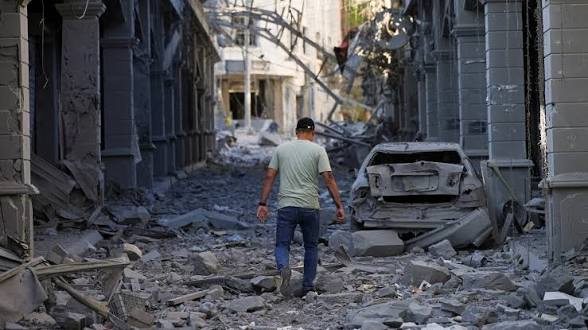
In recent months, Israeli airstrikes have heavily damaged several towns near the border, while some areas remain under Israeli military control.
A displaced resident, Mona Mazeh, currently sheltering in Beirut’s Hamra district, said she was uncertain about returning home.
“Frankly, we are hesitant; Israel cannot be trusted,” she said.
Israeli Defence Minister Israel Katz stated that Israel, which is not a party to the U.S.-Iran agreement, would maintain its security positions in Lebanon, Gaza, and Syria. He also warned of possible retaliation if Iran launched further attacks.
Katz added that so-called security zones in southern Lebanon would remain under Israeli control and claimed operations would continue to target what he described as militant infrastructure linked to Hezbollah.
Meanwhile, Israeli forces have continued demolishing structures in southern Lebanon, saying they are targeting Hezbollah positions allegedly embedded within civilian communities.
Hundreds of thousands of Lebanese Shi’ite residents remain displaced across other parts of the country.
In the city of Nabatieh, heavily damaged by months of fighting, resident Mohammed Daqdouq returned briefly to assess destruction in his neighbourhood.
“We’ll need a lifetime to rebuild – to restore what was lost and bring Nabatieh back to how it was,” he said.
Lebanese President Joseph Aoun issued a cautious response to the agreement, expressing appreciation for international efforts to reduce tensions and highlighting the importance of Lebanon’s stability.
He avoided directly naming Iran or Israel in his remarks but has previously accused Tehran of using Lebanon as leverage in broader diplomatic negotiations with Washington.
Speaker of Parliament Nabih Berri, a Hezbollah ally and leader of the Amal Movement, welcomed the agreement, saying it could help lay the foundation for regional stability, including in Lebanon.
He also thanked both Washington and Tehran for including a cessation of Israeli operations in Lebanon as part of the deal, describing it as a critical provision.
Iran, whose Revolutionary Guards helped establish Hezbollah in 1982, has long insisted that any broader agreement with the United States must include a ceasefire in Lebanon.