

Unless the Oyo State Government urgently addresses both the status and lingering salary problems of the Ladoke Akintola University Teaching Hospital (LAUTECH), Ogbomoso, the health institution may soon lose its highly skilled, well respected and revered staff to other institutions.
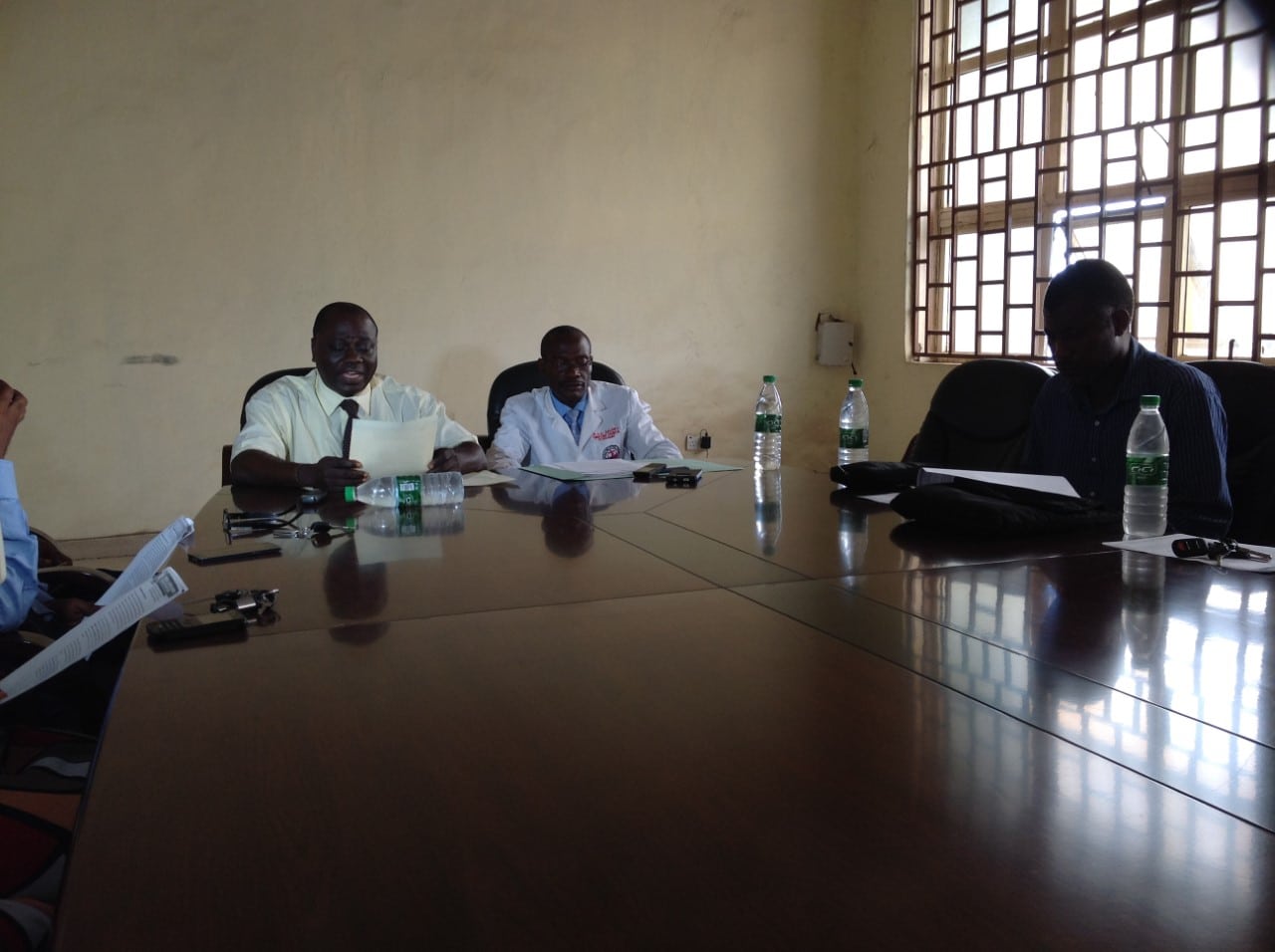
The Medical and Dental Consultants Association of the teaching hospital gave the warning at a media briefing in Ogbomoso.
It also cautioned the government to stop, forthwith, payment of 50 per cent to the staff, and pay without any further delay, arrears of 50 per cent salaries of January to April, as well as 100 per cent of May to November this year.
The N24 billion teaching hospital established by the previous
administration of Otunba Adebayo Alao-Akala became operational in 2011, when staff of the teaching hospital in Osogbo, Osun State, who are of Oyo State origin were directed to relocate as a result of Oyo State Government circular.
Government desire was to directly benefit from the immense number of
quality specialists in healthcare, and the need to fill the gap which
had existed in the provision of more readily quality tertiary
healthcare services to the people of the state, especially Oyo,
Ogbomoso and Oke-ogun areas.
However, five years after take-off of the teaching hospital, some key
equipment contracted are yet to be fully supplied, despite payments.
Many equipment that were procured and supplied in 2011 before the take off of the hospital are yet to be installed.
This, findings revealed is due to non-completion of ancillary
structures needed for their installations or functions.
Some of these equipments include the Magnetic Resonance Imaging
[MRI], Dental complex, patients’ elevator systems and the integrated
Information Technology systems, among others.
In his address, Chairman of the Association, Dr. Adewale Adeyemi, said despite obvious challenges, the hospital has grown exponentially in
the short through fiancial commitment of staff towards ensuring
survival and smooth running, as well fulfillment of aspiration of
government and the people of the state.
“The dedication and determination of all staff within less than five
years of existence, had resulted in ninety percent accreditations for
Postgraduate Medical Training, and had produced Specialist Medical
Consultants from among residents trained in the hospital. Th
performance of our resident doctors at various postgraduate
examinations has been highly commendable, and sometimes much better
than some of the more established training centres in the country”.
This, according to him, was I addition to accreditation of medicine
undergraduate programme withdrawn in 2010, increase in MBSS quota from
fifty to seventy-five students, mainly because of additional
facilities in the health institution.
On salary situation, Adeyem regretted that arrears of salaries are
being owed all categories of workers since January 2016.
Said he: “Oyo State Government has only paid fifty percent of January
to April 2016 salaries, and as at today, the eleven month, no other
salary has been paid. In fact, the first salary this year , which is
fifty percent of January salary, was received in August 2016.
Government owes the staff fifty percent balance of January to April,
and a hundred percent of May to November 2016. For clarity of purpose,
the last fifty percent salary which was intended to be April 2016
salary was paid in October 2016.”
The medical and dental consultants association chairman lamented that
while every category of workers in other health institutions in the
state were paid hundred percent of their salaries for January to April
this year, only LAUTECH Teaching Hospital was singled out for fifty
percent of salary payment.
LAUTECH Teaching Hospital, Ogbomoso, he noted, has erroneously been
categorized by government as a tertiary educational institution, and
charged with the responsibility to generate the fifty percent of its
monthly wage bill.
“The teaching hospital, for clarity and emphasis, does not own any
students, but rather facilitates trainings of students of College of
Health Sciences of the university, and does not charge or receive any
fee from either the students or university for these services”.
He added, “healthcare services are social services and this cannot be
commercialized, and no teaching hospital can change commensurate fees
for its service without pricing itself out of affordability of the
populace. There is no federal or state teaching hospital that
generates up to ten percent of their monthly wage bill. Teaching
hospitals are not tertiary educational institutions. A teaching
hospital serves as clinical laboratory to University ”.
Adeyemi hinted journalists that the teaching hospital took up the matter of misconception about its status with top government officials to no avail.
“Though government officials agreed in principle that the teaching hospital is not a tertiary educational institution, but insisted that
government would not pay a 100 per cent salary to staff of the
tertiary institution. This was corroborated by the state Commissioner
for Health, who told the management, during his visit to the teaching
hospital, to forget balance payment of its staff half salaries, as
government had made available what it could afford”.
On the key equipment yet to be supplied by the contractors,
Consultant, Paediatrics, Dr. Michael Olaniyan Onigbinde, one of the
pioneer staff of the teaching hospital, disclosed that most of the
contracts were awarded before resumption of the consultants.
“The amount of money collected by the contractors, Biostadt Medical Equipment Supplier, does not commensurate with the equipment supplied
to the teaching hospital. Though, about fifty-five percent of
equipment had so far been supplied, the remaining forty-five
percent equipment yet to be supplied by contractors are very vital
and critical to optimal service delivery of the teaching hospital.”
Onigbinde who earlier conducted journalists on facility tour of the
teaching hospital, informed that both the management and consultant
were mounting pressures on both the government and state house of
assembly towards taking stern decisions on the contractors for
defaults.
Investigation further showed that out of about eighty Consultants on
the payroll of the teaching hospital, ten have resigned their
appointments and re-absorbed into either federal government-owned
teaching hospitals or federal medical centres.
This is in addition to highly skilled health personnel who had also
left the tertiary health institution for what reliable sources
referred to as ‘punitive working conditions’.


LAUTECH: Going, going…Mass resignation of medical, dental consultants looms


Leave a Reply








Latest Stories







© 2026 Published by SWAAYA LIMITED, Plot 20, Block G, Scheme 1, Residential 3, OPIC Beachland Estate, Lagos/Ibadan Expressway, Lagos. Gabriel Akinadewo, MD/CEO 08023010222, 08094000056, 08052097814.