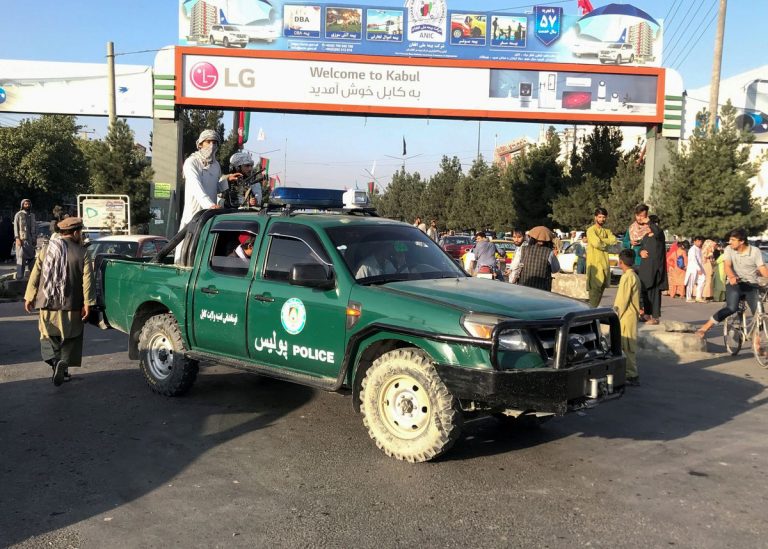
Some Kabul residents cautiously ventured back to work through quiet streets on Tuesday, fearful after a night broken by the sound of gunfire and facing questions from their new Taliban rulers who have set up checkpoints across the Afghan capital.
The Islamist Taliban, who stopped women from working and administered punishments including public stoning during their previous 1996-2001 rule, swept the country in days as U.S.-backed government forces melted away.
By Sunday evening, the Taliban had captured Kabul.
While the Taliban have pledged there will be no retribution against opponents and promised to respect the rights of women, minorities and foreigners, many Afghans are sceptical.
But they also know life must go on.
“I am scared but what made me open my shop is to feed my family,” 48-year-old grocery shopkeeper Mohammadullah told Reuters by phone.
“I don’t have any other way of income.
“If I don’t open my shop then how can I feed my family of 12?” he asked, adding that there were far fewer customers than usual.
Residents said the majority of shops and supermarkets in Kabul were shuttered and schools closed.
They said, however, that some small grocery shops and butchers were open, as were hospitals.
Traffic was light, but there were several pick-up trucks with mounted white flags that were carrying Taliban gunmen.
“It was with the nation supporting us that the Americans failed here, and the Islamic system is established,” a Taliban commander on the street, Mawlavi Haq Dost, said.
“This is a legal system and we assure our people whether they are Hazara, Tajik or Turk (minorities) that there won’t be any harassment from mujahideen to them,” he added.
Asadullah Wardak, who has worked as a doctor in Afghanistan for 12 years, said he decided to return to work after sitting at home for two days.
His children, who live in Canada, have urged him to leave, but he has opted to stay in Kabul where he works as a gynaecologist.
On his way to work at the Sana Medical Hospital, two Taliban men checked his car and his identity card.
He said they told him he was free to work and gave him phone numbers to call in case his hospital encountered problems with blood supplies or medicine shortages.
They also asked him to ensure women patients and female doctors work separately while male doctors are only allowed to see female patients in presence of another female doctor, he said.
Alberto Zanin, medical coordinator of an Italian medical charity in Kabul, said his hospital had treated several patients with gunshot wounds in the last 24 hours, some of whom were injured in the chaos at Kabul airport as hundreds of citizens tried to flee aboard diplomatic evacuation flights.
He said there was a lot of gunfire during the night and that the situation in the city remained tense, with armed Taliban soldiers stopping people at checkpoints close to his home.
“In the city, there is much less traffic, far fewer people out and about. People are worried,” he said.
Meanwhile, the runway at Kabul’s airport is free for take-off and landing again on Tuesday, after a day of confusion and crowds amid the Taliban takeover.
NATO’s representative in Afghanistan, Stefano Pontecorvo, said that evacuation efforts can resume.
“I see airplanes landing and taking off,’’ wrote Pontecorvo on his Twitter feed.
Flights had to be suspended on Monday amid chaos at the airport.
Masses of people have crowded the airport, which they saw as the only way to escape Afghanistan after Taliban forces took effective control of the country on Sunday.
The crowds, which included embassy staff, local hires, foreign nationals, and many who simply fear that the Taliban will impose a repressive Islamist rule, spilled out onto the runways on Monday.
The crowd made any plane that landed and making arrivals and departures impossible.
Images circulated online of planes full of Afghan refugees taking off after officials decided not to try to keep them out.
There were also reports of people fallen to their deaths after they lost their grips while clinging to the outside of departing planes.
But U.S. forces, which still control parts of the airport, were seeking to maintain order.
Both local U.S. representatives and U.S. President Joe Biden had warned of repercussions if the U.S. forces at the airport were targeted.
The Taliban ruled the bulk of Afghanistan for about five years at the end of the 20th century.
During that time, they enforced a strictly Islamist society, which meant most women were banned from public life and men could be punished for not displaying enough piety.
Perceived vices, such as alcohol and Western music were banned.
Although the Taliban said they would not be as strict after routing the Western-backed government in a lightning series of offensives in the last two weeks, few believed them and were not willing to take their chances under a renewed Taliban regime.
Some Western governments had vowed to try to bring home interpreters and other Afghan locals who have helped them.
“It is not clear if there is enough time or space to get them all out. Many people at the airport have no papers, so it’s impossible to tell most people’s status.’’
Furthermore, it’s impossible to tell if people seeking evacuation would be able to reach the airport.
CNN broadcast images of Taliban fighters setting up a perimeter around the airport, allegedly only allowing through people with valid travel documents.
According to the report, people are still trying to force their way in, but Taliban forces are working to push them back.
Multiple countries were seeking to pull out their nationals amid the uncertainty, though the chaos at the airport was making that difficult.
A German plane had to depart with only seven evacuees because of the breakdown in security.
India evacuated its embassy in Kabul early on Tuesday, with an Indian Air Force flight carrying 140 Indians, including the ambassador along with staff members and paramilitary guards, the state-run broadcaster Doordarshan reported.
Other countries were petitioning neighbours to try and help get their nationals out. Nepal has written to several governments for aid in evacuating its citizens, according to the Ministry of Foreign Affairs.
Around 1,500 Nepalis work in western missions and UN agencies, especially as security guards in western embassies in Kabul and UN bodies, with an unknown number working in other parts of Afghanistan, the government said.