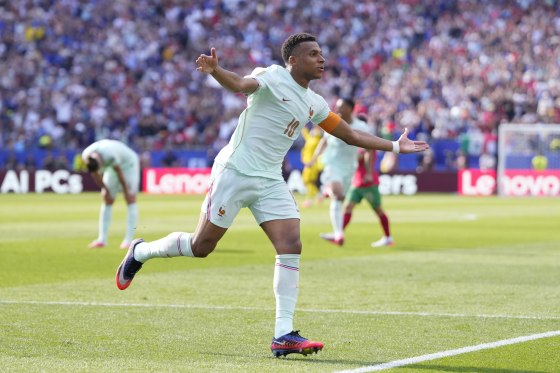
Africa’s unforgettable journey at the 2026 FIFA World Cup came to an end on Thursday as Les Bleus of France, inspired by Kylian Mbappé and Ousmane Dembélé, defeated Morocco 2-0 to book their place in the semifinals.
Morocco, Africa’s sole remaining representative, began brightly with Brahim Díaz orchestrating several dangerous attacks that briefly unsettled the French backline. However, the Atlas Lions were unable to convert their promising first-half play into goals.
After the interval, France demonstrated why many regard them as the tournament’s most complete team, taking firm control of possession and dictating the tempo. Mbappé broke the deadlock before Dembélé doubled the advantage just minutes later, extinguishing Morocco’s hopes and sealing another clinical French performance.
Morocco’s elimination also brought the curtain down on Africa’s unprecedented 2026 FIFA World Cup campaign, which saw 10 African nations reach the tournament and an extraordinary nine progress to the knockout rounds—a landmark achievement for the continent.
Yet despite the historic progress, the tournament also exposed a recurring weakness, with several African teams surrendering winning positions or conceding decisive late goals in what many observers have dubbed the “86th-minute curse.” Addressing game management, tactical discipline and mental resilience in the closing stages of matches will be vital if Africa is to take the next step toward producing a World Cup champion. Nevertheless, the future of African football has never looked brighter. With a new generation of talent emerging across the continent, attention now turns to the 2027 Africa Cup of Nations, to be jointly hosted by Kenya, Uganda and Tanzania, where many of these stars will once again showcase the remarkable progress of African football.