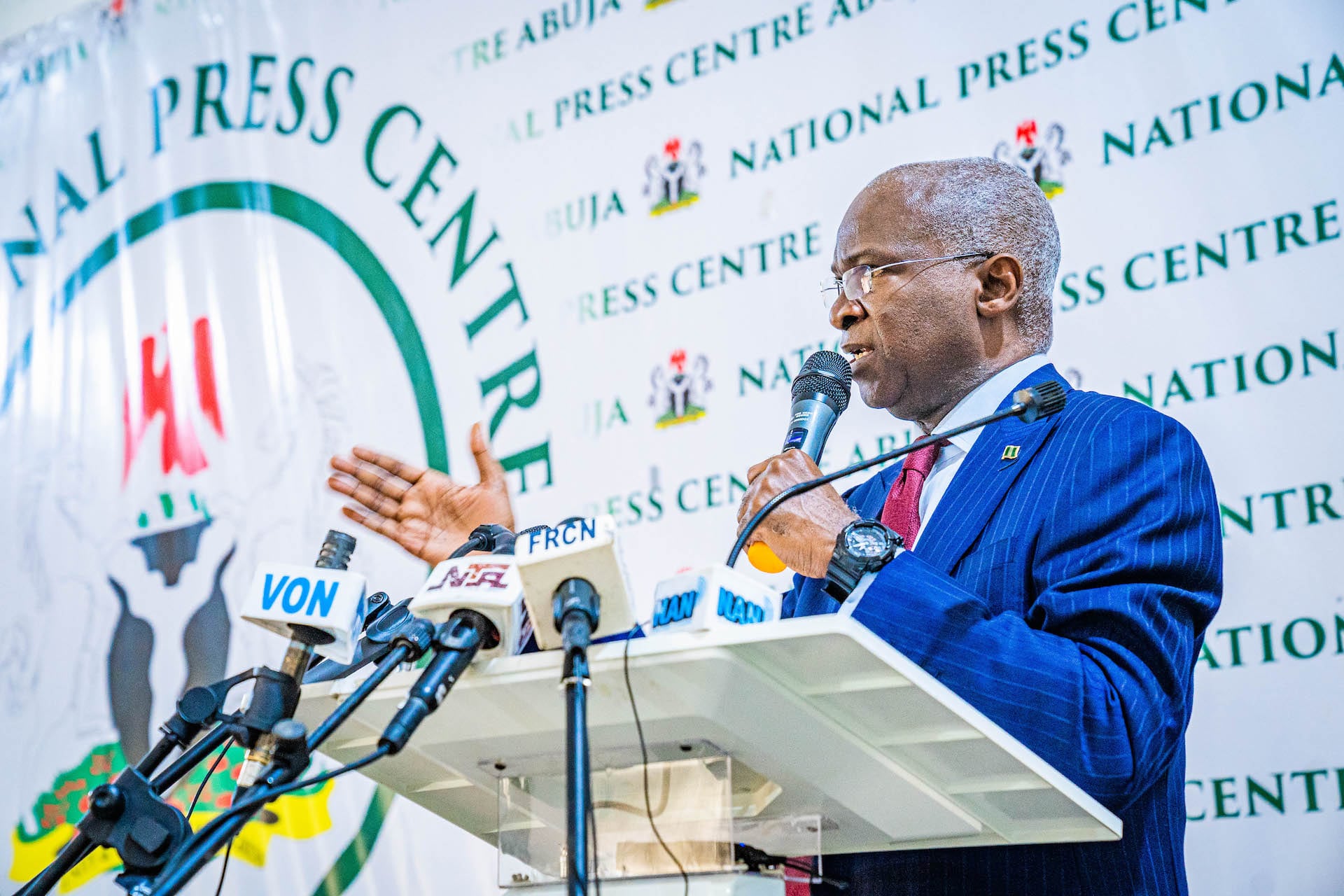
“AN INTEGRATED WEST AFRICAN TRANSPORT AND INFRASTRUCTURE – HISTORY, POTENTIALS AND FEASIBILITY” REMARKS BY BABATUNDE RAJI FASHOLA, SAN AT THE CONVERSATIONS SERIES 3 BY SEGUN ODEGBAMI AT THE NIIA, VICTORIA ISLAND, LAGOS ON THURSDAY, DECEMBER 15, 2022.
In 1971, United Nations Economic Commission for Africa (UNECA) established the Bureau to develop the Trans African Highway (TAH) Network in collaboration with the African Development Bank.
The project comprises of 9 (NINE) major highways that connect all parts of Africa in a grid type connectivity on a North-South and East-West basis.
The total length of the roads is 56,683 KM.
Three of those highways, namely, the Algiers-Lagos (4,504 KM) TAH 2; the Dakar-Lagos (4,010 KM) TAH 7 and the Lagos-Mombasa (10,270 KM) TAH 8 connects Nigeria with other parts of West Africa, and the continent at large.
Probably known and unknown to large sections of the Nigerian public, these highways have either been built before and falling into disrepair, or are being rebuilt or just being built for the first time.
The investment of the Buhari administration in infrastructure, particularly roads and bridges are not just national investments, they have international consequences because they facilitate connectivity between many parts of Nigeria, and beyond Nigeria.
On November 3rd 2022 President Buhari commissioned the Ekok-Mfum Bridge and approach roads linking Nigeria with the Republic of Cameroon.
The approach to the road and bridge is from Enugu and Abakiliki, and for those who do not know, the Second Niger Bridge is not just a bridge to the East of Nigeria, but an alternative to the old bridge to facilitate access to Enugu from Asaba to Onitsha and onwards to Enugu.
On Friday, 9 December 2022, I was in Togo Republic in the capital of Lomé, where I represented Nigeria as Chairman of the steering committee of ministers for Roads, Infrastructure and Transport from the Republics of Côte d’Ivoire, Ghana, Togo and Benin.
Our mandate from the Presidents of the 5 (Five) countries is to facilitate the completion of the design, financing and construction of the Lagos-Abidjan highway (1,028 kilometres), which is a part of the Dakar-Senegal, (TAH 7) Highway.
It must be made clear that the work being done on Lagos-Ibadan, Oyo- Ogbomosho, Ilorin – Jebba, Sokoto – Tambuwal, Jega-Yauri, Abuja to Kano are not just stand alones, but part of a larger international and Transcontinental road transport connectivity.
Therefore, when our government announced that a part of our national rail network was going to link to the Niger Republic, and there was some outcry, I believe it must have been driven by those who are unaware that transport facilities are not ends in themselves but instead means to larger national and international purposes.
Human beings need to connect, to interact, to exchange, and to share, and this happens through business, sports, tourism, and many more undertakings. It is the global Sea, Air, land and water transportation network that makes this possible.
Sports and tourism, especially are about destinations first, before the economic side kicks in, and if you cannot get there, you lose, not only the sporting and tourism, but also the value chain and trickle-down economic benefits, which are almost unquantifiable.
The benefits are themselves the subject of a whole debate and discussion outside of the 20 minutes allocated to me.
But beyond roads and bridges, the Buhari government is investing in broadband connectivity, and I can share examples of the Kano-Maiduguri, 560 km highway and the Abuja-Makurdi 220 km Highway whose ducting is part of the construction to make them Broadband ready without the need for digging on completion.
The new Lekki Seaport, the five major airport expansion and completion in Lagos, Abuja, Enugu, Port Harcourt, and Kano and the Lagos to Kano Maradi Rail are examples of the infrastructure readiness of our country.
The Blue and Red Rail Lines in Lagos State as well as the Abuja intra-city rail that are at various stages of completion are examples of subnational transport infrastructure readiness.
I am the first to acknowledge that the work is not finished, but while the construction is going on, this is the time to start Thinking.
My first thought is what we do with the infrastructure after we finish building them.
Yes, the construction will generate jobs for construction companies, subcontractors and suppliers; artisans, and skilled labour, as it is already doing, but this will not last forever.
President Muhammadu Buhari also understands this and he has signed Executive Order Number 11 of 2022 to make maintenance obligatory and optimize the economy of maintenance which we used to call a culture.
This thought about what to do with infrastructure led me only in one direction – we must connect the Roads, Rail and Bridges to centres of human activity and destinations which we must consciously design and create.
So, on 18 December 2019, I wrote a letter to 7 (SEVEN) state Governors, titled “Housing development along the Lagos – Kano Rail track.”
This is what I said:
“I write to solicit your Interest and support in respect of the housing development along the Lagos-Kano rail track·.
As you are aware, the Federal Government, through the Federal Ministry of Transportation has committed to the revival of Passenger and cargo Rail Transport Development.
In order to maximize the Investments that have been made and those still to come, I have suggested, and the Honourable Minister of Transportation has agreed that global best practice Is to ensure that housing developments are encouraged to evolve in a sustainable way dose to and around major stations along the rail corridor.
Therefore, as the custodians of land under the Land Use Act, and the focal Government for urban planning and development control, I am requesting that you exercise your powers to:
(a) acquire vast tracts of land 20-50 Hectares or more within 2- 5 km of each Rail Station that traverses your State; and
(b) direct your Town Planning and Urban Development Departments to develop master plans for Residential, Recreational, Commercial, Education, Industrial and other uses to control development and avoid re-emergence slums.
Once this ls done, the Federal Ministry of Works and Housing can take up some of the land, as you may decide to allocate, for Housing Construction, Site · and Services Development, while the State Government can develop what is not allocated, sell some as it pleases or engage partnerships at its discretion, for the development
Without prejudice to your decision as to how your State Government elects to proceed, the main purpose of this letter Is to elicit your interest to the opportunities that exist for housing development along the Rail corridor, in the hope that you will embark on housing development around It and create employment opportunities that housing construction stimulates.
The long-term benefits of this approach will maximize the Rail Transportation Infrastructure, ensure that people live dose to a Transport asset, and ensure that the development around the Rail Corridor (which will happen in any event) is controlled and sustainable.
Should you find this suggestion to your liking and consistent with your State’s Development Agenda, kindly revert and advise how we can collaborate to achieve this.
You may wish to accord this request the required priority, please.”
At the time, I was thinking about how to revive the national football league in the hope that small stadia of 10 to 30,000 people can be integrated into the centre of those Housing estates.
I was also thinking of the giant strides made in Nollywood and music and the absence of purpose-built concert arenas to maximize their talent and grow the industry.
This is for me an appropriate background to the conversation that Chief Segun Odegbami has invited us to have.
Obviously, he has identified all the moving parts, one of which is infrastructure.
Bidding to host, local, and global events puts to the test not only what we have done, but what we can do to improve on what we have done.
As a former Governor, I can tell you the benefits to Lagos when we hosted the FIFA under 17 World Cup in 2010 and the National Sports festival in 2012.
China opened herself to the world after building infrastructure by bidding for and hosting the Olympics in 2008. London was upgraded and so was the quality of life and economic prosperity with the hosting of the 2012 London Olympics. South Africa’s rail, telecoms, and other infrastructure benefited from hosting the 2010 World Cup.
I was in Mumbai when they were preparing to host the 2010 Commonwealth Games.
The examples are legion, and for those who are in Qatar, a tiny nation has not only opened herself to the world, and she is projecting herself on a global stage. The benefits of the 2022 World Cup are now hers to harvest or throw away.
I am able to also report that in the current national development plans, Sports is now one of the economic drivers rather than just recreation and a hobby.
With the policy now in place, the economic benefits must begin to converge. For example, with our success in fashion, why are our Super Eagles still wearing foreign designs? Why can we not convene a local design competition to produce a new Jersey for the Super Eagles?
Why can we not decide that our athletes wear Nigerian designs?
When ‘Big Seg,’ as Chief Odegbami is fondly called, floated the idea of Nigeria hosting a World Cup many years ago, many dismissed him as daydreaming. But not enough know his mind, mindset and state of mind.
A dream it may be, but dreams are the foundations of many realities.
Our nation must be thankful for this big idea. We must recognise its potentials and see beyond the messenger.
The message is deep and only the deep can hear it.
International sports and entertainment is not just big business and jobs for young people, it is the new global power with which to influence and shape not only global policies but the global economy.
That is the stage where National Anthems are rendered with National Flags and colours displayed to the pride and admiration of patriots and perhaps the envy of competitors.
A bid to host the World Cup by Nigeria alone or along with other West African Nations must be led by Nigeria.
The challenges of launching a successful bid are enormous enough but they are nothing compared to the actual hosting.
The undertaking itself, whether successful or not, will challenge our organizational, planning and execution capacity as a people and a nation.
Either way we cannot lose because we will only get better. The world will not lower the standards, rather they will challenge and support us to meet them.
I vote for Nigeria to venture and to lead the bid for a major global sporting event.
Thank you.
Babatunde Raji Fashola, SAN
Honourable Minister of Works and Housing