

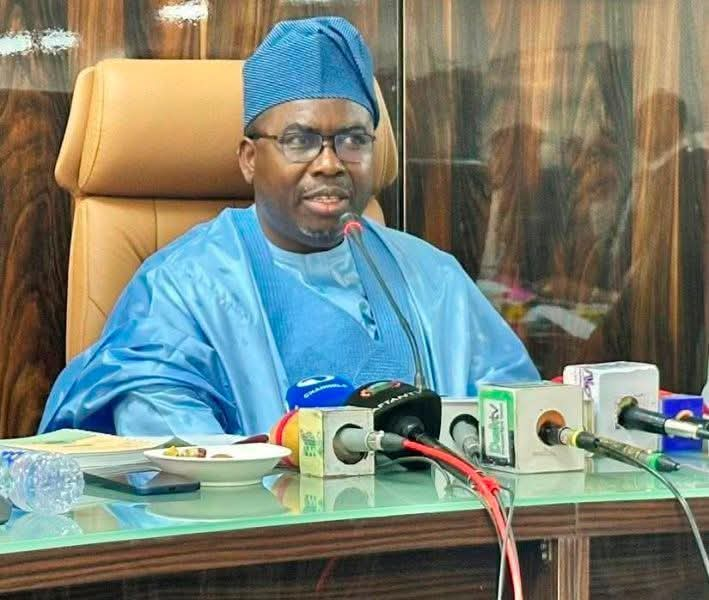
Every chairman of the Federal Electoral Commission (FEDECO) or National Electoral Commission (NEC), now Independent National Electoral Commission (INEC) has always been accused of partisanship.
Some of them, if not all, left the office in frustration. Some of them have been accused of compromising their office and that they are not neutral. That they are agents, disciples or henchmen of the ruling party.
That has been part of our political history.
This was the reason why the former Ondo state Chief Judge and first Nigeria Director of Law School, Honourable Justice Olakunle Orojo CFR (16 February, 1923 – 3 July, 2009) from Arigidi in Akoko North West local government area of Ondo state, rejected the job after it was announced by General Ibrahim Babangida (85) GCFR to replace Professor Humphrey Nwosu (2 October 1941 – 20 October 2024) in 1993.
One needs to read the 392-page book of Professor Humphrey Nwosu titled “LAYING THE FOUNDATION FOR NIGERIA’S DEMOCRACY:MY ACCOUNT OF JUNE 12, 1993 PRESIDENTIAL ELECTIONS AND ITS ANNULMENT”. His close friend, Mr. Fab Uche, who is equally close to me, is never tired of telling me the humiliation Professor Nwosu faced as Chairman of the electoral body during and after his tenure till he died in the United States of America on October 24, 2024.
Professor Nwosu’s laudable efforts ended in annulment of the election, the consequences of which we are still enduring till today.
The process for the selection of INEC Chairman is wrong and it gives room for suspicion.
In English, we have the saying that “He who pays the piper calls the tune,” which means that the person that pays for something decides on what happens to that something”. In Hebrew, it says, “the man who controls the riches is the man who controls the judgement”. A French version says “Celui, qui tient les rênes, tourne la tête.” He who holds the reins, turns the head.
Salman Iqbal, an author wrote, “He with the big stick has got to be the owner of the she-bufalo!”
Past Chairmen of INEC felt that they owe their appointments to the man who appointed them.
Section 50 of the 1963 Constitution says “(1) There shall be an Electoral Commission for the Federation (2) The members of the Electoral Commission of the Federation shall be—(a) a Chief Electoral Commissioner, who shall be chairmen; and (b) a member representing each territory. (3) The members of the Electoral Commission of the Federation shall be appointed by the President, acting in accordance with the advice of the Prime Minister. (4) Before tendering any advice for the purposes of this section in relation to the appointment of the member of the Electoral Commission of the Federation representing a Region, the Prime Minister shalil consult the Premier of that Region. (5) A person shall not be qualified to hold office as a member of the Electoral Commission of the Federation if he is a member of either House of Parliament, a member of a legislative house of a Region, a Minister of the Government of the Federation, a Minister of the Government of a Region or a member of the public service of the Federation or the public service of a Region.
Section C third schedule of the 1979 Constitution says, “The Federal Electoral Commission shall comprise the following members, namely—- (a) a Chairman, who shall be appointed from among members specified in sub-paragraphs (b) and (c) of the paragraph; (b) one member from each of the States of the Federation; (c) not more than 5 additional members who shall be appointed on their merit.
The Section gave the President the power to appoint members of the Commission including the Chairman.
Section 153 of the 1999 Constitution equally gives the President the power to appoint the Chairman and members of INEC. Sub section 3 of Section 154 of the Constitution states “In exercising his powers to appoint a person as Chairman or member of the Independent National Electoral Commission, National Judicial Council, the Federal Judicial Council Service Commission or the National Population Commission, the President must consult the Council of State”.
We have to devise means and ways to appoint the members of INEC in a way that does not make them suspects.
I want to limit myself to the fate of the four pioneers of the electoral body.
The Past chairmen of the electoral body were Mr Roland Edward Wraith (1958-1963), Sir Kofoworola Adekunle Abayomi (1963-1964), Chief Eyo Esua (1964–1966), Chief Michael Ani (1976–1979), Justice Victor Ovie-Whiskey (1980–1983), Professor Eme Awa (1987–1989), Professor Humphrey Nwosu (1989–1993), Professor Okon Uya (1993, June-November), Chief Sumner Dagogo-Jack (1994–1998), Justice Ephraim Akpata (1998–2000), Sir Abel Guobadia (2000–2005), Professor Maurice Iwu (2005–2010), Professor Attahiru Jega (2010–2015), Professor Mahmood Yakubu (2015-2025) and Professor Joash Ojo Amupitan (SAN)—2025 till date.
Professor Joash Amupitan hails from Ayetoro gbede in Ijumu Local Government Area of Kogi state.
If we are to judge Ayetoro gbede by the likes of Senator Dino Melaye, what of notables like Major General (rtd) David Medayese Jemibewon (86), Shola Ameobi, who once played for Newcastle United football club in the English Premiership, John Obaro, founder Systemspecs and others.
I first visited Ayetoro gbede in 1975 when it was part of Kwara state. I was there for the grand reception by the people of Ayetoro gbede in honour of Colonel Jemibewon who was appointed the Military Governor of Western state to replace Captain Akintunde Aduwo (86). I was then the Western state Editor of Kwara state owned THE NIGERIAN HERALD reporting from Ibadan.
The people of Ijumu have passion for Education. They are intrepid and doughty. They are fearless. I have in mind the likes of Chief Bayo Ojo, SAN, CON; Senator Smart Adeyemi, Lt. General(rtd.) Rufus Modupe Kupolati, Lt. General(rtd.) Joseph Olorungbon Owonibi, Major General(rtd) Funso Samson Owonibi, Mrs Folashade Yemi-Esan, Dapo Olorunyomi, CON, Mr. Eniola Bello, Gbenga Ogunleye, Prince Olushola Akanmode, Mr. Tunde Ipinmisho, S. A. Ajayi, Professor Yemi Akinwumi, Professor Gbenga Ibileye, Honourable Abiodun JamesFaleke, Barrister Ayo Abraham Olorunfemi and so many others.
Coincidentally an Ijumu illustrious Professor is to conduct our coming general elections. Those who love Nigeria must wish Professor Joash Ojo Amupitan the best of luck.
After the Constitutional conference in London, it was agreed that an electoral body be established for 1959 and other elections. Mr. Roland Edward Wraith was therefore appointed to head the body. Other members of the commission were Alhaji Bello Dan Amar, Mr. Anthony Aniagolu, Mr. H. Orisejolomi Thomas, Mr. K.A. Bohu and Mr. M. A. Sho-Silva. Mr. Orisejolomi Thomas, later resigned to go back to academics which was his calling and was replaced by Prince Peter Akenzua.
Mr. Ronald Edwards Wraith was born 1908 in Derby, Derbyshire, England. He was a British scholar and public administrator specializing in colonial and post-colonial governance in Africa. Mr. Wraith authored influential studies on local government systems in West Africa, including examinations of structures in Nigeria, Ghana, and Sierra Leone, and co-wrote Corruption in Developing Countries (1963) with Edgar Simpkins, analyzing administrative challenges and graft in emerging nations. His works emphasized practical reforms to build effective institutions amid decolonization, drawing from direct experience in British colonial service.
His tenure, which extended until 1960, focused on establishing impartial mechanisms for voters’ registration and election conduct amid Nigeria’s diverse ethnic and regional divisions. Mr. Wraith, drawing from his prior administrative experience in colonial service, prioritized logistical preparations, including the compilation of electoral rolls across Nigeria’s expansive territory, where infrastructure limitations posed significant hurdles such as inadequate transportation and communication networks.
Under Mr. Wraith’s leadership, the ECN organized the 1958 regional elections, which served as a precursor to federal polls, achieving widespread voter registration despite challenges like low literacy rates and geographic isolation in rural areas. The subsequent 1959 federal elections, held on December 12, saw the Northern People’s Congress secure 134 seats in the 312-member House of Representatives, forming a coalition government with the National Council of Nigeria and the Cameroons.
Voter’s participation reached approximately 79.5%, reflecting effective mobilization efforts, though ethnic-based campaigning intensified regional rivalries. Wraith’s commission addressed logistical issues by deploying polling stations in remote locations and training local staff, enabling the process to proceed without widespread disruption despite predictions of potential violence. The outcomes of these elections contributed to short-term political stability, paving the way for Nigeria’s independence on October 1, 1960, with Alhaji Abubakar Tafawa Balewa appointed as Prime Minister.
Success metrics included the acceptance of results by major parties, minimal reported irregularities in vote counting, and the establishment of a precedent for federal oversight of polls. However, persistent ethnic tensions, evident in the uneven regional vote distributions—such as the Northern People’s Congress dominating the North while the Action Group prevailed in the West—foreshadowed future instability, including the 1964 election crises that undermined the nascent democratic framework. Wraith’s role emphasized procedural integrity over partisan influence, though critics later noted that structural ethnic imbalances limited long-term cohesion.
By 1963, there was agitation for a Nigerian to be appointed to head the body. Nigerianisation became the key word. So, Alhaji Tafawa Balewa’s friend, Dr. Moses Adekoyejo Majekodunmi (17 August 1916 – 11 April 2012) a pioneering Obstetrician, Gynaecologist, Administrator, and Politician who served as Federal Minister of Health from 1961 to 1966 and as Administrator of the Western Region in 1962, introduced his friend, Sir Kofo Abayomi to replace Mr. Wraith, who resigned his appointment in frustration. Thereafter, Mr. Wraith went back to England and Sir Kofo Abayomi was appointed chairman of the electoral body.
Sir Kofo Adekunle Abayomi was a doctor and politician born on 10 July 1896 in Lagos. He attended the UNA School and then, from 1909, the Wesleyan College (now Methodist Boys’ High School) in Lagos, where he became a pupil teacher, on completion in 1912. He later transferred to a similar job at the Eko Boys’ School. He joined the civil service as a government dispenser in 1914, working first at the African Hospital in Lagos. A few months later, when the First World War broke out, he worked as a dispenser with the Nigerians Forces which fought for the British in the Cameroons Campaign. He was decorated for this service.
In 1922, he went to Edinburgh University, where several other West African doctors had already qualified, to study medicine. He completed those studies at Moorfields Eye Hospital, London, and specialized as an Ophthalmologist. He won the M.B. and Ch.B. of Edinburgh in 1928, and the M.D. in 1936. From 1928 to 1930 he was demonstrator in Physiological Methods at Edinburgh.
Returning to Nigeria in 1930, he combined private medical practice with politics. In 1938, he took over from the deceased Dr. J.C. Vaughn the presidency of the Nigeria Youth Movement (NYM) which he had joined on its foundation as the Lagos Youth Movement in 1933. Also, in 1938 he was elected to the Legislative Council as an NYM member for Lagos. He served for two years but resigned in 1940 to go to Britain for further studies.
In 1958, Sir Kofoworola Adekunle Abayomi was appointed Chairman of the Lagos Executive Development Board, which had authority to demolish unsanitary buildings and undertake town planning schemes. The board was also involved in freehold housing and estate development in Surulere, North East and South West Ikoyi reclamation schemes and up to one thousand acres reclaimed in Victoria Island.
Sir Abayomi became the first Nigerian Chairman of the Board of the University College Hospital, Ibadan in 1958, a position he held until 1965. In 1959, he was chairman of the Board of Management of the Lagos University Teaching Hospital in Lagos. He served on the board or as chairman of several companies for the rest of his life.
By 1964, at the age of 68, it became clearer that Sir Abayomi was too old to function as the chairman of the electoral body. He spent less than a year in office, but conducted the Mid-West House of Assembly election in 1964. He too resigned in frustration.
Following his resignation as the Chairman of the Federal Electoral Commission (FEC),the Electoral Body at that time, the then Prime Minister, Alhaji Tafawa Balewa replaced him with Chief Eyo Ita Esua (14 January 1901 – 6 December 1973).
Chief Esua was a school master and a founder member of the Nigeria Union of Teachers. He was the first full-time general secretary of the union from 1943 until his retirement in 1964. He was an Efik, Calabar man, renowned for his dedication to duty and uprightness.
The Esua-led commission organized the December 1964 elections, which was mired in controversy. Two members of the commission, Mr. Anthony Aniagolu from Eastern Region and Prince Peter Akenzua from Mid-Western Region, disagreed with the chairman and resigned from the commission. Prince Akenzua later served as Vice-President the Legal Aid Council under Chief Timothy Chimezie Ikeazor SAN (1930-October 12, 2012), the Oboli Obosi from Anambra state. As for Mr. Anthony Nnaemezie Christopher Aniagolu (October 22, 1922- June 28, 2011), he later served as Chief Judge of Anambra State from 1976 to 1978 and was a justice of the Supreme Court from 1978 to 1987. In 1988, he chaired a Constituent Assembly to propose a draft constitution for the Third Republic.
Chief Esua also conducted the 1965 Western Region elections, which was violent and was disputed by the opposition United Party Grand Alliance. A few days before these elections Chief Esua acknowledged that his organisation could not guarantee a free and fair poll. The widespread electoral abuses may have been a factor in the success of the military coup of January 1966 in which Major General Johnson Aguiyi-Ironsi came to power.
The major task Chief Esua faced as the chairman of the electoral commission was delimitation of constituencies. By mid July 1964, the Commission announced far reaching changes in the numbers of Federal members representing each administrative division. These changes were presumably based on the figures of the 1963 population census, still to be published in details. The main changes showed the North reduced from 1974 to 1967, the East reduced from 73 to 70, the Mid West from 15 to 14, the West increased from 47-57, and Lagos 2 to 3. Among changes in the West, Osun division was increased from 9 to 12, Ekiti from 3 to 8; in the East, Brass, Calabar and Degema were increased from 1 to 2 each, and Eket was increased from 2 to 4. In the North, Kano (31) and Sokoto (21) were increased by one.
In August, during the Northern Nigeria tour of the Commission, Mr. Esua, chairman and the leader of the delimitation committee said that to divide Nigeria into 312 constituencies was an exclusive prerogative of the Federal Government, and that the figures of the recent census were the basis of delimitation. Each constituency was based on a population quota 178,000.
In 1965, the Federal Electoral Commission under Chief Esua held a sham election in Western Region. Chief Esua was forced to resign in frustration on December 15, 1965 and was replaced by Chief Michael Ani on December 16, 1965 by the then Prime Minister, Alhaji Tafawa Balewa. Chief Esua wrote in his memoirs, before he died during which he expressed his frustration. The memoirs are with his children and grandchildren in the ancient city of Calabar.
The military came in on January 16, 1966, so there was no election thereafter and no need for an electoral commission.
On November 15, 1976, the then Head of State, General Olusegun Obasanjo GCFR, inaugurated the Federal Electoral Commission at the Nigeria Institute of International Affairs, Victoria Island, Lagos. The twenty-four members included four women and headed by Chief Michael Ani. The four women were Mrs Yetunde Gbadebo, Mrs Elizabeth Pam, Mrs Hassan Iro and Mrs Ethel Onwu. It was the second time Chief Ani would head that body.
Speaking on Chief Ani on Wednesday July 26, 1989 at Calabar, the former Secretary to the Government of the Federation, Chief Allison Akene Ayida (June 16, 1930- October 12, 2018) narrated the circumstances that led to Chief Ani being reappointed as the Chairman of the electoral body “We are here to honour a man who spent the better part of his life defending the integrity of the public service as the Permanent Secretary, Federal Ministry of Establishments and Service Matter (Personnel Management to the new generation), and Member of the Federal Public Service Commission. He is better known in Calabar as the Administrator for the Liberated Areas of South-Eastern State during the civil war, and the Founding Father of the South-Eastern State Civil Service as its first Secretary to the Military Government and Head of Service. He attained international Civil Service Commission in 1974, having previously served on the UN Panel of Experts on Public Administration for setting up the proposed Federal Service for Uganda, Kenya and Tanzania in 1963.
When I was appointed to act as Permanent Secretary to the Federal Ministry of Economic Development, in 1963, I was the youngest permanent secretary in the Federation. It was part of an experiment to try out the then then new breed in the civil services as PermSecs. I had to look up to senior colleagues such as the late Chief Ani for guidance and leadership. We received their full co-operation. If the experiment succeeded, it was due partly to Chief Ani’s fatherly guidance and support.
It is not generally known that Chief Ani retired prematurely from the Federal Civil Service in 1965 to accept the challenge of the late Prime Minister, Sir Abubakar Tafawa Balewa, for him to be appointed the Chairman of the Federal Electoral Commission. I was one of those people he consulted and I advised against the move. But Chief Ani decided to accept the appointment for two reasons: first, as a good civil servant he felt obliged to respect the Prime Minister’s wishes and, second, he was anxious to demonstrate that Nigerian elections could be conducted fairly and justly without fear or favour. Before he could demonstrate this, the Military seized power on 15 January 1966 and Chief Ani suddenly became unemployed pensioner at the tender age of 49 years, judging by the standard of those days!
But an act of providence, when the Obasanjo administration was, in 1976, conducting the search for a suitable person to head the Federal Electoral Commission to supervise the elections for the return to civil rule in 1979, I was the Secretary to the Federal Military Government and Head of Service. When consulted, I advised that the man the Prime Minister appointed in December 1965, never functioned and was untainted. But told General Obasanjo that the late Chief as a good civil servant, might not be sufficiently independent of the Government to be seen to conduct the elections fairly and that the FMG might be seen to have a preference for one of the Presidential candidates. The General, to my surprise, replied, “that is the man we want.”
When Chief Ani was approached, he came to my house to seek my opinion once gain as a trusted friend. I told him candidly what transpired between General Obasanjo and me and once again, I advised him against the reappointment as Chairman of FEDECO but he still saw it as a challenge and an opportunity to establish that Nigerians could conduct an impartial and fair democratic election. The rest of the story is better left to the verdict of history but I believe the Chief did his best in the difficult circumstances of the countervailing powers and conflicting instructions on the 1979 elections. No wonder all the honours followed— New Nigerians Newspaper’s “Man of the Year 1977” and “Commander of the Federal Republic” (CFR) in 1978”.
However, the two major issues which FEDECO under Chief Michael Ani faced were the tax issue of the Presidential candidates of the five parties before the 1979 elections and the issue of 12 2/3 of nineteen states.
On April 21, 1979, under the heading Zik and Aminu Out: ‘Tax papers not in order’ THE NEW NIGERIA published that Dr. Nnamdi Azikiwe, Presidential candidate of the Nigerian People’s Party (NPP), was completely out of the presidential race.
Also out was Alhaji Aminu Kano, Presidential candidate of the People’s Redemption Party (PRP).
This was because the Federal Electoral Commission (FEDECO) confirmed in Lagos that the two presidential candidates did not pay their taxes as they were due. The same paper had earlier carried exclusively a story with a banner “Zik, Aminu Out of Race.”
In the story it was said that both Dr. Azikiwe and Alhaji Aminu, were virtually out of the race because the Federal Military Government was reluctant to grant them security cover because of their tax positions.
This story generated a lot of interests and controversies. Both NPP and PRP issued statements claiming that the tax positions of their presidential candidates were in order. But in Press conference of April 20, the Chairman of FEDECO, Chief Michael Ani said that the Commission could not recommend “additional security coverage for Dr. Azikiwe and Aminu because of their tax position.” He said that the Commission still had to carry out formal clearance or disqualification exercises in connection with the forthcoming elections.
Dr. Azikiwe disputed the allegations made by FEDECO, which he described as “absolutely false and without foundation.” He threatened to sue newspapers which published Chief Ani’s statement. He said he would continue electioneering “and expose the clown hoof of our detractors.”
In his statement to the Press Conference, Chief Ani said that in the letters FEDECO had sent to the two Presidential candidates announcing that it felt unable to recommend them for additional security coverage it was stated:
“This letter does not in any way imply that the Federal Electoral Commission has, as of now, disqualified you as a presidential candidate, or has even yet given consideration to such a course. But it will have the duty to take full account of the tax documents submitted by you when nomination papers are received.”
Chief Ani went to say that none of the five candidates were known to have been found guilty by a commission of inquiry and so all that was needed was evidence of payment of income tax as it became due for each of the three fiscal years preceding the date of the election (i.e. for 1976/77, 1977/78 and 1978/79). The Commission could not recommend two of the candidates for additional security cover because:
“One of them, Alhaji Aminu Kano, submitted evidence of payment of poll or community tax (not income tax) N4.00 on a tax ticket purported to be issued on April 1, 1976 in respect of 1976/77; N5.00 on a tax ticket purported to be issued on January 31, 1979 in respect of 1978/79. Upon a very careful examination of the relevant books of tax tickets, it was clear that, the dates shown on the first two tax tickets notwithstanding, the tax for those two years were all paid during 1978/79 along with the tax that actually became due in that fiscal year. There is no evidence of whatsoever of payment of income tax by this candidate.
The other candidate, Dr the Honorable Nnamdi Azikiwe, paid no income tax at all during 1976/77; he paid a part of his tax for 1976/77 during 1977/78 and the remainder during 1978/79; he paid the whole of his 1977/78 tax in three separate instalments not during the fiscal year but all during 1978/79, in addition, of course, to the tax due for that year. Nearly all the payments made during 1978/79 were after the Commission’s letter dated February 6, 1979 calling on the leaders of the political parties to arrange for the respective presidential candidates to submit particulars of their tax payments as agreed at the meeting December 28, 1978.”
On April 26, 1979, Chief Obafemi Awolowo (6 March 1909 – 9 May 1987), leader and Presidential candidate of the UPN, paid a total of N373,563.70k as income tax for the years 1976/77, 1977/78 and 1978/79. His income for the three years totalled N753,031.00k.
These details were issued by the Unity Party in Lagos, in apparent response to Dr. Azikiwe’s call on the on the Federal Electoral Commission to “let the nation know how much tax Chief Awolowo, Alhaji Shagari and Alhaji Waziri paid in the last three years and when how they paid it”.
The party said categorically that while it never wanted to dabble into a problem that was squarely between Dr. Azikiwe and the FEDECO authorities, the Owelles’s statement had necessitated it to publish its Presidential candidate’s tax details
“Our leader and Presidential candidate, Chief Obafemi Awolowo has never defaulted in the payment of his tax and he has always discharged his civic duties as a responsible Nigerian citizen,”
The photocopy of a Lagos State Government income tax clearance certificate, issued by the Inland Revenue Division of the Ministry of Finance showed that Chief Awolowo paid a tax of N44,505.50k on an income of N199,811.00k for the year 1976/77. He paid N102,327.70k tax on an income of N177,884 IN 1977/78.
For 1978/79, Chief Awolowo paid N226,730.50k on a total income of N375,326.00k. Chief Awolo’s receipts bore number 6807A and 2533 for 1976/77; 53904 for 1977/78 and 5850B for 1978/79”.
The UPN torch-bearer paid the above tax on his income as a legal practitioner. The tax clearance certificate, No. 19315, was signed by B.O. Fasunloro, the statement said.
However, in the end all the five Presidential candidates were finally cleared to contest the election which ended in dispute over FEDECO’s ruling of 12 2/3 of the nineteen states to mean thirteen. The issue was finally settled by the Supreme Court which endorsed Alhaji Usman Aliyu Shagari GCFR as the winner of the 1979 elections. After the Supreme Court verdict, Chief Ani felt frustrated. It was as if he was abandoned. I am not sure he wrote a book or memoirs on his frustration.
There is an urgent need for us to re-examine the report of Justice Uwais on electoral reforms. Till then we are trapped with whatever Professor Amupitan will offer us.
In the conduct of the coming elections, we expect Professor Amupitan to be fair and ensure that our votes will count. That is our expectation. If he is not fair, like his predecessors, we shall feel frustrated too and that will be a tragedy.
Our fate is in the hands of Professor Joash Ojo Amupitan. All eyes are on him. He has a golden opportunity to write his name in the annals of history.


CONSTANT FRUSTRATION OF INEC CHAIRMAN, BY ERIC TENIOLA
Leave a Reply








Latest Stories




© 2026 Published by SWAAYA LIMITED, Plot 20, Block G, Scheme 1, Residential 3, OPIC Beachland Estate, Lagos/Ibadan Expressway, Lagos. Gabriel Akinadewo, MD/CEO 08023010222, 08094000056, 08052097814.