


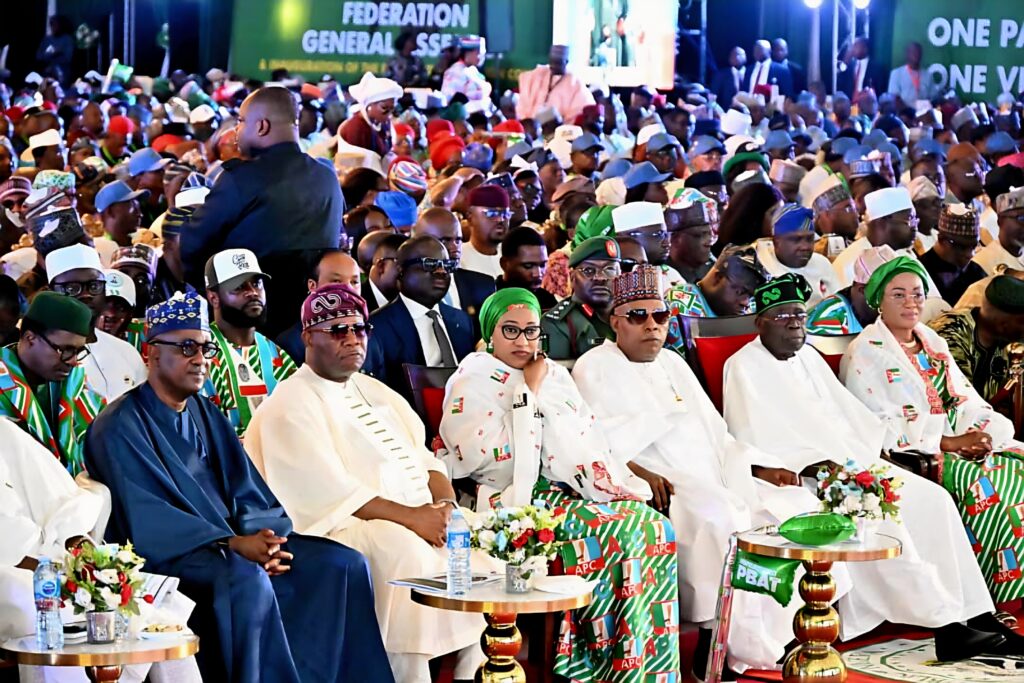
There is something intriguing about President Bola Tinubu’s approach to the 2027 presidential campaign.
He appears determined not to conduct the election as though the business of governing Nigeria can be suspended for the sake of campaigning.
Rather than carry his campaign physically from one rally to another, he is placing considerable responsibility on governors, party officials, ministers, legislators and political allies to take the message into the country.
At first glance, this could look like a candidate stepping back from the electorate. I see something more calculated. Tinubu may be testing whether the political organisation he has spent decades building is now strong enough to campaign on his behalf.
That is the real question.
The 2027 election may be the first major test of whether Tinubu can turn a presidential campaign from a candidate-centred operation into a system-wide political enterprise. If he can, it would say something important about the sophistication of his political organisation. But it would also expose the limit of political engineering: an organisation can carry a message into every state, but it cannot determine whether citizens believe the message.
Tinubu is not an accidental politician. He has spent decades learning the mechanics of power, from the difficult years of opposition politics to the construction of the Lagos political machine, the coalition that eventually became the APC, the struggle against an incumbent federal government and, finally, the presidency. He understands something many politicians learn too late: a serious political organisation cannot depend entirely on the physical presence of one man.
The APC’s latest campaign structure suggests that this is precisely the calculation. The revised presidential campaign council places all 32 APC governors in charge of the presidential campaign in their respective states. It also reaches beyond the APC itself, assigning campaign responsibilities to Nyesom Wike in Rivers and the Federal Capital Territory, Chukwuma Soludo in Anambra and Ademola Adeleke in Osun. Tinubu remains at the centre of the structure, with Vice President Kashim Shettima and APC national chairman Nentawe Yilwatda as his principal deputies.
This is more than a distribution of campaign duties. It is an attempt to make the campaign a network rather than a procession behind one candidate.
The President governs from Abuja. Governors take the political argument into the states. Ministers defend the administration. Legislators mobilise their constituencies. Party officials coordinate the structure. Political allies outside the APC widen the coalition. Tinubu is effectively asking whether the political system he has assembled can do much of the campaigning traditionally expected of the presidential candidate himself.
There is historical precedent for such an approach, but the lesson from history is more nuanced than the simple proposition that delegation works.
Richard Nixon’s 1972 re-election offers the closest parallel. His campaign allowed him to spend substantial time governing while surrogates carried the message across the country, and he went on to win 49 of 50 states. But the organisation worked because it was operating in a favourable political environment. Jimmy Carter’s defeat in 1980 showed the reverse. His limited campaigning during the Iran hostage crisis was only one element in an election already shaped by economic dissatisfaction, political fatigue and Ronald Reagan’s challenge. Four years later, Reagan benefited from an improving economy that allowed his record to become a powerful campaign argument in its own right.
Nigeria has its own cautionary history. Shehu Shagari’s 1983 re-election demonstrated the reach of incumbency and party organisation, but the controversy surrounding that election remains a reminder that political strength and democratic legitimacy are not interchangeable.
The lesson is simple: political organisation can amplify a favourable political environment. It cannot manufacture one.
That is where the Nigerian reality becomes decisive for Tinubu.
A governor can explain the administration’s reforms. A minister can defend its policy choices. Party officials can mobilise supporters and political allies can broaden the coalition. But Nigerians will not assess the 2027 election solely through political speeches. They will also assess it through the cost of feeding their families, moving to work, paying rent, keeping the lights on, sending children to school and dealing with insecurity.
This is where public hardship deserves careful treatment.
Hardship is politically powerful, but it is not politically deterministic. Nigerians can endure painful reforms if they believe the pain is temporary, necessary and producing visible results. They can also reject an administration that tells them the future will be better when their experience of the present offers little evidence of improvement.
The real political question, therefore, is not whether Nigerians have suffered. They plainly have. It is whether enough Nigerians will believe that the suffering is producing a destination worth reaching.
That is why the President’s own argument about reform matters. Tinubu has repeatedly maintained that Nigerians have endured necessary sacrifices and that the foundations for a stronger economy are being laid. He has also acknowledged the crucial next step: the benefits of reform must increasingly be felt in the daily lives of ordinary Nigerians.
By 2027, that will no longer be merely an economic argument. It will be an electoral proposition.
Are Nigerians better off?
The answer will not be determined by how convincingly the governors explain the reforms. Nor will it be determined simply by how angry critics are about them. It will be determined by whether citizens can see and feel enough improvement to conclude that the sacrifice was worth it.
If food becomes more affordable, transport less punishing, electricity more reliable, security stronger, jobs more available and purchasing power better, the administration’s record may begin to campaign for itself. The governors and other surrogates would then have something much stronger than a talking point. They would have lived evidence.
But if household hardship remains stubbornly dominant, the political calculation becomes much harder. A government can have respectable macroeconomic indicators and still struggle to persuade citizens who cannot reconcile those indicators with the arithmetic of their homes.
That is not necessarily proof that the reforms have failed. It is proof that economic reform and political legitimacy do not always move at the same speed.
This is where Tinubu’s political sophistication will face its most serious test.
Governors are not merely campaign operatives. They are politicians with their own futures, successors to produce, factions to manage, alliances to preserve and political debts to repay. Their interests may overlap with Tinubu’s, but they are not identical to his. The deployment of 32 governors therefore gives the ruling party extraordinary political reach while simultaneously creating a complex web of state-level calculations.
Tinubu’s long political apprenticeship becomes significant here. His political strength has arguably never rested principally on speechmaking. It has rested on political engineering: building coalitions, identifying useful alliances, accommodating competing interests and keeping a broad political structure together long enough to achieve an objective.
The inclusion of politicians outside the APC can therefore be understood as an extension of that philosophy. The coalition is less about ideological purity than electoral arithmetic.
That is politics as Tinubu has practised it for decades.
But political sophistication carries a danger of its own. Those who command a political structure can begin to confuse the strength of their organisation with the strength of their argument.
The 2027 electorate will not be a meeting of governors.
It will be millions of individual decisions.
A voter may cheer at a rally and vote differently. He may support the direction of the reforms but dislike their consequences. He may believe that the sacrifice is finally producing results. Or he may conclude that he has sacrificed enough.
Those decisions cannot be read reliably from the size of a crowd, the number of governors behind a candidate or the prominence of the people assembled on a campaign platform.
This is why Tinubu does not necessarily need to be everywhere. But he needs to be present where the political argument is most difficult. He needs to explain the choices his government has made, defend its record, answer its critics and, above all, demonstrate that he understands the distance between a reform that looks successful on a government balance sheet and one that feels successful in a Nigerian household.
That may ultimately determine whether his unconventional campaign strategy becomes a masterstroke or a miscalculation.
If the political environment is improving, the governors can amplify it. If citizens are beginning to feel relief, the campaign can give that relief a political narrative. If hardship remains the dominant experience, however, political organisation will have a much harder task. It can explain hardship. It can ask for patience. It can present the promise of tomorrow.
It cannot erase the experience of today.
The machine can carry the message.
It cannot determine whether Nigerians believe it.
That is the real test of Tinubu’s 2027 strategy.
And when the campaign finally gives way to the ballot, the most carefully constructed political architecture in the country will still have to confront the one variable it cannot organise away: the independent judgement of the Nigerian voter.
*Ogundipe, Public Affairs Analyst, former President Nigeria Union of Journalists writes from Abuja.