

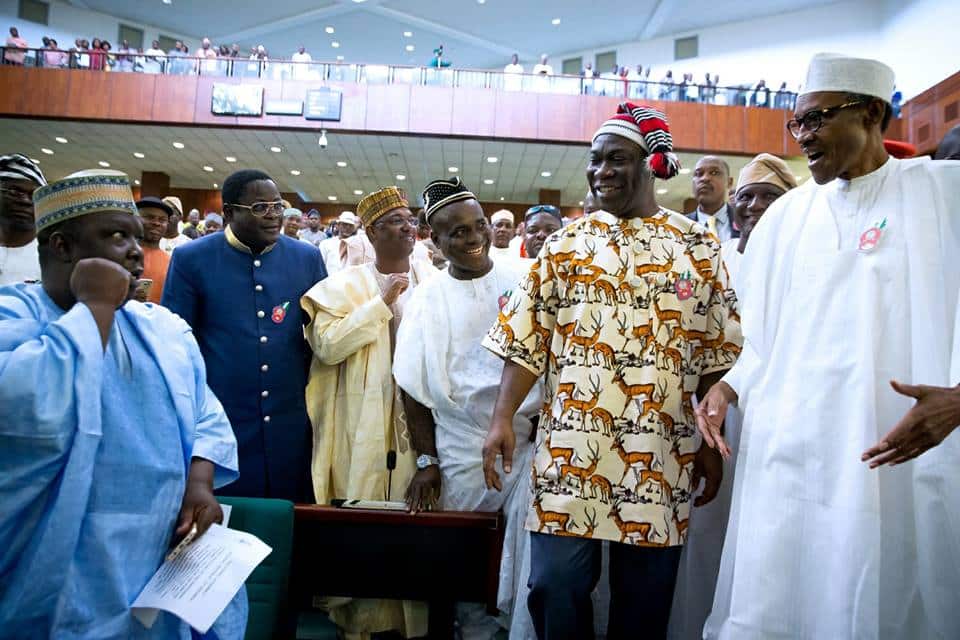
President Muhammadu Buhari on Wednesday in Abuja presented a budget of N7.30 trillion for 2017 before a joint session of the National Assembly.
Buhari, who arrived at the assembly Chambers at 1.55p.m., apologised for shifting the time for the presentation of the appropriation bill from 10a.m. to 2 p.m.
He explained that the delay was informed by his sudden trip to The Gambia in an attempt to avert possible political in that country, occasioned by the insistence of President Yayah Jammeh.
The president said that N2.24 trillion, representing 30.7 per cent of the 2017 budget, would be committed to capital expenditure aimed at pulling the economy out of recession as quickly as possible.
He said the capital expenditure was increased from N1.8 trillion in 2016 to N2.24 trillion in 2017.
The president also announced N2.98 trillion as recurrent expenditure for the 2017 fiscal year.
He said, having reviewed the trends in the global oil industry, the government had decided to set a benchmark price of 42.5 dollars per barrel and a production estimate of 2.2 million barrels per day for 2017 fiscal year.
According to him, the aggregated revenue available to fund the 2017 is N4.94 trillion, 28 per cent higher than the 2016 budget.
He said that oil was projected to contribute N1.99 trillion of the amount and non-oil revenue would be contributing N1.73 trillion.
Buhari also disclosed that the Federal Government had implemented about N3. 58 trillion out of the N6.08 trillion budgeted for 2016.
He said that the implementation of the 2016 Budget was hampered by the low oil prices in the first quarter of 2016, and disruptions in crude oil production which led to significant shortfalls in projected revenue.
He said this also negatively affected revenue collection by the Federal Inland Revenue Service and the Nigerian Customs Service.
“As at Sept. 30, 2016, aggregate revenue inflow was N2.17 trillion or 25 per cent less than prorated projections.
“Similarly, N3.58 trillion had been spent by the same date on both recurrent and capital expenditure.
“This is equivalent to 79 per cent of the prorated full year expenditure estimate of N4.54 trillion as at the end of Sept. 2016.
“In spite of these challenges, we met both our debt service obligations and personnel costs. Similarly, overhead costs have been largely covered,’’ he said.
Buhari said that in spite of revenue shortfalls, the amount of N753.6 billion had so far been released for capital expenditure as at the end of Oct. 2016.
“Although capital expenditure suffered as a result of project formulation delays and revenue shortfalls, it is important to note that this is the highest capital releases recorded in the nation’s recent history.
“In fact, it exceeds the aggregate capital expenditure budget for 2015,’’ he said.
Buhari said that from the 2016 budget, construction of new terminals at the country’s four major airports, numerous road projects, power transmission projects and completion of the Kaduna – Abuja railway project was still ongoing.
Buhari also said the economy was negatively affected by the poor revenue collection by the Federal Inland Revenue Service and the Nigerian Customs Service in 2016.
He said the significant shortfalls in projected revenue were due to the combination of relatively low oil prices in the first quarter of 2016, and disruptions in crude oil production.
He said as at Sept. 30, the aggregate revenue inflow was N2.2 trillion or 25 per cent less than the projections.
He added that N3.6 trillion had been spent by the same date on both recurrent and capital expenditure.
“In 2016, the budget was prepared on the principles of zero based budgeting to ensure our resources were prudently managed and utilised solely for the public good.
“This method was a clear departure from the previous incremental budgeting method. We have adopted the same principles in the 2017 Budget.
“You may recall that the 2016 Budget was predicated on a benchmark oil price of US$38 per barrel, oil production of 2.2 million barrels per day and an exchange rate of N197 to the US dollar.
“On the basis of these assumptions, aggregate revenue was projected at N3.86 trillion while the expenditure outlay was estimated at N6.06 trillion.
“The deficit of N2.2 trillion, which was about 2.14 per cent of GDP was expected to be mainly financed through borrowing,’’ he said.
However, the president said in spite of the challenges, the federal government met both its debt service obligations and personnel costs.
He added that overhead costs were largely covered.
“Although capital expenditure suffered as a result of project formulation delays and revenue shortfalls, in the five months since the 2016 Budget was passed, the amount of N753.6 billion has been released for capital expenditure as at the end of October 2016.
“It is important to note that this is one of the highest capital releases recorded in the nation’s recent history. In fact, it exceeds the aggregate capital expenditure budget for 2015.
“Consequently, work has resumed on construction of new terminals at the country’s four major airports; numerous major road projects; key power transmission projects; and the completion of the Kaduna-Abuja railway.
“We remain resolute in our commitment to the security of life and property nationwide.
“The courageous efforts and sacrifices of our heroes in the armed forces and paramilitary units are clear for all to see. The gradual return to normality in the North East is a good example of the results.
“Our spending in the 2016 fiscal year focused on ensuring these gallant men and women are properly equipped and supported.
“In June 2016, a conditional Budget Support Programme was introduced, which offered State Governments N566 billion to address their funding shortfalls.’’
On the 2017 Budget priorities, the president said, the budget tagged “Budget of recovery and Growth’’, will be a continuation of 2016 plans.
He added that there would be only a little adjustment to reflect new additions made in the Economic Recovery and Growth Plan.


Buhari presents N7.30trn budget for 2017, says ‘FG implemented N3.58trn out of N6.08 budgeted for 2016’


Leave a Reply








Latest Stories






© 2026 Published by SWAAYA LIMITED, Plot 20, Block G, Scheme 1, Residential 3, OPIC Beachland Estate, Lagos/Ibadan Expressway, Lagos. Gabriel Akinadewo, MD/CEO 08023010222, 08094000056, 08052097814.