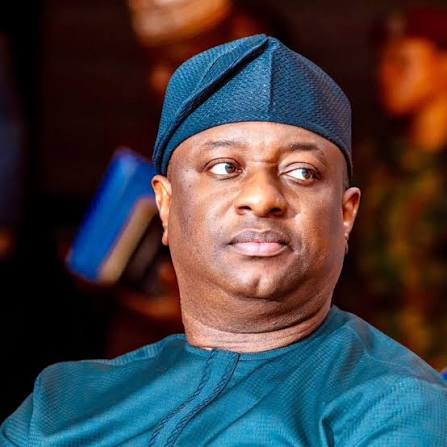
The Infrastructure Concession Regulatory Commission (ICRC) has commended Aviation and Aerospace Development Minister Festus Keyamo for helping to resolve a longstanding concession dispute between the Federal Government and Bi-Courtney Aviation Services Limited.
The commission said negotiations involving Keyamo and Bi-Courtney Chairman Wale Babalakin produced a compromise over a dispute linked to the Murtala Muhammed Airport Terminal 2 (MMA2) in Lagos.
ICRC Director-General Johnson Ewalefoh disclosed this on Tuesday during the 32nd Nigerian Economic Summit in Abuja.
How Keyamo Helped Resolve the Bi-Courtney Dispute
Ewalefoh said the aviation minister played a significant role in bringing the Federal Government and Bi-Courtney back to the negotiating table.
According to him, the disagreement had continued for approximately 15 years and involved a court judgment valued at ₦132 billion against the government.
He explained that Bi-Courtney had obtained favourable court decisions during the dispute, but the judgments had not been enforced.
The ICRC chief said negotiations eventually produced a compromise acceptable to both parties.
Under the arrangement described by Ewalefoh, Bi-Courtney agreed to relinquish its monetary claims against the Federal Government.
The concessionaire’s decision, he said, formed part of a broader settlement addressing unresolved obligations connected to the airport terminal.
MMA2 Agreement Covers Hotel, Convention Centre and Regional Flights
Beyond the financial claims, Ewalefoh said the settlement addressed outstanding commitments under the MMA2 concession.
These include the proposed development of a hotel and convention centre associated with the airport project.
He also disclosed that the agreement would create an opportunity for regional flight operations from MMA2.
The development could expand the terminal’s operational role if the necessary aviation approvals and implementation arrangements are completed.
However, the ICRC director-general did not provide a timetable for the proposed regional services or the completion of the outstanding facilities.
ICRC Says Negotiation Is Key to Successful PPP Projects
Speaking during discussions on the role of law in infrastructure development, Ewalefoh described the resolution as an example of how disagreements in public-private partnerships (PPPs) can be addressed through negotiation.
He explained that infrastructure concessions often run for decades, making contractual disputes possible as economic and operational circumstances change.
According to him, such disagreements do not necessarily have to end in prolonged litigation or the disruption of essential services.
Instead, he urged government institutions and private investors to seek commercially reasonable solutions while respecting their legal obligations.
Ewalefoh maintained that successful PPP arrangements depend on transparency, trust and the willingness of both parties to fulfil agreed responsibilities.
Commission Moves to Strengthen Concession Agreements
The ICRC director-general said the commission was drawing lessons from previous infrastructure disputes to improve future concession contracts.
He disclosed that the agency was developing a model agreement designed to strengthen transparency, contractual compliance and dispute resolution.
The commission is also working with the Office of the Attorney-General of the Federation to improve the government’s handling of disagreements arising from infrastructure partnerships.
Ewalefoh stressed that contractual commitments should remain binding regardless of changes in political leadership.
He noted that some concession agreements last between 20 and 30 years, requiring clear legal protections and consistent government policies to sustain investor confidence.
Why the MMA2 Settlement Matters for Aviation Investment
The Murtala Muhammed Airport Terminal 2 is one of Nigeria’s prominent privately operated airport infrastructure projects.
Its concession history has featured disagreements over contractual rights and obligations, highlighting the difficulties that can arise when long-term infrastructure arrangements are contested.
The reported settlement could help reduce uncertainty surrounding the terminal’s concession and provide a clearer basis for future development.
Ewalefoh said government agencies must recognise that concession agreements are continuing partnerships rather than one-off transactions.
He argued that protecting contractual rights and resolving disagreements fairly would encourage private investment in Nigeria’s infrastructure sector.
The ICRC chief described the Bi-Courtney negotiations as a practical demonstration of the value of dialogue in settling complex public-private partnership disputes.