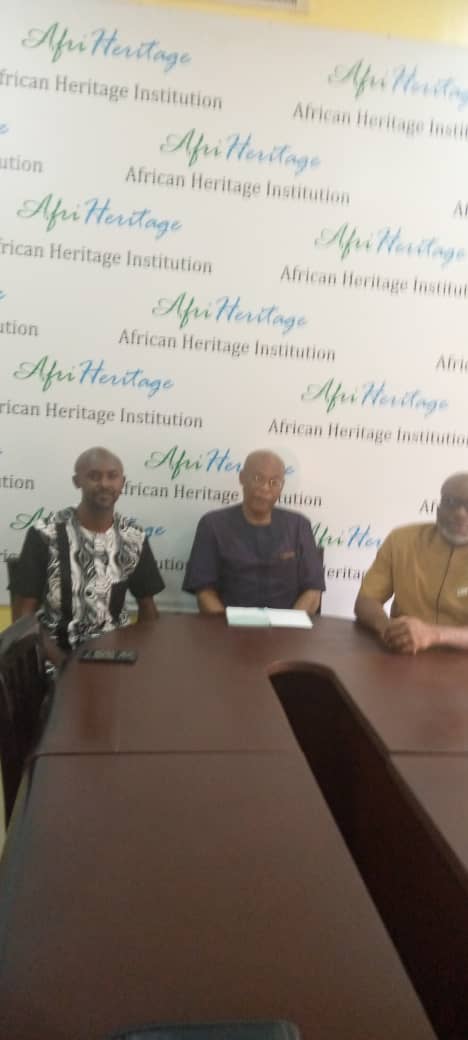
African Heritage Institution (AfriHeritage), a policy formulation research institution in Enugu will, on Thursday, November 25, unveil its Business Environment and Competitiveness across Nigerian States (BECANS) iv report.
Briefing newsmen on Monday on the upcoming programme which would be held at BON Sunshine Hotel, Enugu, the Director General of AfriHeritage, Professor Ufo Okeke-Uzodike, said that Business Environment Competiveness Across Nigerian States (BECANS), is a brainchild of AfriHeritage which started almost two decades ago.
“Business Environment and Competitiveness across Nigerian States (BECANS) is the flagship research, survey and dissemination initiative of African Heritage Institution (AfriHeritage)” he said..
According to him, the initiative runs in successive cycles of research, surveys, dissemination and policy dialogue for the promotion of better business environment throughout the country. Each cycle begins with desk research (the scientific validation of models, methods and indicators) and followed by survey/data collection, data analysis, report writing, publication, dissemination and dialogue between the government and stakeholders in private sector and civil society.
The Director-General said that until recently, most investment climate assessments relied on aggregate indicators of the quality of a country’s policy, regulatory and institutional environment. Investment climate assessments were cross-country comparisons based on universal set of measures.
He noted that while aggregate indicators of investment climate at the national level are useful, the aggregate picture masks differences in business environment across the states. In particular, any national picture of business environment in Nigeria that does not take into account potential differences across subnational jurisdictions cannot give a fair and true picture of the reality. This is because Nigeria’s federal constitution allows considerable autonomy for subnational governments to shape the business environment in their respective locations.
Before BECANS was initiated, there was no assessment of the business environment at the subnational level in Nigeria. To address this shortcoming, BECANS focuses on disaggregated business environment analysis at the state level. With state-level disaggregated data, state governments will have the empirical basis to guide policy, institutional and regulatory improvements. Also, stakeholders,private sector and civil society will get evidence basis to support advocacy and dialogue for business environment reforms in respective states of the country.
He explained that BECAN is an evidence-based report that focuses on issues affecting Business Environment in Nigeria, with the aim of identifying the problems in the business communities in Nigeria and proferring solutions to them.
Professor Okeke-Uzodike added that in Nigeria, “We see business environment that results as joblessness, business that does not pay them salaries.
” That is why we have businesses that are suffering when we talk about multiple taxation . It is a problem.Where there are no infrastructure, multiple taxation, harsh policies, business would not survive, he said”
The Director General hinted that AfriHeritage expanded the coverage of BECANS from 88 to 103 in terms of indicators.BECANS iv he said, brought in issues of gender and youths Some aspects of indications that were outdated were changed .
Professor Okeke-Uzodike disclosed that the researchers went to 36 states and the federal Capital Territory,(FCT) , that is 37 locations for data collection.
According to him, most of the businesses in Nigeria are small,medium and micro enterprises. The problem is the hassles that go with it “BECAN covers all businesses including small, medium and micro businesses.
Adding his voice, Dr Chuwuike Ubah said that they collaborated with some states, institutions and collected data that responded to various indicators needed. He added that they engaged with both state and non- state a tors, business people , Civil Liberty Organisation(CLO) ,after which they adopted normal quality control that took them to data analysis and report writing.
Ubah said that BECANS is a multi crunch work that involves advocacy research, it is evidence-based..
“We use evidence to engage the institutions involved to get them to do things better.
He said that working with stakeholders to measure, benchmark and monitor the business environment is the overarching role of the programme on business environment and competitiveness across Nigerian states (BECANS).
Monitoring and reporting the business environment is important for designing and implementing policy and institutional reforms by the federal, state and local governments. On the other hand, an independent and objective assessment of the business environment is useful tool for private sector and civil society to advocate and dialogue with government.
So far, the Institution has successfully undertaken three editions of the BECANS project with their reports published and are presently in public domain. The first was in 2006, the second was in 2010 while the last one was carried out in 2016. Presently, the 2019 edition of the project (BECANS IV), which would be unveiled on November 25.