

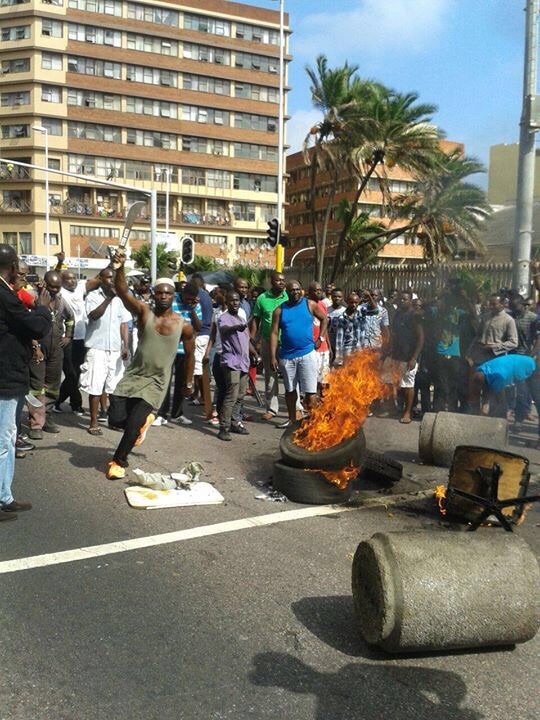
The xenophobic attack on Nigerians living in South Africa between February and March 2017 expectedly generated a lot of anger and outrage across the country. While the umbrella body of students in the country held a protest to register their displeasure, and threatened retaliation, militants in the Niger-delta threatened to destroy all South African business concerns in the country if they did not close down before a set date.
While these threats have not yielded anything near what they promised, they signify nonetheless, the increasing frustration with the attitude of the Federal Government of Nigeria to the incessant attacks on its citizens in the Rainbow nation. Several of such have happened in the last few years, and there’s a legitimate perception that the increase in the level of recurrence is proportional to the level of vacuum existing from the Nigerian end in terms of response both to the despicable attacks and its handling by the South African government.
The recent attack is not the first.
Xenophobic violence targeted particularly at Nigerians began in 1994. In 2008, another xenophobic tragedy led to the death of 62 persons in Johannesburg townships, many of them Nigerians. Another attack that same year also directed at African immigrants from countries like Nigeria, the Democratic Republic of Congo, Ethiopian, Mozambique and Malawi, was carried out without consequences. Then again, in April 2015, a spate of violence directed against Nigeria claimed another seven lives.
From South Africa to Libya, the UK, China and even Malaysia, the indifference of the Nigerian State to the inhuman treatment of its citizens has become a trademark. The way the country even treats its own citizens, whether at its embassies abroad or even at home, has become a classic example of self-deprecation. When embassy officials are not mistreating Nigerians abroad, while giving special treatment to foreigners, soldiers are busy at home rough-handling a handicap over his choice of dress. It should therefore not be so surprising, depressing as it is, when Nigerians are humiliated in foreign countries. Their country treats them worse.
Still, the development in South Africa is worrisome and unfortunate for at least two reasons. It is the height of ingratitude, and a consequence of wilful or voluntary amnesia for South Africans to deal such a hand with Nigerians. As has been widely reported, Nigeria, more than any other country in the world, contributed to the end of apartheid in South Africa.
Perhaps it is pertinent to remind black South Africans the role Nigeria played in liberating the country from the shackles of apartheid. In March 1960, 69 black people were massacred in Sharpeville, South Africa, by the white apartheid police. Earlier in the year, Nigeria successfully liberated itself from 160-year British occupation.
The new Nigeria’s leaders’ reaction to the Sharpeville massacre changed everything. Nigeria’s Prime Minister Abubakar Tafawa Balewa sent a letter to the African National Congress (ANC) militants on April 4, 1961, in which he emphasized Nigeria’s commitment to fight against apartheid in South Africa. Immediately after, Sir Balewa lobbied for the effective expulsion of South Africa from the Commonwealth in 1961.
Beyond political support, Sir Abubakar Tafawa Balewa was the first leader to provide a direct financial aid to the ANC from the early 1960s. At the height of the liberation movement in the 1970s, Nigeria alone provided $5 million subvention to the ANC and the Pan Africanist Congress (PAC) annually. Also, in 1976, Nigeria decided to set up the Southern Africa Relief Fund (SAFR) with the aim of bringing succour to the victims of the apartheid regime in South Africa, as well as provide educational opportunities to them and promote their general welfare.
The military administration of General Olusegun Obasanjo contributed $3.7 million to the fund. Moreover, General Obasanjo made a personal donation of $3,000, while each member of his cabinet also made personal contributions of $1,500. Nigeria’s civil servants and public officers made a 2% donation from their monthly salaries to the SAFR. Students skipped lunch to make donations, and just in six months, in June 1977, the popular contribution to the fund reached $10.5 million.
The donations to the SAFR were widely known in Nigeria as the “Mandela tax”.
As a result of the fund’s work, a first group of 86 South African students arrived in Nigeria in 1976, following the disruption of the education system in South Africa. It happened after the massacre of 700 students by the white police while the former were protesting against the decision by the apartheid regime to change their education language to Afrikaans. Hundreds of South African students benefited from the fund’s activity having come to study in Nigeria for free.
Beyond welcoming students and exiles, Nigeria also welcomed many renowned South Africans like Thabo Mbeki (former South African president from 1999 to 2008). He spent seven years in Nigeria, from 1977 to 1984, before he left to the ANC headquarters in Lusaka, Zambia. For South Africans, who could not travel abroad because the apartheid regime had withdrawn their passports, Nigeria’s government issued more than 300 passports.
Furthermore, along with fellow African countries, Nigeria lobbied for the creation of the United Nations Special Committee against Apartheid and chaired it for 30 years, longer than any other country. Between 1973 and 1978, Nigeria contributed $39,040 to the UN Educational and Training Programme for Southern Africa, a voluntary trust fund promoting education of the black South African elite.
As for trade, Nigeria refused to sell oil to South Africa for decades in protest against the white minority rule. That decision cost Nigeria approximately $41 billion during that period. Above all, Nigeria was the only nation worldwide to set up the National Committee Against Apartheid (NACAP) as early as 1960. The committee’s mission was to disseminate the evils of the apartheid regime to all Nigerians from primary schools to universities, in public media and in markets, through posters and billboards messages. The NACAP was also responsible for the coordination of Nigeria’s government and civil society joint anti-apartheid actions and advising of policy makers on anti-apartheid decisions. For over three decades, NACAP successfully built alliances with labour movements, student groups, progressive elements and other international grassroots organizations within Nigeria for effective anti-apartheid activities. In fact, until 1960s, the ANC fight against the apartheid regime in South Africa was yielding very small results. The whole world was quite indifferent to the suffering of the black South Africans. Moreover, Western countries strongly supported the apartheid regime by providing it with technologies, intelligence and favorable trade agreements.
Second, given the prevalent rate of illiteracy among the blacks in South Africa, one may suspect that the current generation of young South Africans lack sufficient history of how their country was liberated from apartheid, and as such are unable to properly appreciate the contributions of Nigeria. More serious though, is the fact that the end of apartheid seems not to have translated into meaningful life for most of black South Africans, who though are about 80 percent of the entire population, and control less than 25 percent of the land, alongside contributing a staggering 90 percent to the unemployment rate. The whites on the other hand, who are less than 10 percent, control over 70 percent of land, mines and other resources. The acquisition of political power and its attendant euphoria has papered over the problem of intergenerational inequality rooted in race and racism. It is therefore safe to say that while there are sufficient reasons for South African black to express discontent, they have chosen the wrong culprit. Sadly, the South African authorities have not shown sufficient will or capacity for dealing with the problem.
In its 2007 report, the African Peer Review Mechanism (APRM) of the African Union stated that “despite the solidarity and comradeship between black South Africans and the rest of the people of sub-Saharan Africa during the decades of struggle against apartheid and for liberation, foreigners, mostly of African descent, are being subjected to brutality and detention. Xenophobia against Africans is currently on the rise and should be nipped in the bud.”
“We are requesting those who come from outside to please go back to their countries”, was the scathing and inciting statement that emanated from Zulu king, Goodwill Zwelithini, who lamented that foreigners were making life difficult for South Africans. That was in 2015. Incitement by the political class and the black elite seems to have encouraged the latest round of attacks. The failure to enforce order and punish the perpetrators appears to be a convenient way for the South African authorities to deflect the blame for its failure to manage the crisis of economic inequality in post-apartheid South Africa as successfully. It has thus watched with glee, and sometimes amusement, as its frustrated citizens ignorantly, but viciously, visit havoc on foreign blacks who control less than 3 percent of the South African economy.
While there seems to be a gradual awakening of the consciousness of poor, black South Africans to the real source of their problems, especially through the social media, it is apparent that more coordinated efforts are needed to call the attention of the South African authorities to its failure in meeting the needs of its people; as well as educating the latter about its need to refocus energy on the second phase of liberation – this is the contest for economic power.
Unfortunately though, the Nigerian government which ought to assert its rejection of the barbaric treatment of its citizens and take measures that would compel the South African government to protect them has been found grossly wanting. For several days in the past week, the world watched as the two chambers of the Nigerian parliament squabbled over who should embark on a jamboree to South Africa to dialogue with its government. This betrays to say the least, insensitivity, indifference, and the total lack of coordination among the ruling class. That the Nigerian government, through the ministry of foreign affairs has been unable to come up with deterrent measures to forestall a recurrence, is an indication that it does not prioritize the lives and interests of its citizens as it professes to.
The South African government has been irresponsible in its dealing with its people, a situation which we think will inevitably escalate beyond attacks on foreign blacks, as the poor masses of that country get wiser. The irresponsibility of the South African government however, has a parallel enabler in the silent complicity of the Nigerian government. To put a decisive halt to these attacks, the New Independence Group (NIG) believes that it is of utmost importance for the Nigerian government to become alive too to its responsibilities to Nigerians both at home and abroad. It must begin by recognising the office of the citizen as the employer of government, which in the immortal words of John Locke, is like a “glorified secretary”. It is equally essential that it takes demonstrable steps to serve notice to other countries that it will no longer condone the maltreatment of Nigerians under any guise. Where Nigerians are suspected of violating the rules of their host country, it should ensure that they undergo the judicial procedures of such a country fairly and transparently. Every undignified treatment of a Nigerian citizen that goes unchallenged diminishes each and everyone of us, those in authority inclusive.
·This statement was signed by the Convener of the New Independence Group (NIG), Professor Akinyemi Onigbinde.


Xenophobia: Time to call South Africa to order, by Nigerian Independence Group

Leave a Reply





Latest Stories



© 2026 Published by SWAAYA LIMITED, Plot 20, Block G, Scheme 1, Residential 3, OPIC Beachland Estate, Lagos/Ibadan Expressway, Lagos. Gabriel Akinadewo, MD/CEO 08023010222, 08094000056, 08052097814.