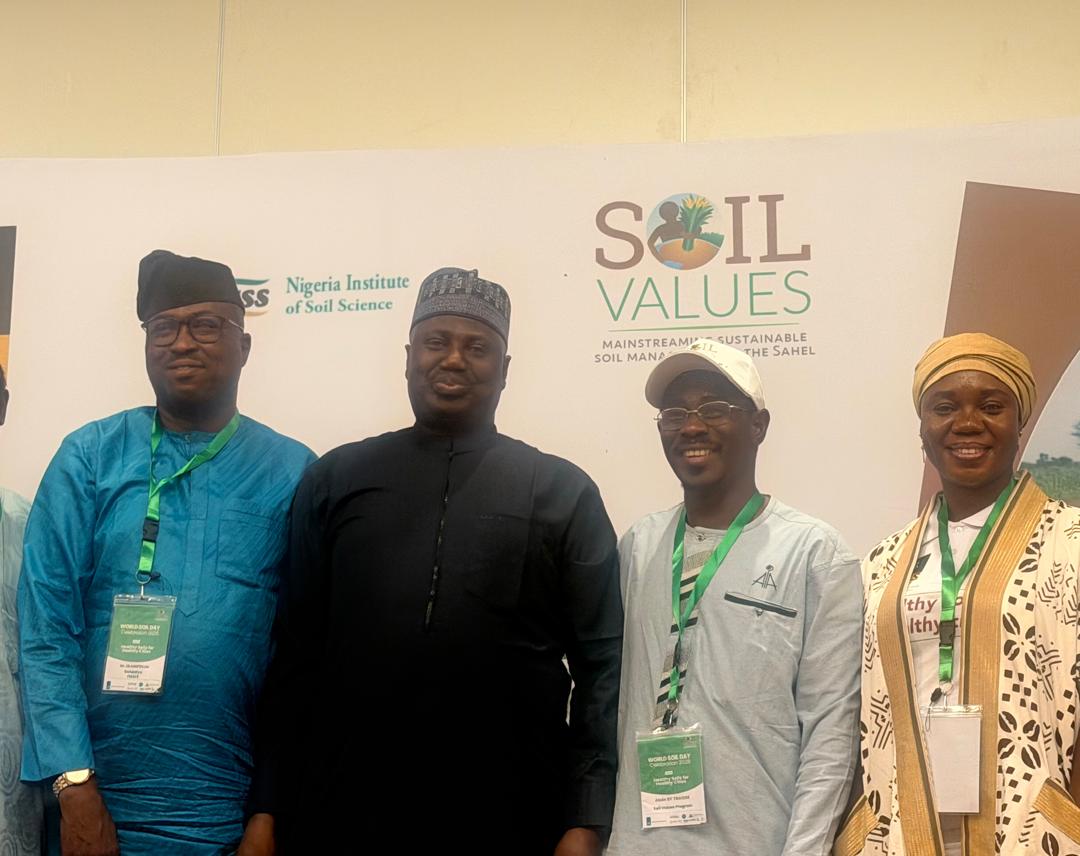
The International Fertilizer Development Center (IFDC), through its Soil Values program funded by the Kingdom of the Netherlands , and in collaboration with the Federal Ministry of Agriculture and Food Security and the Nigerian Institute of Soil Science , launched the activities marking World Soil Day 2025 in Nigeria.
The theme, “Healthy Soils for Healthy Cities” , was celebrated in the presence of the Minister of State for the Federal Ministry of Agriculture and Food Security, Senator Abdullahi Aliyu Sabi , as well as numerous other agricultural sector stakeholders.
In his opening address, titled “Soil as the Foundation for Food Sovereignty and Climate Resilience” , the Minister emphasized that soil health constitutes an essential basis for achieving food sovereignty and climate resilience in Nigeria. He recalled that World Soil Day is a global event that highlights the importance of soils in ensuring food sovereignty, climate resilience, and improving livelihoods.
The Minister stated that soil is the backbone of the agricultural sector , providing 95% of our food and 15 of the 18 essential elements required for plant growth (un.org; fao.org). Soil supports crop growth and livestock farming, purifies water, regulates climate, sequesters carbon, reduces greenhouse gas emissions, and provides a habitat for beneficial microorganisms, thereby contributing to ecosystem services and biodiversity.
However, “our soils face unprecedented threats: degradation, erosion, and pollution, which negatively affect yields, food quality, and ultimately, food security. It is regrettable to note that 33% of our soils are already degraded and that it takes up to 1,000 years to regenerate only 2 to 3 cm of soil,” he added.
The Minister stressed that the celebration of World Soil Day will help to raise public awareness, particularly among farmers, about soil conservation and its benefits , promote sustainable agricultural practices , support the ministry’s initiatives for soil health , encourage research , and advocate for soil protection policies.
According to him, the ministry launched the Nigerian Soil Health Program for Farmers (NFSHS) on October 13, 2025 , in the presence of approximately 600 farmers, dignitaries, and partners. This initiative constitutes a major advance in achieving the food security and sovereignty vision of President Asiwaju Bola Ahmed Tinubu GCFR.
The NFSHS aims to transform the Nigerian agricultural sector. This program provides fertilizer recommendations adapted to crops and areas , which discourages the indiscriminate application of fertilizers , reduces waste , and lowers production costs for farmers. It also promotes organic amendments and sustainable land management practices, encouraging the adoption of technologies to improve soil health across the country’s different agroecological zones.
The Minister acknowledged that significant progress has been made, thanks to the collaboration of partners such as GIZ, the Soil Values programme, OCP, AGRA, the World Bank’s ACReSAL project, Sasakawa Africa, and the International Institute of Tropical Agriculture (IITA). Another important progress is the integration of the NFSHS into the federal budget and the organization of consultation workshops that led to the creation of the “Coalition of the Willing” (CoW) platform and the readiness assessment. The Minister called on all stakeholders to protect soils for future generations and to prioritize soil health to ensure food sovereignty and climate resilience in Nigeria.
In his message, the Director of the Soil Values program, Dr. Alain Sy Traoré, explained that the sub-theme of the 2025 edition – “Valuing our Soils, Foundation for Food Sovereignty and Climate Resilience” – was chosen to emphasize the crucial importance of healthy soils for the economies of countries.
For her part, the Deputy Director of the Soil Values technical program, Dr. Alimata Boundaogou, in her presentation titled “Scaling Up ISFM and SWC Practices” , stressed the need to improve seeds, among other measures. She urged participants to strengthen farmer resilience and promote gender equality and social inclusion , especially for women, youth, and people living with disabilities.
The second day of the celebration was marked by an awareness march/road show from the Ministry of Agriculture headquarters to the Abuja Continental Hotel. Students participated in debates focusing on restoring the value and health of soils.
ABOUT IFDC AND SOIL VALUES:
The Soil Values programme intervenes in a context marked by climate and socio-economic challenges faced by Sahelian countries, particularly recurrent droughts, socio-political conflicts, desertification, and the effects of climate change. Aggravated by a lack of investment and insufficient financing mechanisms, these conditions exacerbate the degradation of soil fertility and health, compromising food security in the Sahelian countries.
Soil Values aims to improve the fertility and productivity of two million hectares of agricultural land in the Sahel, while strengthening the resilience and well-being of 1.5 million farmers , with a specific focus on women and youth. The program’s approach is based on Integrated Soil Fertility Management (ISFM) and participatory landscape management to promote the adoption of agricultural practices favorable to soil fertility. The initiative is structured around three intervention pathways (Agroecology, Inclusive Markets, and Enabling Environment) and five intervention axes (Clustering, Integration, Facilitation, Consultation, and Documentation & Learning).
Soil Values is implemented by a consortium led by IFDC, in collaboration with main partners SNV and Wageningen University and Research Center (WUR) , as well as knowledge partners such as AGRA, CIFOR-ICRAF, IITA, ISRIC – World Soil Information, and the International Water Management Institute (IWMI). IFDC is an international public organization present in 27 countries , which combines scientific research and interventions to help smallholder farmers in developing countries increase their productivity while promoting sustainable environmental management technologies.