

Today, Nigeria faces serious social and economic challenges.
Although Nigeria’s oil and natural gas revenues are estimated at over $40 billion per year, its human development indicators are among the world’s lowest, and a majority of Nigerians suffer from extreme poverty.
Despite having the second largest economy in Africa and generating over $47 billion a year in oil and gas revenue, many of the citizens are among the continent poorest.
According to USAID, 70 per cent of Nigerians live on less than $1 per day, and the average life expectancy is only 47 years.
Nigeria ranks 158 of 177 countries on U.N. Development Programme’s
(UNDP) Human Development Index.
Youth time is a period of great passion and energy.
Nigeria has a youthful population of close to 70 to 80 million, about 55 to 60 per cent of her population.
Of this youthful population, more than 80 per cent are unemployed while about 10 per cent are under-employed.
The estimated 10 per cent in employment are burdened and depressed with near total dependence of relative and family members.
The glory of the youth is their strength. This can be clearly seen at the way youths have been seen to pursue their dreams and vision.
The Niger Delta which produces over ninety per cent of the nation’s oil has become a nightmare for some time now due to incessant kidnappings by militants demanding for a fairer share of the resources derived from oil exploitation.
Armed robbery is on the increase due to unavailability of jobs for
the youths after graduation.
Most of these youths are incredibly intelligent. This intelligence
manifests through negative channels like internet scams or 419.
If this desire for success can be channeled rightly, the Nigerian
society can give birth to some great intellectual and entrepreneurs of
international repute.
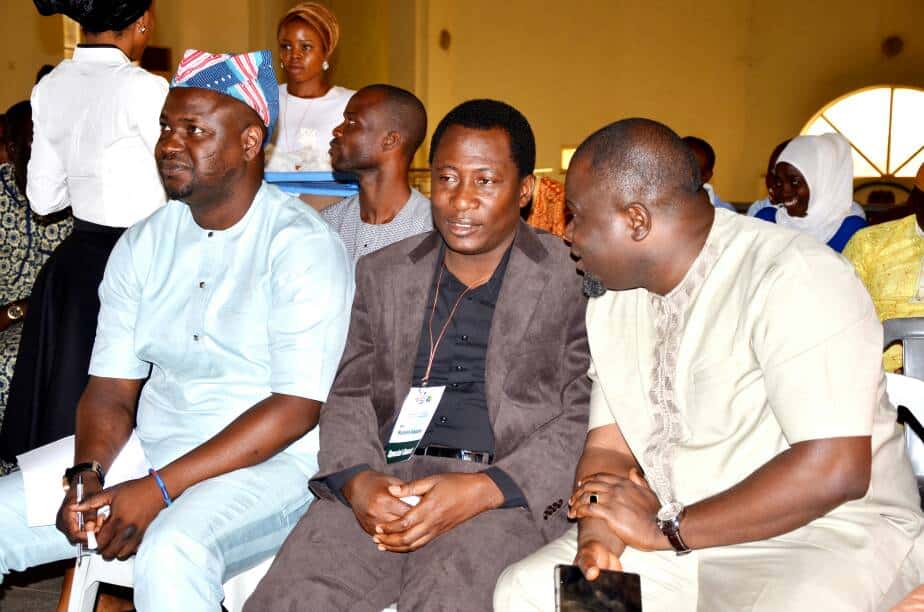
To this end, the first ever human development summit was organised for youths from Afijio, Atiba, Oyo-East and Oyo-West local governments areas that constitute Oyo Federal Constituency.
The well-attended event held at Atiba Hall in Oyo town, was sponsored by a member of the House of Representatives representing the constituency, Prince Adeniyi Adeyemi.
The motive of the organisers was that given the right combination of motivation, ideas and opportunities, youth are more than able to establish productive and creative businesses.
Resource persons drawn from within and outside Oyo State tutored the youths one after the other on how to engage in entrepreneurship, so as to lift young people from being “job seekers” to “job creators,” and also from social dependence to self sufficiency.
In his address, former Speaker, Oyo State House of Assembly, Kehinde Ayoola, said entrepreneurship in Nigeria is a major avenue to increasing the rate of economic growth, create job opportunities, reduce import of manufactured goods and decrease the trade deficits
that result from such imports.
Stressing the importance of knowledge acquisition for self
fulfillment, Ayoola noted that the influx and encouragement of youth into ventures will definitely help salvage the wasting economy.
“Rebirth is the regeneration of something that is destroyed,
regeneration of something that has died or has been destroyed. It also
means the revival of important ideas or forces usually as part of
broad and significant change. It typifies renaissance, reawakening,
return or resurgence. Hence economic rebirth can simply be defined as
the regeneration of a battered economy to improving the standard of
living of the nation, through holistic development of the youths’’,
former Assembly Speaker asserted.
Other resource persons, Mr. Falolu, Dr. Oyinlola, Olatoso Akinrinola
and Bayo Adelakun, respectively submitted that human Capital
Development is one of the most vital keys to bringing economic
rebirth, adding that it is the level of applied knowledge of the youth
that helps in tackling the economic problems facing the nation.
They argued that placing values on education and skill acquisition is
the way out of the present economic doldrums, as the youths need to
develop an acute appetite for learning and knowledge without which
civillisation crumbles.
Also speaking, Special Assistant to the President on Legal Matters,
Biodun Aikomu, posited that Nigerian youths need to hunger for
relevant facts and skills, thereby seeking solutions to the challenges
facing them through enhanced mental capacity.
This, he said, is the foundation to any true renaissance.
According to him, ‘’the youths are often called the potential leaders
of the nation hence their role in building a sustainable economic
development is essential by integrating them into the national
policies and decision making. The youth needs an active involvement in
participating with the current political and economic leaders to
foster inter-generational dialogue hereby enhancing adequate
transitional shift’’.
Youths, Aikomu pointed out, should be actively involved in the
Millennium Development Goals (MDG) agenda as reflected by their
participation and articulation of ideas at various international fora
including the World Youth Summits.
A contributor, Biodun Adeyemo, attributed slow pace of development in
the ancient town to ‘indoctrination and self-afflicted curses’’ among
the people.
Said he, ‘’we are the architects of our misfortunes due to sheer
laziness, timidity and lack of self-assertion. In this ancient town,
anything one wants to buy, be it edible, textile, electronic, or
building materials, even shoe making, are made available by
non-indigenes. What are our people doing? We are too complacent and
lazy, but take solace in glorifying the wealthy for mere pot of
porridge. How long will this last?’’
Addressing the gathering, sponsor of the summit, Prince
Adeniyi Adeyemi, said youths are one of the greatest assets that any nation can have, adding that not only are they legitimately regarded
as the future leaders, they are, potentially and actually the greatest
investment for a country’s development.
‘’They serve as a good measure of the extent to which a country can
reproduce as well as sustain itself. The extent of their vitality,
responsible conduct and roles in society is positively correlated with
the development of their country. This category represents the most
active, the most volatile and yet the most vulnerable segment of the
population. People in this age bracket definitely constitute a
sizeable chunk of a nations population on which the burden of nation
building falls’’.
Adeniyi went further, ‘’the youths also constitute the major resource
base for any country that want to embark on any meaningful development
project. Young people must be trained and as quickly as possible, to
provide leadership in Agriculture, Industry, Government and Economic
Development Projects. They must be developed intellectually, morally,
socially and with relevant skills to face a rapidly advancing
technological world. This is the fulcrum of the summit, which is first
of its kind in the federal constituency’’.
While reiterating his recognition of the youths as raising leaders who
are critical to nation building and wealth creation, the federal
lawmaker asserted that his determination was to inspire and equip
youths, business owners and social entrepreneurs to lead ethically and
implementing initiatives that transform their communities and
organizations for better through sustaining livelihood as well as
contributing to national development.


Rep sponsors Human Capital Development summit for Oyo youths


Leave a Reply






Latest Stories






© 2026 Published by SWAAYA LIMITED, Plot 20, Block G, Scheme 1, Residential 3, OPIC Beachland Estate, Lagos/Ibadan Expressway, Lagos. Gabriel Akinadewo, MD/CEO 08023010222, 08094000056, 08052097814.