

Nigeria is an interesting country to be and visit.
There is so much to be proud of with respect to arts and culture.
Drumming, especially, is a vital part of the cultural heritage of the Yoruba people of South-Western Nigeria.
Drums are used on special occasions, festivals, carnivals, ceremonies.
They even add special effects and style to some bits of Yoruba culture.
Drums are differentiated by the sound they make, how they are made, history, and appearance.
The Yoruba possess an infinite variety of musical instruments that is paralleled in world music history.
These instruments come in various shapes and sizes. Others are made
with consummate skills.
Yoruba musical instruments and their extra musical functions in the
society make the procedure of teaching them unique.
Worrisomely, the organizational skills in teaching and lening
procedure of Western musical instruments have made it much more
comfortable for students in schools to prefer studying them to Yoruba
instruments.
Among the Yoruba, the Gbedu drum signifies royalty.
Being the largest of the Yoruba drums, it was played only in the
king’s service.
Investigations showed that Gbedu drum is a single headed fixed- pitch
membranophone that has been dedicated to the King and some features in
kingship ritual.
Gbedu drums are made of cow skin that has been skinned of its hair,
this skin is now coupled to an already cast wood with an hollow bottom
so as to enhance vibration and resonance.
The skin is bound to the already cast wood and the wood serves as both
a stand for the skin and resonance and contributes to the timbre of
the instrument.
The animal skin of the Gbedu drums make it easier for the hands to
play the instruments, but the Gbedu drums are usually played with
sticks.
They are shaped like an hour-glass and have an hollowed end, that
enhances the sound production of these instruments.
What then is the significance of Gbedu drums to the Yoruba society?
During the Oranyan festival in 2014 with the theme, ‘’OUR PALACE, OUR
PRIDE’’, the Coordinator of the festival organization, Arch-Bishop Emeritus Ayo Ladigbolu, in his address, called on the Yoruba speaking
State Governments to re-construction of the ancient palace of Oyo, and
the need for a comprehensive policy of historical preservations of the
palace, which was ravaged by fire in 2013.
Ladigbolu’s argument was premised on the fact that the Palace of the
Alaafin is a monument to Yoruba people because of the role the Alaafin
institution played and continues to play in the history and culture of
the people.
He further stressed that the institution is about a thousand years
old, and over these years, the institution had served as a repository
of Yoruba history and culture.
These, according to him, are few dynasties in the world that are older
than that of the Alaafin.
However, in order to set the ball rolling, the Oranyan Festival
Organisatiion has renovated, this year, one of the six Kobis at Aganju
in the palace and convert it to a permanent abode for the GBEDU DRUM.
Addressing journalists at a press conference to flag off
this year’s Oranyan festival, Ladigbolu informed that ‘’both the Kobi
and the Gbedu are unique in the culture of the Yoruba Nation, and they
have some peculiarities for Oyo and the Alaafin’’.
The Kobi, he explained, ‘’is a bay projecting from the house with a
conical top higher than the roof. It is a projection of the verandah
space to itself and to bring it closer to the people gathered in the
courtyard or a square around it. The Kobi was highly regarded as
architectural and urban symbol of royalty’’.
While the Gbedu drum, in the words of the clergy is meant for the
exclusive use of the King, and it is only found in the Palace. We
believe that our renovation and restoration effort will not only
beautify the palace, but also rescue the ancient GBEDU drum from
desecration and destruction’’.
Gbedu drums, it was further learnt among the Yorubas is symbolic, as
it serves as a historical source to a Yoruba child.
Once the children acquire the knowledge of Gbedu instruments, Yoruba
drums expert asserted that they recognise the instruments as their
heritage and strive so hard to uphold it by studying everything about
its existence and participating actively in it.
‘’Another major significance of the Gbedu drums in the society is
that they provide a source of entertainment to the people and even to
the musicians playing them. They also serve as aesthetic monument when
outsiders( Non- Yorubas) come in contact with them,by so doing our
cultural heritage is being sustained and preserved for the generation of people and posterity’’, the expert submitted.
Ladigbolu also urged governments at federal, state and council levels to, as a matter of urgency, re-integrate the Yoruba in West African countries back to their
ancestral roots, in order to save their souls from continued trauma .
Ladigbolu said the Ohoris have their ancestral home at Olufowoti
compound in Oyo town, but were found in Benin Republic, Togo, and
other West African countries.
According to him, ‘’ the Pobe people also have their family house in
Oyo town, but are currently and predominantly domiciled in Benin
Republic. The Ewes too settled in Oyo and Ile-Ife respectively before
their forefathers migrated to Ghana, Benin Republic and other parts of
West Africa. Oranyan Festival has now made it possible for them to
their kits and kin in South-West Nigeria, and Oyo Metropolis. It is a
thing of joy that the Ewes are fully back home in Nigeria, and are
predominantly congregated in the Lagos/Badagry axis’’.
While lamenting that factor of national boundaries whose implication
has divided a single people into two or more distinctive countries
should receive some serious attention from the authorities, the
retired clergy pointed out that the Oranyan Festival Organisation
determinedly drew public attention to the issue, particularly as it
affects dual citizenship of people of Yoruba Extraction.
‘’The movement of people from Benin Republic to Nigeria and vice versa
have been hampered. All Yorubas with dual citizenship are traumatized.
Should we abandon our people in this predicament? There have been
requests from Ohoris, Ewes and Pobe people to the Alaafin for
allocation of land to build their Diaspora Villages in Oyo’’.
‘’Other Yoruba elements in Benin Republic and Togo , like the
Alapinnis, Onikoyis, Idasas, Fiditis, Sabigannas, Isemins, Ijayes and
Agboluajes will want to return to or the festival, ancestral homes
to settle down and live. Now is the time to give their matter serious
attentiion’’.
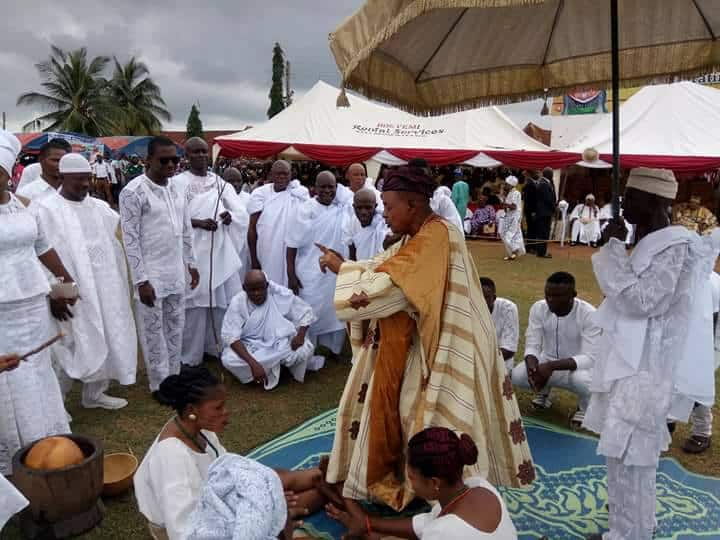
On the Festival, Ladigbolu said it is a festival where the Yorubas
celebrate all the Alaafins of both Old and New Oyo.
According to him, ‘’ it brings to remembrance the chivalry of their
forebears in the internecine wars in Yoruba land, and the cessation of
the bitter hostilities through the ingenuity of the Alaafin Adeyemi 1,
who as King of the Yoruba, invited the British to stop the war and
restore peace to his Nation’’.
Nigeria and Benin Republic have had so many things in common right
from the pre-colonial era.
Historically, Nigeria and Benin were one and the same people , as
Nigerian empires had governed almost all parts of Benin before the
colonial separation.
Republic of Benin is a country that shares about 778 kilometres of
border, and is about the country that has the most densely populated
frontiers with Nigeria.
Benin Republic is a country that has produced the first official border at
Idi-Iroko, the country that has the most lucrative border with
Nigeria, Seme, where about 6,000 people cross per day.
But for the colonial separation, Cotonou use to be part of Oyo Empire and the capital was Oyo-Ile up to the shores of Ghana and the Northern part of Benin Republic used to be Borgu.


Oranyan Festival: Preserving Yoruba’s cultural heritage



Leave a Reply





Popular Stories
-

Bloody clash in Lagos
-
Tinubu rejigs Cabinet
-
Umahi to Tracy Ohiri: Only a queen can claim a handsome man like myself has been making love advances for 12 years
-
Sad! 24 hours after, newly elected APC Asst. Publicity Secretary dies
-
Congress: Crisis hits Oyo APC as stakeholders reject Adeyemo’s chairmanship
-
Court Grounds NG Eagle Aircraft, Bars Sale Pending $5.3m Aviation Dispute




Latest Stories







© 2026 Published by SWAAYA LIMITED, Plot 20, Block G, Scheme 1, Residential 3, OPIC Beachland Estate, Lagos/Ibadan Expressway, Lagos. Gabriel Akinadewo, MD/CEO 08023010222, 08094000056, 08052097814.