

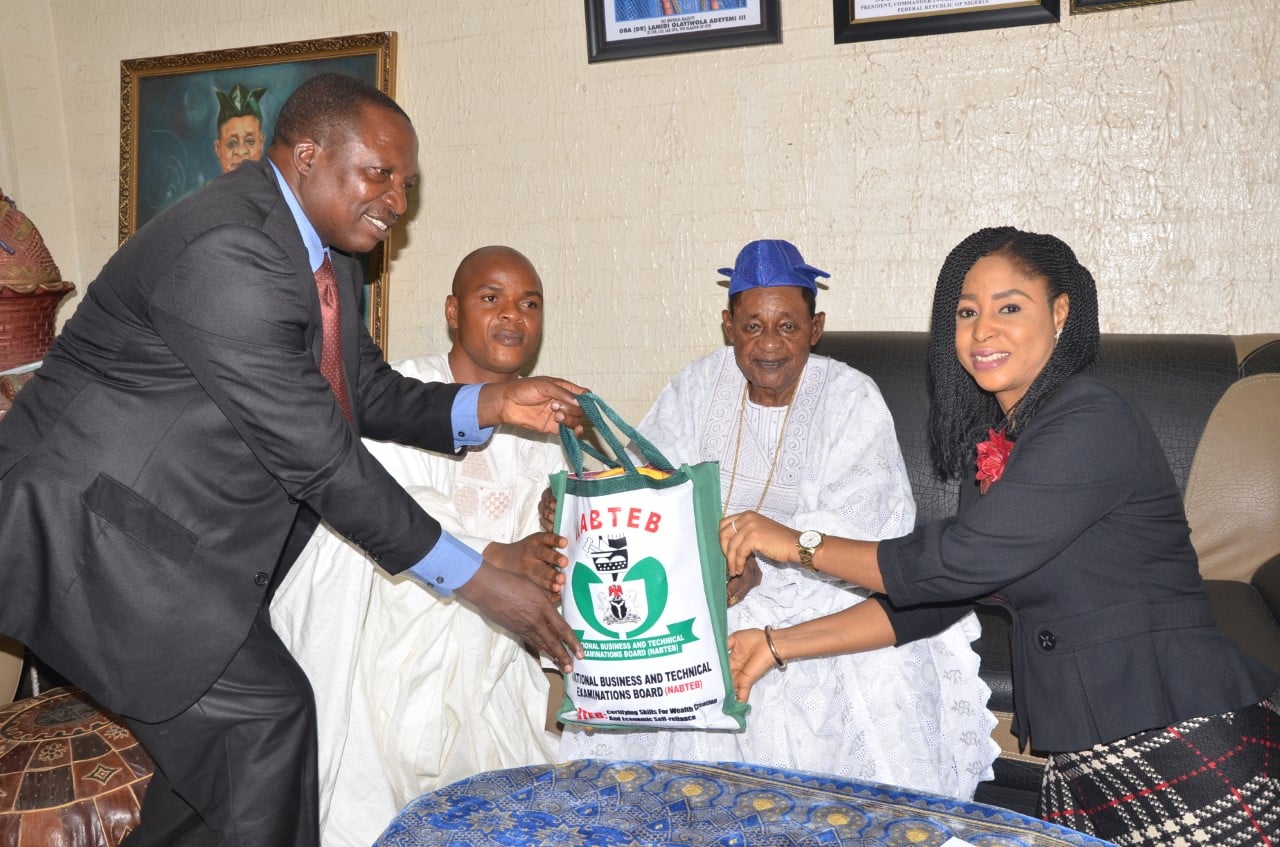
The National Business and Technical Examinations Board (NABTEB) is to collaborate with Kenfrawan Development Company Limited, a private firm owned by the Alaafin of Oyo, Oba Lamidi Adeyemi, “in a bid to enhance the status and financial fortunes of the poor masses in the society”.
Those targetted include the unskilled, unemployed, skilled, semi-skilled without certificate of competence, as well as secondary school drop-outs with deficiency in their senior school certificate examination results.
The Registrar and Chief Executive of NABTEB, Professor Ifeoma Isiugo-Abanihe, disclosed this in Oyo town, during a courtesy visit on the Alaafin.
Represented by Mr. Borokini Joseph who was accompanied by other top officials of the board, the Registrar said they were appreciative and impressive of Alaafin’s desire to collaborate with NABTEB to foster youth employment, wealth creation and rapid socio-economic development in Oyo State in particular and the nation in general
through various skilled-oriented certificate examinations.
While pointing out that the board team were in the palace on the invitation of the royal father to seal collaboration with his company, she used the occasion to share information about NABTEB , which she said were crucial for all who are interested in the progress of youths and development of the country.
NABTEB certificates, the chief executive noted, are designed to make vocational training and skill acquisitions more attractive to teeming unemployed youths, and promote wealth creation and economic reliance.
Isiugo-Abanihe, therefore, called on the paramount ruler to mobilise corporate and well-meaning Nigerians for the training of the unskilled and retraining of semi-skilled artisans, in order to alleviate their status and boost economic fortunes.
Responding, Oba Adeyemi said the visit and collaboration became imperative as it would significantly go a long way in helping to produce skilled manpower in vocational and technical education needed to drive the development of the state in particular and the nation in general.
According to him, ‘’the major essential tool for achieving sustainable development should include, improving the quality of basic education, reorienting existing education programme to address sustainable development, developing public awareness and understanding, and providing training for all sectors of private and civil society’’.
Alaafin stated that continued sustainable development is only
possible or assured when concrete steps are taken to make the youth acquire skills that will enable them to be self reliant and, therefore, become the tools for achieving development and its sustainability.
“Any nation that trivialises its vocational and technical education is certainly bound to have some development oriented challenges as such nation would obviously find it very difficult to have skilled experts in vocational and technical training that would drive its economy. It would be suicidal for anyone to undermine the roles of artisans, technicians, technologists and graduands of other components
of vocational and technical education in nation building because of their immeasurable contributions to the Gross Domestic Products (GDP)
of any nation’’.
This, according to him, accounts for the reason behind the
significant attention developed economies in the contemporary global setting give to vocational and technical education.
“Nigeria, as a nation, has, of late, begun to appreciate the fact that it has to develop its vocational and technical education to enable the nation assuage its thirst for technological breakthrough. However, it must be noted that the country needs significant input from the organised private sector to enable it have an institutionalised vocational and technical education that would equip youths in the country with relevant skills that would ultimately galvanise them to contribute to national growth and development.


NABTEB, Alaafin’s firm partner on skill acquisitions for artisans, unemployed youths

Leave a Reply






Latest Stories





© 2026 Published by SWAAYA LIMITED, Plot 20, Block G, Scheme 1, Residential 3, OPIC Beachland Estate, Lagos/Ibadan Expressway, Lagos. Gabriel Akinadewo, MD/CEO 08023010222, 08094000056, 08052097814.