


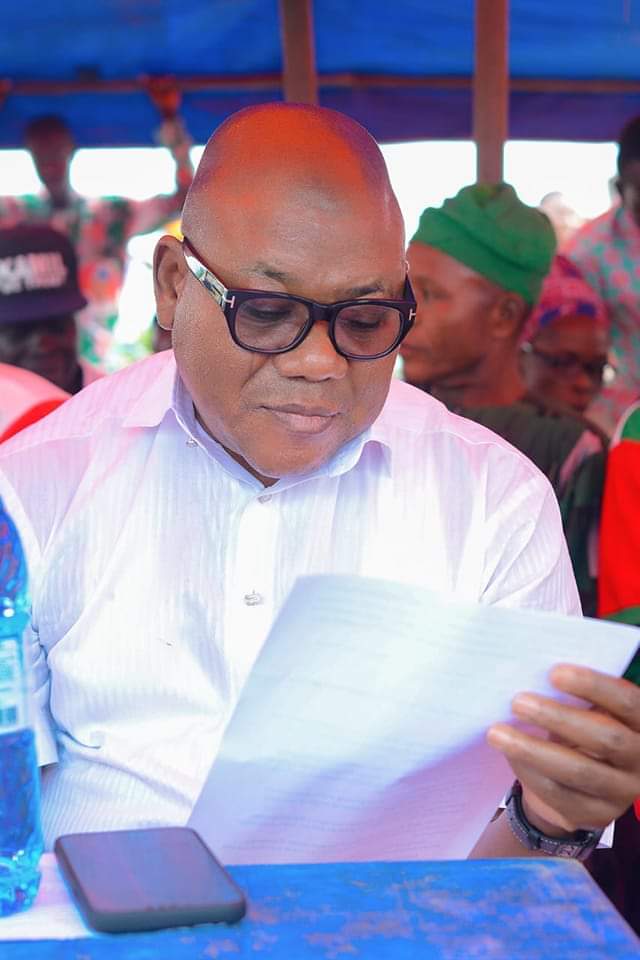
The Peoples Democratic Party’s Candidate for House of Representatives in Oyo Federal Constituency, Oyo State, Honourable Kamil Mudasiru Akinlabi, is a Go-Getter Personality.
He is passionate, resourceful, perceptive, dependable and success-driven.
Akinlabi is extremely open-minded and often asks very inquisitive questions that helps him see things from various viewpoints and perspectives.
While the average person is very reactive by nature, Akinlabi is very proactive in how he deals with the unpredictable nature of the circumstances he faces.
His proactive nature comes from the fact that he doesn’t live by other people’s rules, standards and/or expectations.
Akinlabi, instead, lives life on his own terms, in full control of his own destiny — making the most of every situation he finds himself in.
He enjoys taking calculated risks and pushing the boundaries of what others believe is possible.
This gives him an emotional rush that propels him forward to even greater feats of accomplishment.
In an EXCLUSIVE chat after the campaign tour of most villages in the four local government areas of Oyo Federal Constituency, Akinlabi attributed challenges of rural development to include high population density, poor infrastructure, high level of illiteracy, extreme poverty, rural urban migration, low social interaction and
an appraisal of previous rural development initiatives in the country.
Akinlabi stated that there is usually the absence of sustained, comprehensive and conclusive implementation of rural development policies in the country, adding that SMEs are not well implemented and the targeted population (rural dwellers) hardly benefits due to insincerity of purpose.on the part of those elected by the communities to represent them and government officials.
He noted that, to this end, some of the rural development initiatives are haphazardly implemented as a result of poor supervision and corruption, as evident in many rural communities with installed water taps that lack water since installation.
He said many governments in the country over the years have made attempts at enhancing rural development through various programmes and policies, but it’s meaningful realization however has remained a mirage.
According to him , ” this is clearly seen as there is an apparent lack of basic amenities and the glaring low standard of living conditions among the rural populace
“Extreme poverty is prevalent among the rural dwellers as about 70% of the people in the country living below poverty line are domiciled in the rural areas. One major effect of this rural underdevelopment is rural–urban migration, which is fast reducing the active population which constitutes the workforce of the rural areas in Nigeria.
” In recent times, due to persistent underdevelopment, there has been a noticeably high level of rural-urban migration in search of better standards of living and bigger opportunities for meaningful economic and social activities. This is dysfunctional not only to rural development but retards the overall national development”.
Unfortunately, Akinlabi pointed out that lack of integration of the various rural developmental efforts significantly militated against sustainable rural development.
“This is largely due to the inability of the rural development institutions to cooperate and ensure their respective initiatives, actions and mandates are coordinated to reinforce and support each other and that their activities are streamlined towards effective realization of government’s rural development objectives”.
Said he, ” rural-urban migration is one of the most distressing problems facing the Nigerian socio- economic development. A situation where the desire for better employment, business opportunities and education pushes both young and old out of the rural areas to the urban areas. Rural-urban migration represents a phenomenon of unprecedented movement of people from the rural countryside to the urban cities.
” Historically, migration existed internally across city boundaries to enable excess labour to be taken slowly from the rural areas to provide workforce for industries in the urban areas and therefore aid industrialization and economic growth. However, over time, the rate of rural-urban migration has rapidly outweighed the rate of job creation in developing and underdeveloped countries like Nigeria, with overstretched available social and infrastructural facilities in the urban areas”.
Akinlabi, a Quantity Surveyor, noted that different motives account for rural-urban migration amongst rural dwellers.
These, he pointed out, include socio-cultural issues where people are forced to migrate to avoid numerous social problems at their places of origin.
Others are poor infrastructural development and lack of basic amenities, search for better economic opportunities such as jobs, accessibility and ease of transportation and communication.
“The extension of road network from major towns to the peripheral urban and rural areas that resulted in the decrease in transportation cost and improved communication systems. Rural areas are mostly disabled at various levels by inaccessibility, seclusion, underdevelopment, extreme poverty, ignorance, depopulation, hunger and all types of incapacities. Coupled with these is that migration from rural to urban areas leads to a reduction in the number of the rural populace with a negative effect on rural agricultural output and slowed pace of development in the rural areas”.
With the exit of youths and young adults from the villages and rural communities, Kamil observed that ” the aged, women and children are left behind to labour on the farms which lead to reduction in agricultural output with its attendant effect on the gross domestic product of the nation, lowered funds for development, income and standard of living of rural inhabitants, underdevelopment, and total desertion of the rural areas.
” Constant reduction in rural population over the years will invariably lead to gross rural neglect by government as they tend to concentrate on developing the more obviously populated urban centres. This further reinforces the vicious cycle of gross rural neglect and underdevelopment as reflected in the lack of rural industrialization and poor physical, social and institutional infrastructures.”, Akinlabi submitted.