

Every year, statistics revealed that over 300,000 graduates are churned out from tertiary institutions nationwide.
This number grows yearly and translates into more and more unemployed people littering the streets of Nigerian towns and cities.
With increasing rate of unemployment, coupled with low income and the
frustration involved in it, the unemployed ones may develop negative attitudes toward common things in life and may feel that all sense of
purpose is lost.
Frequent emotions could be – low self-esteem, including mental health
problems like, low self-confidence, feeling unworthy, depression and hopelessness.
Unemployment also leads to increase in the rate of crime and violence, suicide cases, stigma, employment gaps, loss of skills’ usage.
Joblessness also brings with it the disgrace that the person has to bear. Nobody likes to be termed as unemployed.
To further complicate the situation, the longer the individual is out
of job the more difficult it becomes to find one, as employers find
employment gasps as a negative aspect.
No one wants to hire a person who has been out of work for some time
even when there’s no fault of the individual per say.
The unemployed is not able to put his or her skills to use. And in a
situation where it goes on for too long the person may have to lose
some of his or her skills.
However, it is the duty and responsibility of the government and
different policy makers to provide such an environment and conditions
which are conducive for the youth entrepreneurial activities.
This is because different policy initiatives encourage and motivate
young people to come up with new ideas and start their own youth
enterprises.
This will first reduce the incidence of unemployment to a great extent
and as such would have dealt a massive blow to the problem of youth
restiveness.
To do this effectively, the policymakers should realize that public
spending is not going to contribute towards the welfare of the youth.
It is the policies of the states that must be created in a way that
will help to stimulate the younger people as well as their parents and
communities to invest in themselves.
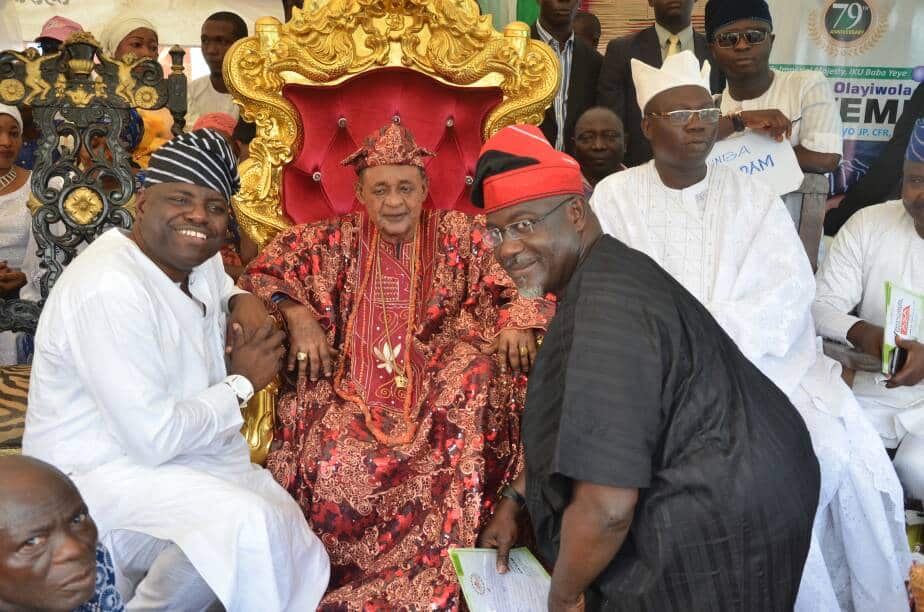
Against this background, the Alaafin of Oyo, Oba [Dr.] Lamidi
Olayiwola Adeyemi 111, had since he ascended the throne of his forefathers evolved a youth friendly policy that is not as costly as
direct investments, but involves a lot of political trade-off to
actually implement the policy, so that it benefit each and every young
person living in Oyo metropolis.
To this end, a town hall meeting was organised to commemorate the just
concluded 79th birthday of the Alaafin, and also a platform to
sensitise the people on lofty efforts of Oba Adeyemi, in collaboration
with the federal lawmakers, Prince Adeniyi Adeyemi and
Senator Monsurat Sunmonu, and few others towards human capacity
development in the four local governments [Afijio, Atiba, Oyo-East and Oyo-West] that constitute Oyo metropolis.
The ancient Atiba hall was filled to the brim, as cross-section of residents and indigenes, including members of the Oyo Traditional Council [Oyo Mesi], the Asolo of Isolo in Lagos State, Oba Kadiri
Agbabiaka, Oke-Ogun traditional rulers in Oyo State and other invited
guests were at the colourful occasion.
In his address, Alaafin was of the conviction that Nigeria’s future is at a time of rapid economic, demographic and
social change, as the country stands on the threshold of what could be
the greatest transformation in its history – with population growth
slowing, and its ‘baby boom’ generation entering the workforce.
The benefits of this to Nigeria, according to the royal father is that
if the country is pragmatic about economic growth, improves
education, health standards, and creates jobs, the average Nigerian
could be three times richer in the foreseeable future, as millions of
people will be lifted out of poverty.
To the Alaafin, ‘’ the risks are as great as the opportunities. If
Nigeria fails to plan for its next generation, it faces ethnic and
religious conflict and radicalization, as a result of growing numbers
of young people frustrated by a lack of jobs and opportunities’’.
‘’The words ‘youth’ and ‘restiveness’ have become so commonly used
together in the last couple of years that it seems to have taken on a
life of its own. In the last decade and more there has been a
proliferation of cases all over the country and indeed the world, of
youth agitations which have tons of people dead and valuable
infrastructure as well as personal properties lost and destroyed’’.
Consequently, the Titan of Yoruba Empire judiciously utilized his
revered institution at both the Federal and State levels, in
conjunction with past and present political office holders who are
indigenes for actualizing his human capacity development drive for the
wellbeing of his people.
To date, over sixty indigenes of Oyo town are occupying
administrative cadre levels in the State Civil Service.
Over twenty people have been recruited into the Nigeria Security and
Civil Defence Corps, the Nigeria Army, Nigeria Police Force, including
some agencies of the Federal Ministry of Science and Technology.
All these were made possible through the collaborative efforts of a
member of the House of Representatives, and son of the monarch
representing Oyo Federal Constituency –Afijio, Atiba, Oyo-East and
Oyo-West local governments’ areas], Prince Adeniyi Adeyemi, Senator
representing Oyo Central Senatorial District, Alhaja Monsurat Sunmonu,
and former Commissioner for Works during the first tenure of the
incumbent Governor Abiola Ajimobi’s administration, Mr. Yinus
Akintunde.
Elated residents could not hold back their excitements, as they were
full of praises to God for bestowing on them what they referred to as
’’a visionary, pathfinder and enigmatic ruler who has transformed the
metropolis from ancientness to a metropolis of splendor with modern infrastructure”


Kudos to Alaafin’s initiative on transformation, human capacity development

Leave a Reply






Latest Stories





© 2026 Published by SWAAYA LIMITED, Plot 20, Block G, Scheme 1, Residential 3, OPIC Beachland Estate, Lagos/Ibadan Expressway, Lagos. Gabriel Akinadewo, MD/CEO 08023010222, 08094000056, 08052097814.