

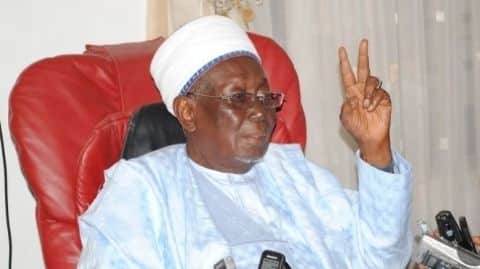
Ibrahim Dasuki, the 18th Sultan of Sokoto, is dead.
He died on Monday and will be buried on Tuesday.
Born December 31, 1923, he died one month, two weeks and three days to his 93rd birthday.
His predecessor was Siddiq Abubakar III who reigned for 50 years, from 1938 to 1988.
Dasuki became the 18th Sultan in 1988 during the regime of General Ibrahim Babangida. He was deposed in April, 1996 by the late General Sani Abacha.
Prior to becoming Sultan, he held the traditional title of Baraden Sokoto.
Dasuki was the first Sultan from the Buhari line of the house of Dan Fodio. He was a close associate of Ahmadu Bello, a friend of Abubakar Gumi and was influential in the founding of Jama’atu Nasril Islam.
After the death of Abubakar Siddique, the 17th Sultan of Sokoto on November 1, 1988, Dasuki was among the leading contenders to become the new Sultan.
Some of his opponents included Shehu Malami and future Sultan, Muhammadu Maccido.
Maccido was the son of Abubakar Siddique and was popular among the populace in Sokoto,
However, Dasuki was close to the administration of Babangida. On December 6, 1988, he was announced as the new Sultan to the dismay of some people in Sokoto.
The announcement led to five days of rioting in which 10 people died.
The late Dasuki was considered a modernist against the wishes of some who wanted the traditionalist candidate, Maccido. As Sultan, Dasuki tried to endear himself to the Sokoto populace. He built 10 Quaranic schools in 1990 and established an adult literacy class. Dasuki also tried to unite the Muslim ummah through the reorganization of Jama’atu Nasril Islam and the Nigerian Supreme Council of Islamic Affairs (NSCIA). He gave impetus to the appointment of the late Dr. Lateef Adegbite, who became the first Yoruba Secretary-General of NSCIA.
In 1996, Dasuki was called into the office of the military administrator of Sokoto, Colonel Yakubu Muazu, and was told he was deposed as the Sultan.
Muhammadu Maccido was announced as the 19th Sultan.
Dasuki was flown to Yola and then taken to Jalingo where he was placed in exile.
Muazu gave some reasons for the banishment such as Dasuki was causing enmity among the people and among the royal family, ignoring government directives and travelling outside his domain without approval or notice from the government. However, it was generally believed that he was deposed because of personal issues between him and Abacha.


Ibrahim Dasuki dies at 93


Leave a Reply






Latest Stories







© 2026 Published by SWAAYA LIMITED, Plot 20, Block G, Scheme 1, Residential 3, OPIC Beachland Estate, Lagos/Ibadan Expressway, Lagos. Gabriel Akinadewo, MD/CEO 08023010222, 08094000056, 08052097814.