


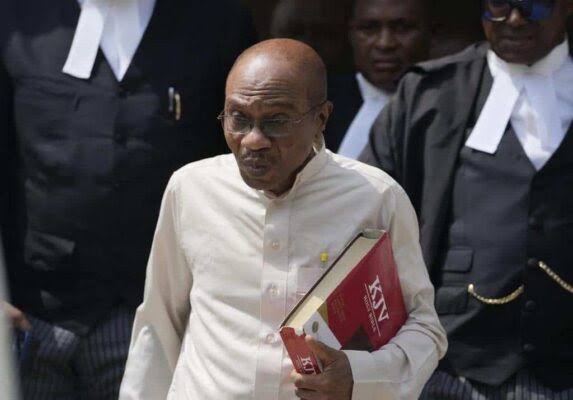
The EFCC on Tuesday told an Ikeja Special Offences Court that Henry Omoile, co-defendant to former CBN Governor Godwin Emefiele, did not make his statements under duress.
Emefiele is standing trial on a 19-count charge bordering on alleged gratification, corrupt demands, and abuse of office linked to large financial transactions.
Omoile, his associate, faces three-count relating to the alleged unlawful acceptance of gifts while acting as an agent in transactions tied to the CBN.
The charges involve alleged dealings estimated at $4.5 billion and ₦2.8 billion, sums prosecutors say reflect serious breaches of trust and procedure.
EFCC operative, Alvan Gurumnaan, led in evidence by prosecuting counsel Rotimi Oyedepo (SAN), said the statements were obtained lawfully.
“The second defendant did not make any statement under duress,” the witness told the court during a trial-within-trial.
He insisted that EFCC officers neither threaten nor coerce suspects into making confessions or written accounts.
“Our officers do not force statements through violence,” Gurumnaan said, emphasising adherence to cautionary procedures.
He explained that Omoile received the required caution before speaking, administered by operative Azeez Ajigbotosho, who works under his supervision.
Gurumnaan also said any claim of duress must be proved by the defendant once an allegation of coercion is raised before the court.
He revealed that Omoile made the statements inside the EFCC conference room on the first floor of Block A, Lagos Directorate 1.
The witness added that Omoile came to the office on Feb. 26, 2024 with his lawyer, Mr E. N. Offiong, which reinforced the voluntariness.
He said Omoile showed no sign of objection at that time, adding that the later claim surprised him.
The court admitted four statements made by Omoile as Exhibits 1 to 4 following the witness’s testimony.
Gurumnaan added that three statements were taken on Feb. 26, 2024 and one on Feb. 27, 2024 during the investigation.
Under cross-examination, he acknowledged that the EFCC did not produce video footage of the sessions despite having such procedures in place.
He attributed the absence of recordings to operational circumstances, saying such lapses occasionally occur during sensitive investigations.
“Circumstances sometimes prevent recordings, and as a result, we could not do any video recording,” he explained to the defence counsel.
He also confirmed that Omoile was not released on the day he made the statements, having remained in EFCC custody.
Justice Rahman Oshodi adjourned proceedings until Jan. 15, 2026 for continuation of the trial-within-trial examining the voluntariness of the statements.
Earlier, the prosecution had attempted to tender the disputed statements on Oct. 9, but defence counsel Adeyinka Kotoye (SAN) objected.
Kotoye argued that Omoile’s statements were not voluntary, insisting that they were made under pressure while in detention.
The judge ordered a trial-within-trial to determine admissibility, delaying the main proceedings in the high-profile corruption case.
The matter continues as both sides prepare further witnesses and documentary evidence ahead of the next hearing date.