



“Regulating migration flows and containing border disputes remain central to border security agencies across the world. The reality, however, is that controlling access to territories and citizens is difficult in the globalised security context, as technology has enabled the increased flow of goods, people and ideas across national boundaries, while global inter-connectedness has increased interactions between people around the world whether for work, sport or entertainment.
The paradox lies, therefore, in the increased relevance of the Nigerian Customs Service with regard to securing the nation’s borders despite the fact that their position is being challenged by transnational security actors and vulnerabilities as well as well as numerous inherent weaknesses from within the Service itself.
Thus, in order to counter threats both from within and outside a state border, new patterns of security interaction must be urgently put in place”.
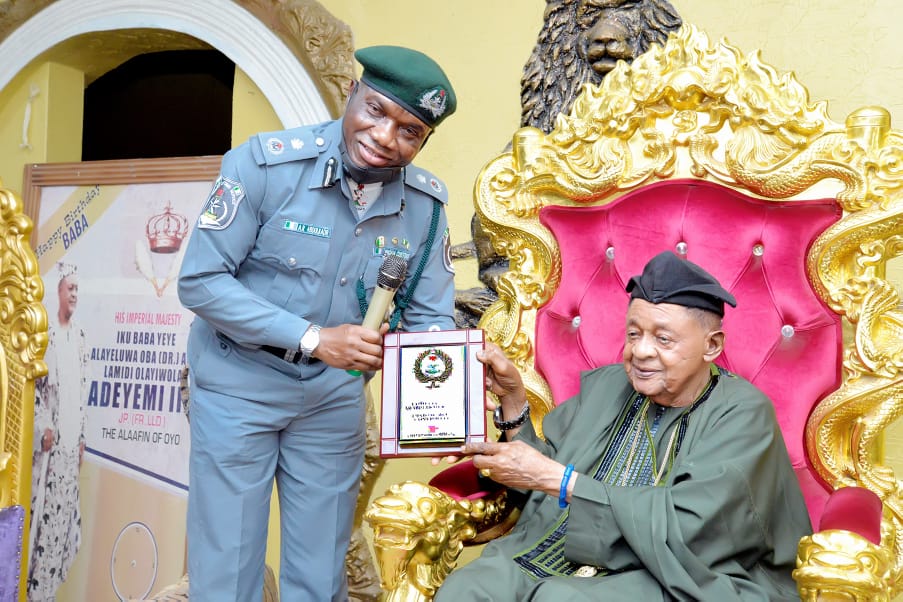
These were the submissions of the Alaafin of Oyo, Oba Lamudi Olayiwola Adeyemi 111, while playing host to the new Customs Area Comptroller for Oyo and Osun Area Command, Comptroller A.R. Abdulkadir, and his entourage in the palace.

The Monarch called for national data base and intensive surveillance of the porous borders with the use of helicopters, in order to enhance optimal service delivery.
Oba Adeyemi, who described the Nigeria Customs Service as crucial and vital to the country’s survival, both in terms of the economy and security, admonished government to improve on the renumerations of officers and men of the Service.
This, he pointed out, would serve as morale booster to the manpower saddled with the arduous task of safeguarding the country’s borders from external attacks.
He pointed out that a scientific modern Nigerian society without a sound social and moral base will be her worst enemy in terms of the human misery, fear,
insecurity and barbarism that would be self-inflicted in the process
of a misguided scientific advancement.
Alaafin also stressed the need for Nigerians to relate their development to values system, adding that to do contrary is to entrust the safety of the insane man into his own hand which is a recipe for self-destruction.
The Paramount Ruler noted that
” morality is a necessary tool for
the survival of human society, as it is vital to the survival of any
society because it is the basis of all social structures and
institutions”.
Oba Adeyemi lamented that the problems which besiege the country are anchored on non-compliance with or total neglect of moral principles and these have led to the doldrums we are experiencing in our private and public lives.
Alaafin, who expressed his strong indignation to tax evasion in the country, stated that moving the government’s revenue away from oil dominated foreign earnings to more predictable sources have the potential to accelerate the country’s economic growth.
“But making the switch is not as easy as it sounds, thanks to Nigeria’s abysmal tax compliance levels, as most businesses in the country charge customers Value Added Tax (VAT) for products supplied or services rendered but do not remit same to the government as statutorily required.
“As such, government lacks the incentive to deliver on capital projects that will fast-track the economic growth collectively envisaged”.
Alaafin went further, “unlike what obtained in the advanced economies, there are several wealthy individuals in this country who do not pay tax. This category of individuals have a lot of money in their accounts, but no Tax Identification Number (TIN) with which they can file the statutory percentage of tax returns on their income.
“Tax is a mandatory financial charge imposed upon taxpayers by government to fund various forms of public expenditure. In the Nigerian environment, citizens are expected to pay several taxes such as Companies Income Tax, Withholding Tax, Value Added Tax, Petroleum Profits Tax, Personal Income Tax, Capital Gains Tax and Tertiary Education Tax, among others.
“In Nigeria where tax evasion has become second nature, the direct implication is that government is not able to generate enough revenue to fulfil its statutory obligations to the citizenry”.

Earlier, Abdulkadir described the Alaafin as a “ monarch with high cerebral and whose knowledge and wealth of experience remain assets to the nation .
While appreciating traditional rulers as custodians of people, culture and traditions, Abdulkadir solicited the support and cooperation of the monarch in checkmating acts of smuggling and other criminal tendencies.