

The ancient Oyo town, Oyo State, holds a remarkable and rich set of tangible resources such as temple, palaces, markets and traditional compounds as well as natural resources like rivers and forests.
This notable set of buildings and natural resources, sustain the maintenance of a millenary culture based on a unique and complex
traditional, political and religious system.
In this report, BODE DUROJAIYE, takes a look at the intangible
heritage preservation, as well as complex and intense festivities
calendar that culminates with the important World Sango Festival, thus
making the ancient town a bulwark of Yoruba traditions and culture in
the country.
Due to the expansion of Oyo territory, it was once the capital of the Oyo Empire, one of the most remarkable and vast Empires of West Africa that ruled for over 600 years, imprinting its culture, language and traditions across the region, known today as Yoruba common culture.
Still, Oyo is perceived as a place where tradition is strongly
preserved in its essence.
Since the eighteenth century, when the transatlantic slave trade
began, the traditions of Sango and Oyo were also widespread to the New
World, being preserved today in several countries in the Diaspora.
The archaic Yoruba language is still used to transmit the embedded
linguistic values of the ancestral identity of the traditional
community in general.
For instance by reciting the traditional oral “Oriki-Sango pipe” poems
(eulogies), as a form of encoding historical antecedence in an
interpretable and intelligible manner, is a clear example of the rich
oral heritage related to the ancestor Sango, and indispensable for the
conduction of the festival.
The learning of “Oriki -Sango Pipe” poems, chants, prayers, liturgical
rites, dancing, divination, drumming and even dancing starts from a
young age.
To ensure that parts of this rich and complex oral legacy, performing
arts and apprenticeship are not lost, traditional families transmit
their knowledge through the informal method by teaching their male and
female children and other members of the community.
This cross-compound learning system is the base of the successful
endurance of Oyo traditions, being a gender friendly tradition as
woman are involved in the activities.
Also, depending largely on craftsmanship, the festival cannot hold
without traditional handmade attires, sculptures, liturgical objects
and other traditional instruments.
As such, it was directly responsible for the diffusion of Yoruba
Culture, traditions and beliefs throughout West Africa, covering a
large territory that extended from the Southwest Nigeria to Benin,
Togo, upto Ghana.
This same cultural heritage was later on diffused through the
transatlantic slave routes to the Americas and the Caribbean and
preserved from generation to generation to date.
In some cases, such as in Brazil this culture was classified as
national heritage through the preservation of the Nago communities of
Bahia’s Cabdomble’’.
Due to the size and scope of Oyo-Sango’s heritage, the Federal
Government took the lead in canvassing for the ancient town to be
nominated as the WORLD SANGO HERITAGE CENTRE, among other contesting
countries, numbering about 20 countries before the United Nations
Scientific and Cultural Organisation [UNESCO]
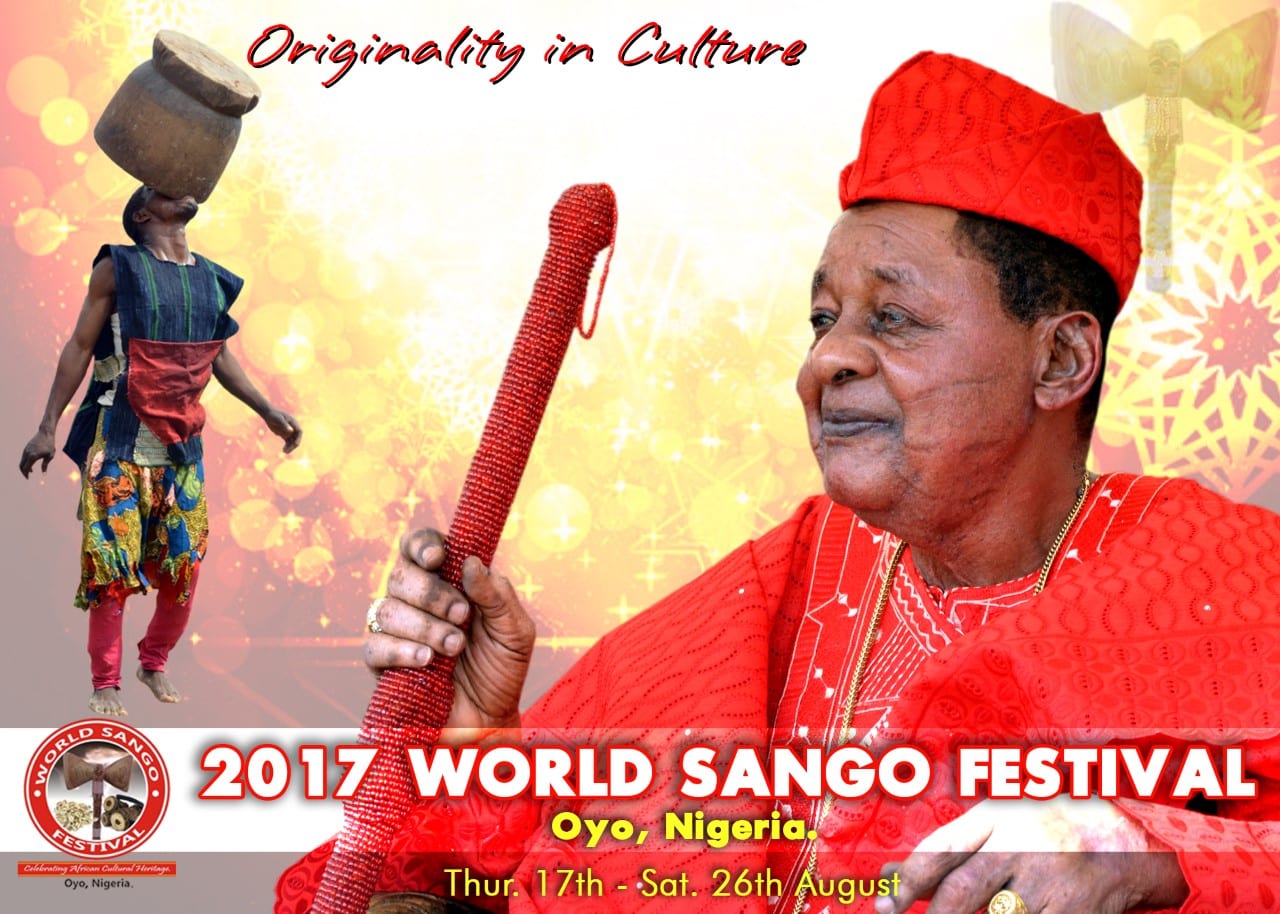
This year’s World Sango Festival which will commence between 17th to 26th August, 2017 in the ancient town, is an international festival, which will attract foreign nationals from several countries, and
eminent personalities across the country.
It is a particular and probably the most distinctive expression of
the larger intangible heritage of Oyo town uniting all the forms of
knowledge.
It is also one of the most ancient, traditional and major festivals of
the Yoruba race.
As such, it encompasses all the range of techniques, skills, and
crafts through which cultural values, customs, and traditions of Oyo
people are manifested.
Due to the expansion of Oyo territory, Oyo was once the capital of the
Oyo Empire, one of the most remarkable and vast Empires of West Africa
that ruled for over 600 years, imprinting its culture, language and
traditions across the region, known today as Yoruba common culture.
Still, Oyo is perceived as a place where tradition is strongly
preserved in its essence.
Since the eighteenth century, when the transatlantic slave trade
began, the traditions of Sango and Oyo were also widespread to the New
World, being preserved today in several countries in the Diaspora.
World Sango Festival is a social practice and festive events deeply
connected to the social, religious, cultural and political
institutions in Oyo.
It is a key element for the maintenance of the city’s identity, unity
among the people since immemorial times and the survival of the heart
and the mind of the Yoruba culture.
It is the maintenance of coexistence with the ancestral world and nature.
World Sango Festival is a social practice and festive events deeply
connected to the social, religious, cultural and political
institutions in Oyo.
It is a key element for the maintenance of the city’s identity, unity
among the people since immemorial times and the survival of the heart
and the mind of the Yoruba culture.
It is the maintenance of coexistence with the ancestral world and nature.
The international cultural event will last for ten days and consists
of intensive traditional and beliefs practices that accommodate many
cultural features.
It is during the period of strong rains, which marks the beginning of
a productivity season cycle and a renewal bond between the Alaafin and
Sango, the ancestral spiritual world.
It is a festival that reflects the traditional diversity of its environment.
Several activities will take place, which include, traditional
prayers, reciting oral poetry under the rhythms of traditional drums
followed by traditional dancing to evoke the ancestors and the
exchanging of traditional presents between the royal palace and the
Sango Koso main shrine.
Highlight of the festival will take place on the last day when the
city’s population assemble in Koso and waits eagerly for the arrival
of the Elegun-Koso representing the ancestral spirit of Sango, who
will lead the crowd towards the palace for the final spiritual
blessing of the city.
The Alaafin does not see eye for eye with the Elegun-Koso, as it is strictly forbidden for him to see the manifested ancestral spirit of Sango.
The genetic resemblances between the Yorubas and the people speaking Nupe, Edo, Ijo, Efik, Fon, etc had a common origin.
By tradition, the Yoruba communities traced their origin to Oduduwa
and the town of Ile-Ife.
Oral history stated that after the death of Oduduwa, his seven
grandchildren ( Ogun Onire, Ogiso, Alaketu, Onisabe, Onipopo, Olowu
and Oranyan), scattered all over, finding their respective kingdoms in
the area today known as South- western art of Nigeria.
The eldest grandchild was the mother of the Owus, the second mother of
the Alaketu, progenitor of Ketu, the third became the king of Benin,
the fourth Orangun, king of Ila, the fifth king of the Sabes, the
sixth the king of the Popos and the seventh Oranyan.
Oranyan was the youngest prince, who inherited the land, being the
first Alaafin, progenitor of the Oyos, who transfer the political
power to Oyo Ile.
Sango, the second son of Oranyan, became the strongest African’s king,
with much power and influence.
Under Sango’s influence, Oyo culture spread within the Oyo Empire
going beyond the Atlantic Ocean and today is known in the world,
including North America, Caribbean (Puerto Rico, Trinidad and Tobego,
Cuba), South America, (Brazil, Ecuador, Chile, Venezuela) and Europe
among others.
In Yorùbá religion, Sàngó is one of the most popular “Orisha”. He was
a strong ruler and a notable magician. Sango was the third king of the
Oyo Kingdom.
He succeeded Ajaka, son of Oranmiyan who appears to have been a weak ruler.
His symbol is a double-headed axe, which represents swift and
balanced justice.
He is the owner of Bata ( double-headed drums), as well as the Arts of
Music, Dance and Entertainment in the Yoruba Culture.
In the Lukumí (Olokun mi which means “my dear one”) religion of the
Caribbean, Sango is considered the center point of the religion as he
represents the Oyo people of West Africa.
Stories about Sango’s life exemplify some major themes regarding the
nature of character and destiny.
In a set of stories, Sango is the son of Aganju and Obatala. As the
story goes, Obatala, the king of the white cloth wanted to cross a
river when travelling, which Aganju the ferryman and god of fire
refused him passage.
It was said that Obatala retreated and changed to a beautiful woman.
The beautiful woman returned to the river and seduced Aganju who later
allowed her to cross over the river.
The result of the uneasy union between Aganju and the beautiful woman
(Obatala) was Sango.
Sango went in search of Aganju, his father, and the two of them play
out a drama of conflict and resolution that made Sango threw himself
into the fire to prove his lineage.
Sango had three wives; Oshun, (a river goddess) was his favorite
because of her excellent cooking, Oba (another river goddess) offered
Sango her ears to eat.
He scorned her and she became the Oba River, which merged with the
Oshun River to form dangerous rapids.
Lastly, Oya (Sango’s third wife) was a crafty woman who stole the secret of
Sango’s powerful magic.
Oba was Sango’s first and legitimate wife, Oshun; his second wife, and
Oya; his third wife, whom he made his queen.
Oshun played a trick on Oba, out of jealousy.
She deceived Oba that if she can cut a piece of her ear and offer it
to Sango as part of his meal, he would love her the more. Oba, excited
by this information, ran home to prepare Sango’s “amala”[yam flour],
his favorite meal.
She sliced off her ear and stirred it into Sango’s food. While Sango
was eating, he saw the ear in the food and was infuriated thinking
that Oba was trying to poison him.
Sango drove her from his house and Oba ran out crying. She fell to the
ground and turned into a river which is still being worshipped till
date.
She became the patron of matrimony (as “Orisha”) and it is believed
that she destroys marriages that abuse either partner.
Historically, Sango brought prosperity to the Oyo Empire during his
reign. He is associated with the sacred animal, the ram, and the
colours of red and white.
Sango is venerated in Haiti, as a god of thunder and weather; in
Brazil, he is known as Xangô; in Umbanda, as the very powerful loa
Nago Shango; in Trinidad and Tobago as Shango god of Thunder, drumming
and dance ; and in Cuba, Puerto Rico and Venezuela – the Santeria
equivalent of St. Barbara, he is known as Changó.
Sango displayed his magical powers by directing lightning unto his own
household killing his wives and children.
He hung himself after the incidence; he was deified as the god of
thunder and lightning.
His followers refuted that Sango hung himself. It was said that
Sango’s followers went to another village to acquire magical powers
and returned furiously to destroy the enemies of Sango.
Today, all other traditional festivals in Yoruba-land depend directly
on Sango festival in Oyo or indirectly on Sango’s calendar, Ijakuta.
Indeed, Sango Festival is celebrated in over 21 countries of the
world and all these countries host their various Sango Festivals where
this tradition is practiced.
In an interview, the Alaafin of Oyo, Oba Lamidi Olayiwola Adeyemi 111
said the purpose of the of the name World Sango is to recognize Oyo
as the original ancestral home of Sango and to unite all Yoruba
descents and enthusiasts once in a year in Oyo town.
He stated that life of Alaafin Sango remains excellent example in
leadership considering the fact that his rule of Oyo was far less
than a decade.
Oba Adeyemi stated that before Sango ascended the throne, his brother
Ajaka was deposed probably because his temperament did not meet the
requirements of the turbulent period.
‘’Sango was preferred because he was a man of valour, purpose-driven
and master of diplomacy.
He became king when Oyo at its formative stage and surrounded by
mighty and warlike states such as Nupe, Ibariba and Owu.
His charismatic leadership re-defined the character and pattern of
inter-group relations and diplomacy and made Oyo the centre-piece of
his foreign relations’’.
The paramount ruler further explained that Sango’s dynamic alliances,
including marriages were constructed to pursue the greater interest of
Oyo just as he spared no effort in consolidating the military
ascendancy of Oyo in the region.
‘’Under the inspirational leadership of Sango, the Oyo kingdom became
known not just for the effectiveness of its political system, but as
well for its military strength, Sango’s seven years reign was marked
with several wars fought to liberate Oyo from its predatory and
truculent older neighbours.
His short reign consolidated the position of Oyo as the foremost
Guinea Savannah State and also secured the independence and
sovereignty of the nascent kingdom.’’
Sango, Alaafin asserted eventually became the hero of his people and
the circumstances of his death as controversial and mysterious as they
continued to be referenced all over the world. He died with the
concern of his people paramount in his heart.
He paid the supreme sacrifice and left Oyo more grandiose, more
stable, better administered and more secured than he met the nascent
kingdom.
He is today been remembered as ‘’one of the rare African leaders who
became instant success in empire building.’’


23 countries to attend Sango Festival in Oyo
Related Posts



Leave a Reply





Popular Stories
-

Ifunanya Nwagene’s snake bite complications: Our defence, by Federal Medical Centre, Abuja
-
Anti-terror fight: U.S. soldiers arrive Nigeria
-
With Agbu Kefas’ defection, APC now has 30 governors
-
Ademola Lookman on target in Atlético debut; records assist, makes history in style
-
Old Oyo National Park killings: Seven arrested (see names)
-
Police officers allegedly assault content creator, Ijoba Lande, brother; steal iPhone 16 Pro Max, $1,200



Latest Stories








© 2026 Published by SWAAYA LIMITED, Plot 20, Block G, Scheme 1, Residential 3, OPIC Beachland Estate, Lagos/Ibadan Expressway, Lagos. Gabriel Akinadewo, MD/CEO 08023010222, 08094000056, 08052097814.